

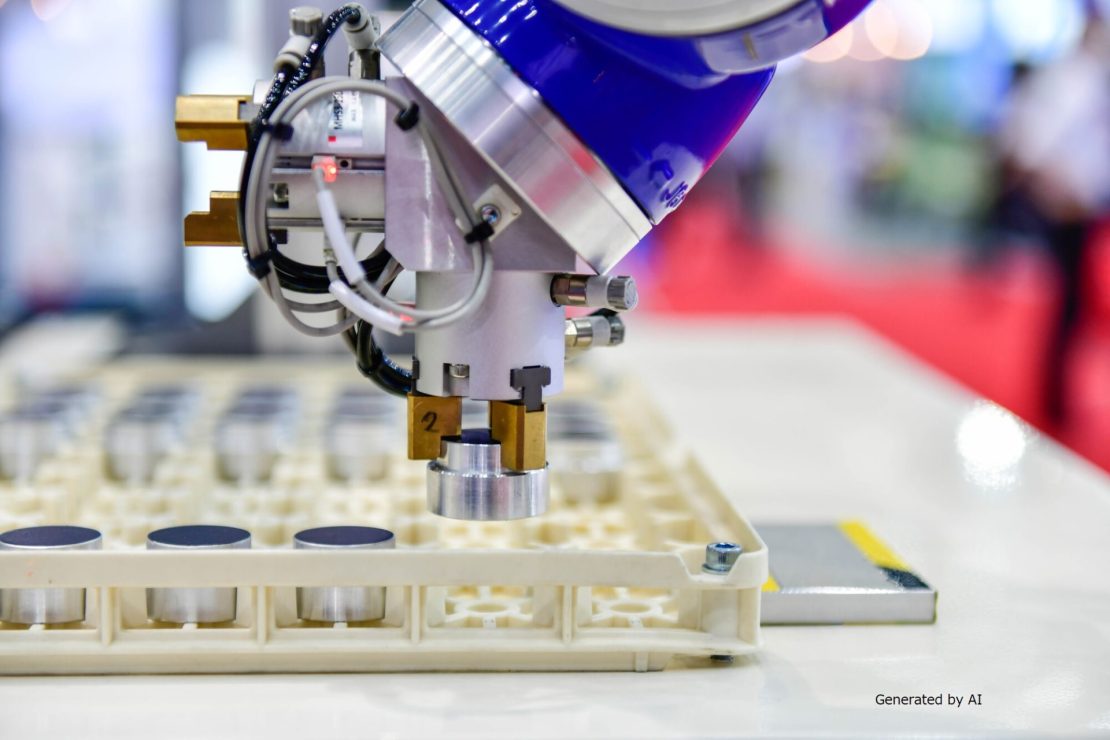
Robotic hands are required to do more than simply grasp and release objects; they must also open and close fingers, bend and extend joints, and make fine adjustments to gripping force. In electrically powered systems, if the motor’s size, torque, and responsiveness are not appropriate, the robotic hand may fail to achieve sufficient gripping force or its movements may become jerky.
Since the performance priorities differ for industrial grippers, multi-finger hands, and prosthetic hands, it is crucial to select a motor tailored to the specific application and mechanical design. This article explains the role of motors in robotic hands, the performance requirements for each type, key selection criteria, and the characteristics of Coreless motors.
| Supervised by: C.I. TAKIRON Corporation Electronic Devices Sales Group This article has been supervised based on the advanced technical expertise and insights we have cultivated since our founding in 1919 as a leading company in plastic processing. Our department continuously analyzes market trends and the latest technologies in ultra-compact, high-precision micro motors, focusing on providing high-value-added information to designers and developers. As a team of experts with in-depth knowledge of product characteristics, we support our customers’ problem-solving and technological innovation by delivering accurate and practical content. |
In Robot Hands, Motors Drive the Fingers and Gripping Mechanisms

A robotic hand is a mechanism mounted at the tip of a robotic arm or similar device that performs tasks such as grasping, holding, and manipulating objects. Gripping methods include gripping-type, suction-type, and magnetic-type mechanisms. In particular, in gripping-type mechanisms—which use motors as the power source—the motor generates the opening and closing of the claws, the flexion and extension of finger joints, and rotational movements.
In addition to directly utilizing the motor’s rotation, there are also designs that transmit motion to the fingers or claws via gearheads, linkages, or wires. By incorporating a gearhead, it is possible to reduce rotational speed while increasing torque; this makes such systems effective for drive systems using compact motors, where it is difficult to achieve the necessary torque with the motor alone.
The motor is not merely a power source; it is a critical component that affects gripping force, operating speed, responsiveness, positioning accuracy, and the smoothness of motion. During motor selection, it is important to first identify the workpiece’s weight, shape, required gripping force, opening/closing speed, and frequency of use, then consider the transmission mechanism and installation space to determine the necessary performance based on the intended application.
Motor Performance Requirements Vary Depending on the Type of Robot Hand
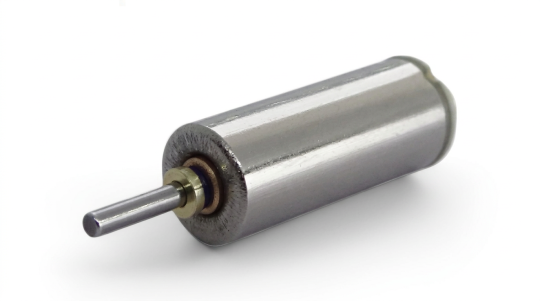
View list of coreless motor products
The performance required of a robot hand varies depending on its application and structure. The motor performance priorities differ for industrial grippers, multi-fingered hands, and prosthetic hands.
First, let’s outline the main applications and key considerations for motor selection for these three representative types.
| Types of Robot Hands | Main Applications | Key Motor Performance Considerations |
| Industrial & Automation Grippers | Handling, assembly, sorting, etc. | Gripping Force, Responsiveness, Durability |
| Multi-fingered grippers | Complex gripping and manipulation | Compact and lightweight, responsive, low inertia |
| Prosthetic-style robotic hand | Daily Activities and Wearable Applications | Lightweight, Quiet, Smooth, Energy-Efficient |
When performing motor selection, the performance characteristics that are prioritized vary depending on the hand’s intended application. Below, we will examine the characteristics of industrial grippers, multi-fingered hands, and prosthetic-style robotic hands, respectively.
Industrial & Automation Grippers | Required Gripping Force and Ability to Handle Repetitive Motion
For industrial & automation grippers, gripping force capable of securely holding objects and the ability to handle repetitive motions are critical. The required torque must be determined not only by the weight of the workpiece but also by factors such as its shape, friction, the length of the grippers’ claws, the opening and closing stroke, and the configuration of the drive mechanism.
Furthermore, since handling and sorting operations involve repeated opening and closing in a short period of time, motors must offer both rapid response and durability. Since compact motors may only produce torque in the range of mN·m (millinewton-meters), it is effective to design the system to incorporate a gearhead as needed to ensure sufficient torque.
Selection must take into account not only gripping force but also operating speed and frequency of use.
Multi-Finger Grippers | Compact and Lightweight, and Highly Responsive
Multi-fingered grippers require compact and lightweight motors that are highly responsive. This is because achieving movements similar to those of a human hand requires moving multiple fingers and joints, which tends to increase the number of motors required.
If the motors are larger, the overall weight and inertia of the gripper increase, which affects operating speed and the payload capacity of the robotic arm. Furthermore, for movements such as quickly moving and stopping the fingers or making fine position adjustments, the ability to follow input commands is essential.
Since multiple motors must operate simultaneously, it is crucial to select them with a focus on balancing compact and lightweight design and low inertia—including considerations for power consumption and heat generation.
Prosthetic Robot Hand | Lightweight, Quiet Operation, and Natural Finger Movement
For prosthetic robotic hands, in addition to being compact and lightweight, they must also have quiet operation and smooth finger movements. Multiple motors and drive components must be housed within a space similar in size to a human hand, and as the weight of the hand increases, it affects both the burden on the wearer and operability.
Furthermore, everyday actions such as holding a cup, pinching an object, or gripping an item require not only strong gripping force but also precise force control to avoid damaging the object. Since these devices are used in everyday living environments, the operational noise of motors and gears, heat generation from continuous use, and battery consumption cannot be ignored.
To achieve a comfortable user experience, it is necessary to comprehensively evaluate lightness, smooth control, and energy efficiency.
4 Key Points for Selecting Motors for Robotic Hands
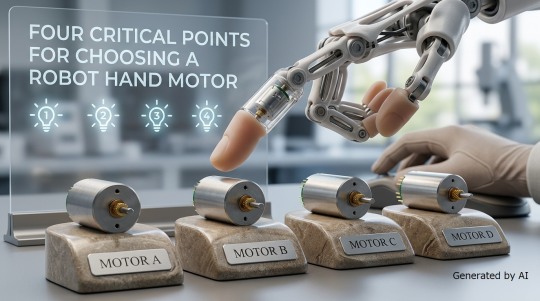
When selecting a motor for a robotic hand, it is not appropriate to base your decision solely on a single specification, such as maximum torque or size. Depending on the application and mechanism, it is necessary to comprehensively evaluate multiple performance characteristics.
The four main points to consider are as follows:
- Balance Between Required Torque and Mounting Size
- Responsiveness to Start, Stop, and Forward/Reverse Commands
- Smoothness of rotation at low speeds
- Heat generation, power consumption, and durability
Since required torque, size, responsiveness, and heat generation are interrelated, it is necessary to evaluate the balance among them based on the application and operating conditions. From here, we will examine each of these four points individually.
Understanding Required Torque and Balancing It with Size
For robot hand motors, it is important to ensure the required torque while balancing it with the available mounting space. The required torque depends not only on the weight of the workpiece but also on factors such as finger length, the distance from the rotation axis to the point of application, friction, and the transmission efficiency of the mechanism.
Prioritizing miniaturization too much may lead to insufficient gripping force or overload. By incorporating a gearhead (reduction gear) as needed, it is possible to increase torque while reducing rotational speed.
Rather than making decisions based solely on size, it is necessary to determine the motor and gear configuration by working backward from the required gripping force.
Verify Responsiveness
Since robotic hands frequently repeat start, stop, and forward/reverse movements, motor responsiveness is also important. For actions such as quickly opening and closing fingers or decelerating when approaching an object, the motor must be able to respond quickly to commands.
In particular, since multi-fingered hands require the coordinated movement of multiple joints, a response delay in a single motor could affect the overall motion accuracy and grasping stability. It is important to evaluate performance under actual load conditions, taking into account not only the response performance of individual motors but also the inertia of rotating parts, fingers, links, and other components.
Verifying Smoothness at Low Speeds
For robotic hands, the ability to move smoothly at low speeds is also a key selection criterion. In situations where the fingers must be slowly brought close to an object or the grasping position must be finely adjusted, even slight rotational irregularities can result in jerky finger movements.
Particular attention should be paid to cogging torque—a fluctuation in torque caused by the motor’s rotational position. High cogging torque can cause movement to become jerky at low speeds, making fine position adjustments difficult.
It is important to select a motor suitable for delicate gripping by checking not only the rated speed and maximum torque but also the rotational characteristics at low speeds.
Evaluating Heat Generation, Power Consumption, and Durability Based on Operating Conditions
Motors for robotic hands must be evaluated for heat generation, power consumption, and durability based on actual operating conditions. When multiple motors are installed, as in a multi-fingered hand, even if the heat generation and power consumption of each individual motor are small, the cumulative effect can place a significant burden on the power supply and thermal design.
Since heat dissipation is difficult within a confined enclosure, it is important to assess factors such as load size, operating time, and operating frequency. Additionally, in Industrial & Automation applications, a lifespan capable of withstanding repeated opening and closing cycles is essential.
It is important to evaluate not just the specifications of the individual motor, but the entire drive system, including the gearhead, sensors, and control system.
Why Coreless Motors Are Suitable for Robot Hands
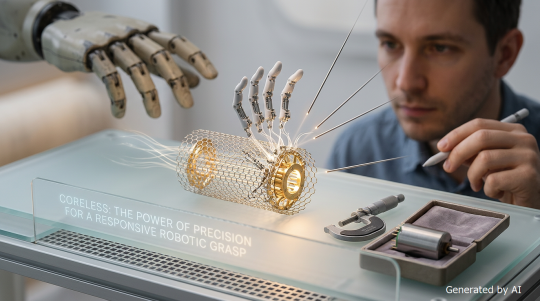
Robotic hands are required not only to quickly open and close their fingers but also to slowly approach objects and make fine adjustments to their gripping position. For these applications, the motor’s responsiveness and smooth operation at low speeds are critical.
Among brushed motors, coreless types—which lack an iron core—are characterized by their ability to easily reduce the inertia of rotating parts and minimize cogging torque. Here, we explain why they are well-suited for robotic hands from two perspectives.
Low Inertia Enables Quick Starts and Stops
Brushed motors come in two types: cored, which have an iron core, and coreless, which do not. Coreless motors are characterized by their ability to reduce weight and minimize inertia because the rotor lacks an iron core.
The lower the inertia, the easier it is to change rotational speed, making it easier to respond quickly even during operations that involve repeated starting, stopping, and reversing. In robotic hands that frequently switch between opening and closing fingers and joint movements, high responsiveness leads to better tracking of grasping motions and improved operability.
In particular, applications that require the coordinated movement of multiple joints—such as multi-fingered hands—can readily take advantage of the benefits of low inertia.
Low cogging torque enables smooth rotation
Coreless motors are well-suited for robotic hands because they facilitate smooth rotation even at low speeds. In cored motors, magnetic interactions between the iron core and magnets can cause torque fluctuations known as cogging torque. In contrast, coreless motors lack an iron core, making them less prone to cogging torque and enabling smoother rotation.
The lower the cogging torque, the easier it is to smoothly control movements such as slowly approaching an object with the fingers or making fine adjustments to the gripping position. For applications involving precision parts or fragile objects, it is important to verify the rotational characteristics even at low speeds during selection, as this makes it easier to achieve smooth gripping motions.
Motor Selection for Robot Hands Should Be Based on Application and Mechanism
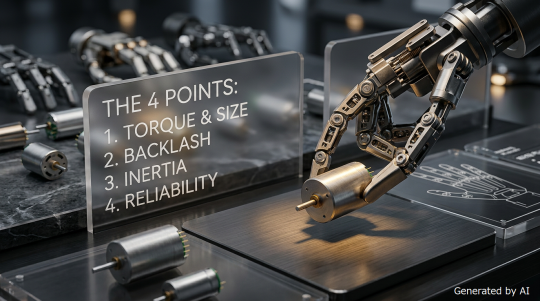
There is no one-size-fits-all motor suitable for robot hands; motor selection must be based on the specific application and mechanism. Prioritized performance characteristics vary depending on the application: for industrial grippers, it is gripping force and the ability to handle repetitive motions; for multi-fingered hands, it is compact and lightweight design, responsiveness, and smooth motion; and for prosthetic hands, it is light weight, quiet operation, and smooth motion.
When performing motor selection, it is necessary to consider not only the size and torque of the motor itself but also the gearhead’s reduction ratio and transmission efficiency, operating speed, frequency of use, heat generation, power consumption, and control method. Even if the motor meets the required performance specifications, the design cannot be considered practical if there are issues such as excessive heat generation or the motor not fitting within the available mounting space.
When requirements are complex, it is advisable not to rely solely on catalog specifications. Instead, it is effective to organize information regarding the installation space, gripping force, and operating conditions before consulting with the motor manufacturer. By evaluating the entire drive system—including the motor and gearbox—it becomes easier to select specifications suited to the application.
Summary

When performing motor selection for robotic hands, it is important to consider not only the required torque and size but also responsiveness, smoothness at low speeds, heat generation, power consumption, and durability. Among these, Coreless motors are a strong choice for applications requiring delicate gripping or precise finger movements, as they have low inertia, respond quickly, and are effective at minimizing cogging torque.
C.I. Takiron Corporation offers a range of compact motors and Geared motors. If you are having trouble with motor selection for your installation space, required gripping force, or operating conditions, please feel free to contact us.
Product Information & Inquiries
For more details on C.I. Takiron’s micro motor products, please visit the website below.
- Product Site: https://cik-ele.com/en/
- Coreless Motors: https://cik-ele.com/en/products/list/coreless_motor/
- Brushless Motors: https://cik-ele.com/en/products/list/brushless_motor/
- Geared Motors: https://cik-ele.com/en/products/list/gearhead/
- Encoders: https://cik-ele.com/en/products/list/encoder/
If you are having trouble selecting a small motor for your product development, please feel free to contact us via the inquiry form. Our technical staff will discuss your application and requirements with you and propose the optimal solution.
- Inquiries: https://cik-ele.com/en/contact/