

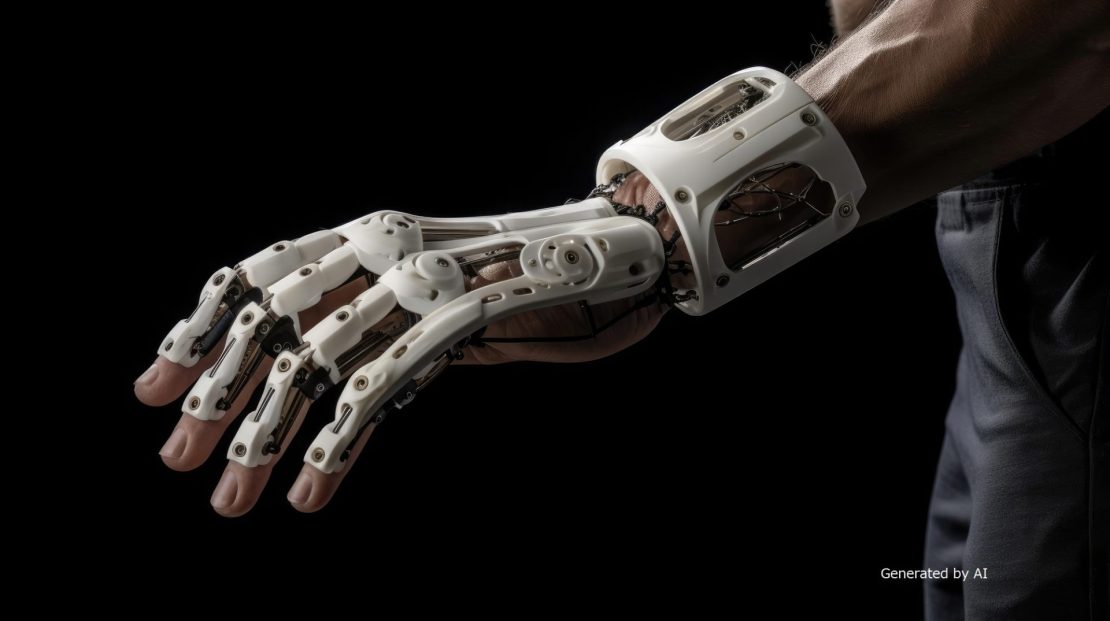
Myoelectric prosthetic hands are devices that read electromyographic (EMG) signals generated by muscle contractions to drive motors and move the fingers and hand. Since they are worn on the body, the motors must meet a wide range of performance requirements—including not only the necessary gripping force but also compact and lightweight design, responsiveness, low power consumption, low heat generation, and quiet operation.
Focusing on only certain performance aspects can lead to increased weight, reduced operability, and shorter operating times. In this article, we will first outline how myoelectric prosthetic hands work, then explain the performance requirements for motors, key selection criteria, and the characteristics of Coreless motors.
| Supervised by: C.I. TAKIRON Corporation Electronic Devices Sales Group This article has been supervised based on the advanced technical expertise and insights we have cultivated since our founding in 1919 as a leading company in plastic processing. Our department continuously analyzes market trends and the latest technologies in ultra-compact, high-precision micro motors, focusing on providing high-value-added information to designers and developers. As a team of experts with in-depth knowledge of product characteristics, we support our customers’ problem-solving and technological innovation by delivering accurate and practical content. |
Myoelectric prosthetic hands drive motors based on electromyographic signals
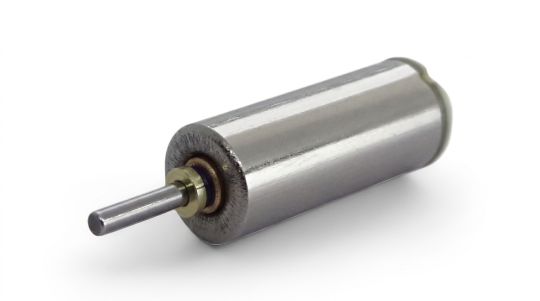
View the Coreless Motors Product List
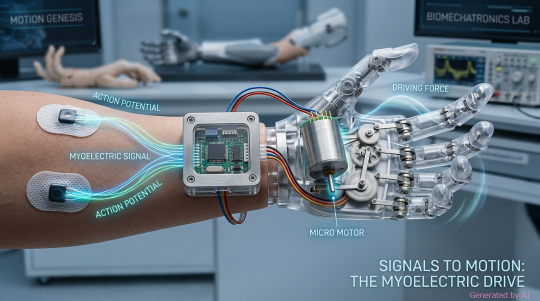
Myoelectric prosthetic hands are a type of “external power source prosthesis” that utilizes external power sources such as motors; they operate using myoelectric signals generated by the muscles remaining in the body. These myoelectric signals are detected by electrodes on the skin’s surface and, after signal processing, are used to determine actions such as “gripping” or “opening.”
The mechanism works by sending control commands to the motor based on the detected action, which generates rotational movement. Since the motor’s rotation is converted into finger and hand movements via a gearhead or wires, the motor’s performance affects not only gripping force but also responsiveness and the smoothness of movement.
Detecting Electromyographic Signals with Electrodes and Converting Them into Control Signals
When muscles contract, they generate weak electrical signals called electromyographic (EMG) signals. In myoelectric prosthetic hands, electrodes placed on the skin’s surface detect these EMG signals, which are then amplified by an amplifier and filtered to remove unwanted signals.
The processed signal is sent to the controller, where it is used to determine the user’s intended actions, such as “grip” or “open.” By adjusting the motor speed according to the strength of the electromyographic signal, it is also possible to achieve more natural operation.
The motor, upon receiving a control signal, moves the fingers or hand
Once the controller determines the user’s intended action, the motors are driven accordingly, generating rotational motion. This rotational motion is then converted into the opening and closing movements of the fingers or hand via mechanisms such as gearheads, linkages, and wires.
In multi-degree-of-freedom systems that move multiple fingers or joints, there are configurations that incorporate multiple motors controlled either individually or in coordination. Selecting the appropriate motors makes it easier to achieve not only the necessary gripping force but also rapid response and smooth finger movements.
Performance Requirements for Motors in Myoelectric Prosthetic Hands
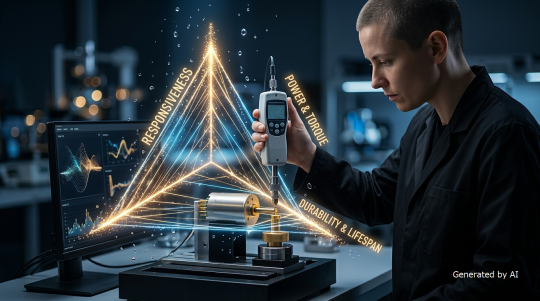
Since myoelectric prosthetic hands are worn on the body, it is not enough for the motors to simply have high output. They must ensure the necessary gripping force within limited space and weight constraints, while also providing a natural feel and supporting long-term use.
The main evaluation criteria and key points to verify are as follows.
| Evaluation Criteria | Checkpoints |
| Compact and Lightweight Design | Ability to fit inside the hand; overall weight of the prosthetic hand |
| Torque | Required gripping force, rotational speed, and compatibility with the gearhead |
| Responsiveness and Smoothness | Responsiveness and Smoothness |
| Energy efficiency, low heat generation, quiet operation, and durability | Battery life, heat generation, operating noise, vibration, and durability |
Below, we provide a detailed explanation of the performance requirements for myoelectric prosthetic hand motors from four perspectives.
Below, we provide a detailed explanation of the performance requirements for myoelectric prosthetic hand motors from four perspectives.
In myoelectric prosthetic hands, it is important for compact and lightweight motors to be used to minimize the burden on the wearer. In particular, if weight is concentrated in the fingertips, it can lead to reduced operability and fatigue during prolonged use.
Furthermore, the interior of the hand must accommodate not only the motor but also multiple components such as gears, sensors, and control boards. As the number of motors increases with higher degrees of freedom, making each individual motor compact and lightweight contributes to reducing the overall weight of the prosthetic hand and ensuring design flexibility.
Ensuring Sufficient Torque Despite Compact Size
In myoelectric prosthetic hands, it is essential to ensure the necessary torque for grasping, holding, and pinching everyday objects while simultaneously achieving miniaturization. The required torque varies not only based on the weight of the object but also on finger length, the point at which force is applied, and the efficiency of the link mechanism.
Compact motors may handle torque in the range of mN·m (millinewton-meters)—equivalent to one-thousandth of an N·m —and when a single motor is insufficient, combining it with a gearhead (reduction gear) is an effective solution. It is necessary to verify continuous torque, maximum torque, rotational speed, and electric current values to achieve a balance between size and output.
High Responsiveness and Smooth Operation
In myoelectric prosthetic hands, the ability to respond quickly to the user’s intended movements and move the fingers smoothly is also crucial. Since actions such as “gripping” and “opening” involve repeated starting, stopping, and reversing direction, the motor must have the responsiveness to track input signals quickly.
On the other hand, in situations where the fingers are slowly brought close to an object or the gripping force is fine-tuned, stable operation at low speeds is also essential. In multi-degree-of-freedom systems, since multiple motors are controlled in coordination, the responsiveness and smoothness of rotation of each motor affect natural finger movements and the feel of operation.
Energy Efficiency, Low Heat Generation, Quiet Operation, and Durability
Since myoelectric prostheses are battery-powered, motor efficiency and power consumption are also important selection criteria. High power consumption shortens the operating time, and increasing battery capacity leads to an increase in the overall weight of the prosthesis.
Furthermore, for devices worn on the body, consideration must be given to heat generation inside the housing and the operating noise of the motors and gears. Given that opening, closing, and grasping are repeated daily, durability and lifespan should be verified in addition to quiet operation.
It is important to conduct a comprehensive evaluation based on the assumption of prolonged use, taking into account actual loads and frequency of operation.
Three Key Points for Selecting Motors for EMG-Controlled Prosthetic Hands
When performing motor selection for an EMG-controlled prosthetic hand, simply comparing the maximum torque and size listed in catalogs is insufficient to determine whether it is suitable for actual usage conditions. It is important to consider the required gripping force, installation space, battery capacity, and frequency of operation to ensure a well-balanced configuration for the prosthetic hand as a whole.
The three main selection criteria are as follows.
- Determine the motor and gear configuration based on the required gripping force
- Evaluate based on the overall size, weight, and battery capacity of the prosthetic hand
- Verify responsiveness, quiet operation, and durability under actual operating conditions
Below, we will explain each of these selection criteria in detail.
Determine the motor and gear configuration based on the required gripping force
When selecting a motor for an electromyographic prosthetic hand, it is important to first clearly define the required gripping force. The required torque depends not only on the weight of the object being grasped but also on the length of the fingers, the point at which force is applied, the efficiency of the link mechanism, and the operating speed.
If the motor alone does not provide sufficient torque, combining it with a gearhead (reduction gear) is an effective way to increase torque. However, since increasing the reduction ratio lowers the output rotational speed, it is necessary to balance this against the required operating speed.
Additionally, it is necessary to take into account backlash—the play that occurs in the gear meshing—and comprehensively evaluate torque, rotational speed, and controllability. Depending on the application, Geared motors may also be a viable option.
Evaluation Based on the Overall Size, Weight, and Battery Capacity of the Prosthetic Hand
With myoelectric prosthetic hands, it is essential to verify not only the performance of the individual motors but also whether the prosthetic hand functions effectively as a whole. Since the interior of the hand must accommodate gears, control boards, sensors, and batteries, the overall size may increase even when using compact motors.
Particularly in multi-degree-of-freedom models, an increase in the number of motors leads to higher weight, power consumption, and heat generation. When anticipating prolonged use, it is important not to base the evaluation solely on maximum output, but to also consider efficiency, actual operating frequency, and battery capacity.
Verifying Responsiveness, Quiet Operation, and Durability Under Actual Operating Conditions
For myoelectric prosthetic hands, it is necessary to verify performance under conditions that closely resemble actual use, rather than relying solely on catalog ratings. Since opening and closing the fingers involves repeated starting, stopping, forward and reverse rotation, and low-speed operation, it is essential to confirm that no response delays or rotational irregularities occur under the anticipated loads and speeds.
Since these devices are intended for everyday use, the operating noise and vibration of the motors and gears are also important evaluation criteria. Additionally, because opening, closing, and gripping are repeated over long periods, it is recommended to review durability test results and lifespan data and consult with the manufacturer as needed.
Coreless motors are well-suited for compact, high-response electromyographic prosthetic hands
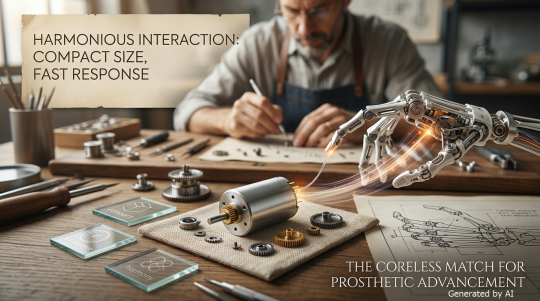
Myoelectric prosthetic hands must be compact and lightweight while also responding quickly to the user’s intended movements and enabling smooth finger motion. One option that meets these requirements is the Coreless motor, which features a structure without an iron core.
Here, we explain the structural characteristics of Coreless motors and the benefits of considering their adoption in myoelectric prosthetic hands.
Their Core-Less Design Facilitates Compact and Lightweight Construction
Brushed motors come in two types: cored motors, which have an iron core, and Coreless motors, which do not. Since Coreless motors do not use an iron core in the rotor, they are characterized by their ability to reduce the weight of rotating parts.
In myoelectric prosthetic hands, multiple components—such as motors, gears, sensors, and control boards—must be housed within the limited space of the hand, and the size and weight of each unit affect the overall design. In particular, since multi-degree-of-freedom models incorporate multiple motors, reducing the weight of each unit will help minimize the total weight.
The ability to balance reduced user burden with greater freedom in internal layout is one of the benefits of adopting Coreless motors.
Low Inertia Enables Both Responsiveness and Smooth Finger Movement
Coreless motors make it easy to reduce the weight of rotating parts and minimize inertia—the resistance to changes in rotational state—thereby enhancing responsiveness during start-up and stopping. In myoelectric prosthetic hands, which repeatedly start, stop, and reverse direction at short intervals in response to the user’s intended movements, the ability to track these movements quickly is critical.
Furthermore, because of their core-less design, it is easier to suppress cogging torque—the rotational irregularities caused by the attraction between magnets and an iron core—resulting in smoother rotation even at low speeds. This makes them well-suited not only for situations requiring rapid finger movements but also for delicate motions, such as slowly approaching an object.
Depending on the required specifications, this makes it a strong choice for achieving natural grasping motions.
Motor Selection for Electromyographic Prosthetic Hands Based on the Overall Usage Conditions of the Prosthetic Hand
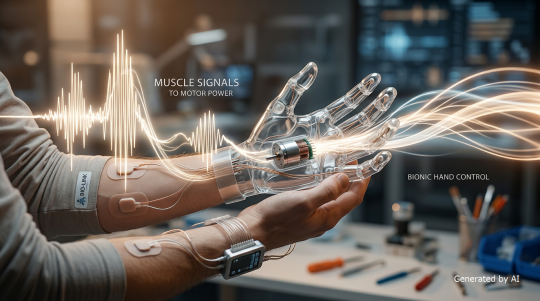
It is important not to perform motor selection for myoelectric prosthetic hands based solely on individual size or maximum torque, but rather to consider the operating conditions of the entire prosthetic hand. In addition to gripping force and operating speed, it is necessary to verify the internal space within the hand and the total weight. Battery capacity, heat generation, and quiet operation are also important evaluation criteria when considering long-term use.
Particularly with multi-degree-of-freedom models, the more motors installed, the greater the impact on weight and power consumption. Even if the required torque and rotational speed are met, practicality may be compromised if wearability or usage time is reduced.
If it is difficult to make a decision based solely on catalog specifications, it is advisable to organize your required specifications—such as voltage, control methods, and durability—and consult with the motor manufacturer, including considerations for pairing with a gearhead.
Summary
Compact and lightweight motors are required for myoelectric prosthetic hands, along with necessary torque, responsiveness, energy efficiency, low heat generation, quiet operation, and durability. Especially when moving toward multi-degree-of-freedom designs, it is important to evaluate the entire prosthetic hand—including gears and batteries—rather than just the motor itself.
Coreless motors are a strong option because they are easy to make lightweight and offer excellent responsiveness. C.I. Takiron Corporation offers a range of compact motors and Geared motors. If you are having trouble with motor selection or development for myoelectric prosthetic hands, please feel free to contact us.
Product Information & Inquiries
For more details on C.I. Takiron’s micro motor products, please visit the website below.
- Product Site: https://cik-ele.com/en/
- Coreless Motors: https://cik-ele.com/en/products/list/coreless_motor/
- Brushless Motors: https://cik-ele.com/en/products/list/brushless_motor/
- Geared Motors: https://cik-ele.com/en/products/list/gearhead/
- Encoders: https://cik-ele.com/en/products/list/encoder/
If you are having trouble selecting a small motor for your product development, please feel free to contact us via the inquiry form. Our technical staff will discuss your application and requirements with you and propose the optimal solution.
- Inquiries: https://cik-ele.com/en/contact/