


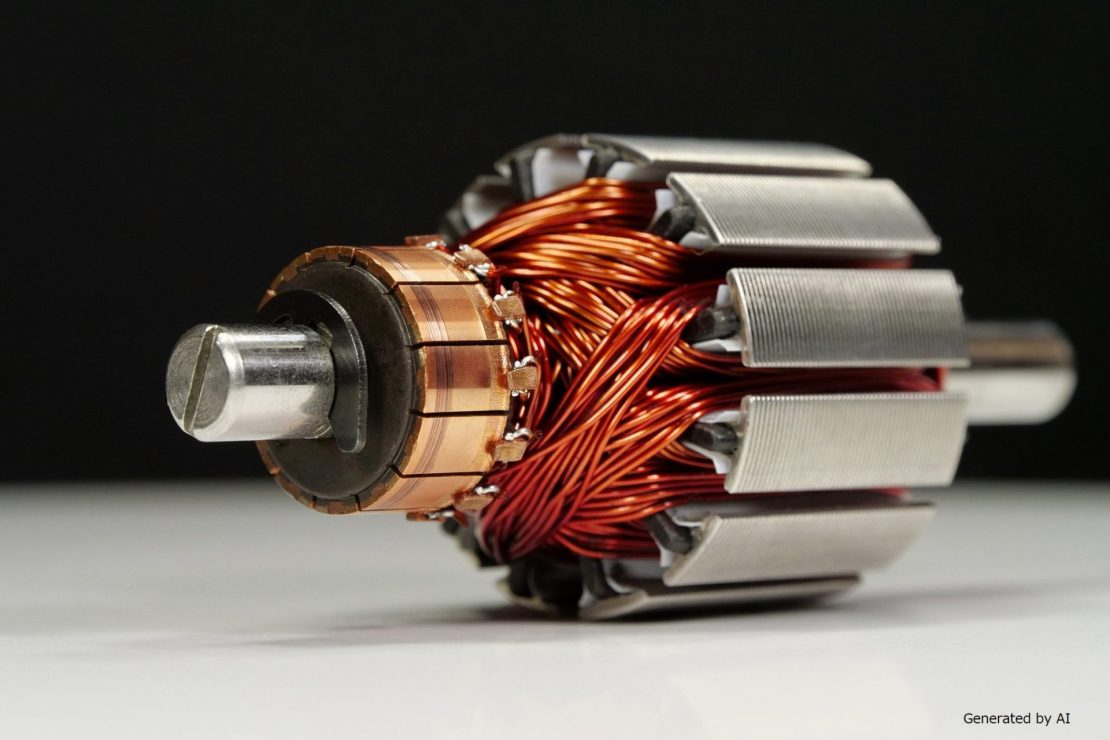
The number of poles in a motor is a basic specification indicating the number of magnetic poles formed inside the motor, and it is a parameter that influences rotational speed and torque characteristics. In the design and procurement of Micromotors, questions often arise regarding whether to choose a 2-pole or 4-pole motor, and how an increase in the number of poles affects performance.The number of poles is not a value determined in isolation; rather, the optimal solution is determined by balancing speed, torque, size, cost, and the technical requirements of each specific application. In this article, we will systematically cover the basics of motor pole count, its relationship to speed, and the approach to motor selection based on application. The content presents perspectives that engineers responsible for design and procurement can use as decision-making criteria to select the best-suited Micromotors for their company’s equipment.
| Supervised by: C.I. TAKIRON Corporation Electronic Devices Sales Group This article has been supervised based on the advanced technical expertise and insights we have cultivated since our founding in 1919 as a leading company in plastic processing. Our department continuously analyzes market trends and the latest technologies in ultra-compact, high-precision micro motors, focusing on providing high-value-added information to designers and developers. As a team of experts with in-depth knowledge of product characteristics, we support our customers’ problem-solving and technological innovation by delivering accurate and practical content. |
Number of Magnetic Poles in Motors and Basic Rules
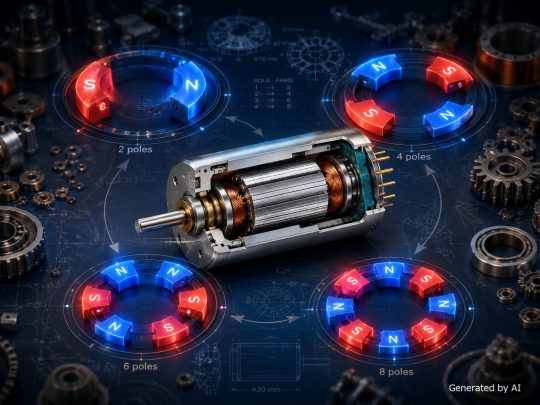
The basic rules governing the number of poles serve as the starting point for interpreting a motor’s performance. While the number of poles is a common specification used across all types of motors, it is a term that is often confused with the number of slots or the number of pole pairs. In this chapter, we will systematically explain what the numerical value for the number of poles represents, why it is expressed as an even number, and how it differs from related terms, summarizing the foundational knowledge necessary for understanding rotational characteristics in later sections.
Contents of This Section
- Number of Poles: The Total Number of Magnetic Poles Inside the Motor
- The number of poles is always an even number, a multiple of 2
- Differences Between Pole Count, Number of Slots, and Number of Pole Pairs
Although the number of poles is a basic item in catalogs, a deeper understanding is gained by delving into the differences between it and related terms. First, let’s confirm what the number of poles actually refers to.
The number of poles refers to the total number of magnetic poles inside the motor
The number of poles represents the total number of magnetic poles formed inside a motor. Magnetic poles refer to the north (N) and south (S) poles formed by the windings and the field magnet; the number of poles is the sum of these two. The number of poles is a common specification used regardless of whether the motor is DC or AC, and it serves as a fundamental indicator for understanding the motor’s structure.In catalogs and data sheets, it is denoted as “2-pole” or “4-pole,” and serves as foundational information for interpreting rotational speed and torque characteristics. For example, in the design of equipment requiring precise motion—such as endoscopes or camera lens drives—it is common to verify the number of poles of the selected motor at an early stage. While the number of poles itself is not a value that directly indicates performance, it serves as a starting point for understanding rotational and vibration characteristics.When performing motor selection, having a clear understanding of what the number of poles signifies makes it easier to compare the differences between various types.
The number of poles is always an even number, a multiple of 2
The number of poles is always a multiple of 2 This is due to the structural properties of magnets. North (N) and South (S) poles do not exist independently; they always form pairs. The number of poles—which is the sum of these pairs—has a minimum value of 2 and increases in even numbers thereafter: 4, 6, 8, and so on. The basic rule is that if there is one pair of N and S poles, it is counted as a 2-pole motor; if there are two pairs, it is counted as a 4-pole motor.
Depending on the application and design objectives, various types of motors are manufactured, ranging from 2-pole motors to multipole motors with many magnetic poles.
In Brushless motors, configurations such as 2-pole/3-slot, 4-pole/6-slot, and 6-pole/9-slot are commonly used. There are also diverse configurations that do not follow the 2:3 ratio, such as 16-pole/12-slot, 8-pole/9-slot, and 10-pole/12-slot . Understanding the basic rule that the number of poles is always an even number will help reduce the risk of misreading specifications in catalogs.
Differences Between Number of Poles, Number of Slots, and Number of Pole Pairs
Terms that are often confused with the number of poles include the number of slots and the number of pole pairs. While all three are values related to motor structure, they refer to different concepts. The main differences are as follows.
| Term | What It Refers To |
| Number of Poles | The number of magnetic poles (N-poles and S-poles) formed inside the motor |
| Number of Slots | The number of spaces in the stator where coils are placed |
| Number of pole pairs | The number of pole pairs (N-poles and S-poles counted as a single pair; half the number of poles) |
The number of poles refers to the number of magnetic poles, while the number of slots refers to the number of spaces where coils are placed; these are counted differently. The number of pole pairs is equal to the number of poles divided by 2; for example, a 4-pole motor has 2 pole pairs. When interpreting data sheets, distinguishing between these three terms helps prevent misunderstandings of the specifications.
The Relationship Between a Motor’s Number of Poles and Speed | Formulas and Characteristics
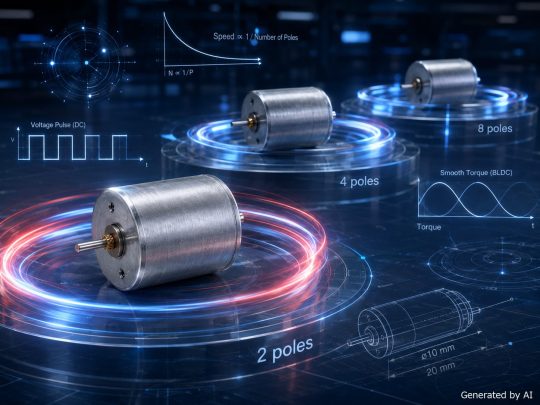
The impact of the number of poles on rotational speed varies depending on the type of motor. While the rotational speed of a synchronous motor is determined by a calculation formula, the structure of a DC motor is such that other factors influence its rotational speed. In this chapter, we will systematically explain the calculation method for determining the rotational speed of synchronous motors, the speed control mechanism of DC motors, and the rotational characteristics of Brushless DC Motors, thereby clarifying the differences between these types.
Topics Covered in This Section
- Calculation Formulas for Pole Number and Speed
- Speed of DC motors Determined by Applied Voltage
- Number of Poles and Speed Characteristics of Brushless DC Motors
Even with the same “number of poles,” the relationship with rotational speed changes depending on the type of motor. We will begin by examining Synchronous motors, where rotational speed is determined by a calculation formula.
Formulas for Pole Number and Rotational Speed
The formula for the number of poles and rotational speed is the basic equation for calculating the rotational speed of a synchronous motor. The synchronous rotational speed is expressed as Ns = 120 × f / P (Ns: synchronous rotational speed in r/min, f: power supply frequency in Hz, P: number of poles). The rotational speed is directly proportional to the power supply frequency and inversely proportional to the number of poles.Looking at specific values: For a 4-pole motor, the rotational speed is 1500 r/min at a power supply frequency of 50 Hz and 1800 r/min at 60 Hz. As the number of poles increases, the synchronous rotational speed decreases; even at the same frequency, an 8-pole motor has half the rotational speed of a 4-pole motor. This formula is a basic equation widely used for AC synchronous motors and serves as a guideline for estimating rotational speed based on the number of poles.When evaluating Micromotors, particularly in cases involving synchronous motors, the approach of calculating rotational speed based on the number of poles and frequency is useful.
Rotational Speed of DC Motors Determined by Applied Voltage
The rotational speed of a DC motor is determined not by the number of poles, but by the balance between the applied voltage and the load. In Brushed DC Motors, increasing the voltage increases the rotational speed; the number of poles itself is not a factor that directly determines the rotational speed. In actual motor control, PWM (Pulse Width Modulation) is widely used. PWM is a control method that varies the average voltage applied to the motor by changing the pulse duty cycle.If the duty cycle is 50%—that is, if the on and off times are equal—the rotational speed will be approximately half . By finely adjusting the duty cycle, the rotational speed can be controlled smoothly. Unlike the calculation formulas for synchronous motors, a key characteristic of DC motors is that voltage control determines the rotational speed. For DC motors, which are widely used in the field of Micromotors, understanding both the number of poles and the mechanism of voltage control makes it easier to plan speed designs.
Number of Poles and Speed Characteristics of Brushless DC Motors
In Brushless DC Motors, the combination of the rotor’s number of poles and the stator’s number of slots determines the rotational characteristics. Typical configurations include 2-pole/3-slot, 4-pole/6-slot, and 16-pole/12-slot. As the number of poles and slots increases, higher torque is achieved, and torque ripple ( ) tends to decrease.Torque ripple refers to fluctuations in torque during rotation; the smaller the value, the smoother the rotation. The differences in characteristics based on these combinations are summarized as follows.
| Configuration Trends | Impact on Rotational Characteristics |
| Fewer poles and slots | Simple structure; relatively high torque ripple |
| High number of poles and slots | High torque, low torque ripple |
In motor selection for Brushless DC Motors, it is important to consider rotational characteristics not just in terms of the number of poles alone, but in combination with the number of slots. In equipment requiring precise operation, differences in this combination directly affect product performance.
How to Select the Number of Poles Based on Application

The optimal number of poles is not determined by a single value. It is determined by considering multiple requirements, such as rotational speed, torque, size, and cost. In this chapter, we will systematically outline how to select the appropriate number of poles for different applications, key points to check during selection, and the approach to selecting Micromotors based on specific applications. This content summarizes perspectives that will aid in decision-making during the early stages of design.
Topics Covered in This Section
- Selecting the Appropriate Number of Poles for Different Applications
- Points to Consider When Selecting the Number of Poles
- Micromotors with the Appropriate Number of Poles for Your Application
Selecting the number of poles becomes much easier when approached from the perspective of the application. First, let’s review the concept of selecting the appropriate number of poles based on the application.
Selecting Different Pole Counts Based on Application
The perspective of selecting different pole counts based on application serves as the starting point for motor selection. Motors with fewer poles tend to be chosen for high-speed applications, while those with more poles are typically selected for applications requiring high torque or precise control . In the case of Micromotors, the type and pole configuration used vary depending on the required rotational speed and load conditions. The basic process is to first determine the motor type based on the application, and then proceed to selection by comparing individual performance specifications.Brushless motors come in a wide variety of models, allowing for precise selection based on the specific application. Clarifying the application first and then narrowing down the number of poles and motor type is the most direct path to finding a motor that meets the required specifications. Organizing the application conditions during the design phase makes subsequent comparative evaluation much easier.
Points to Consider When Selecting the Number of Poles
The key to selecting the number of poles is to organize multiple requirements based on rotational speed. First, confirm the required rotational speed, and then proceed with your evaluation, taking into account torque, size, cost, and controllability. The main items to check are as follows.
| Item | Verification Criteria |
| Rotational Speed | Does it meet the speed range required for the application? |
| Torque | Can sufficient output be secured to drive the load? |
| Size | Does it fit within the equipment’s installation space? |
| Cost | Balance between unit cost and performance during mass production |
| Controllability | Does the configuration allow for control at the required precision? |
The combination of pole pairs and slots also affects torque ripple and efficiency. By clarifying target specifications early in the design phase before beginning the evaluation process, you can make a selection that minimizes the need for revisions later on. While increasing the number of pole pairs offers advantages in terms of torque and low ripple, it also raises challenges regarding control complexity and cost. A practical approach is to narrow down the number of pole pairs that meet the required specifications while balancing multiple requirements.
MICROMOTOR MOTOR SELECTION FOR THE APPLICATION
When performing motor selection for a specific application with the appropriate number of poles, the technical challenges of each device serve as the key criteria.The required characteristics vary significantly depending on the application—for example, medical equipment and optical equipment that requires suppression of cogging and micro-vibrations, or security equipment that requires long-term operation at low voltages. Suppressing cogging and torque ripple is one of the key considerations in the design of motors used in precision equipment. Since the required characteristics vary by application, it is essential to select the number of poles in conjunction with the specific application conditions.
C.I. Takiron Corporation offers a full lineup of Coreless motors, Brushless motors, and Geared motors, and we also provide customized solutions tailored to specific applications and specifications. If you are having trouble with motor selection or narrowing down the right motor for your application, please review the technical information on our product website and feel free to contact us via the inquiry form.
Summary
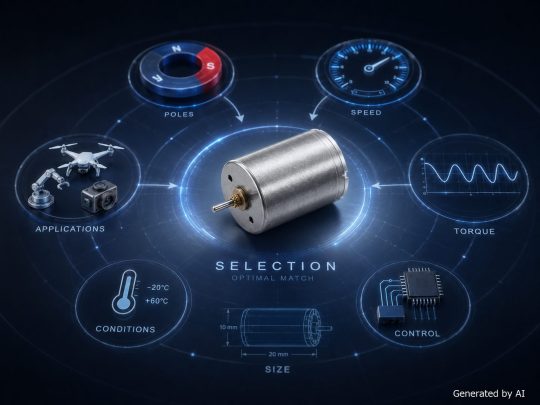
The number of poles in a motor is a basic specification representing the total number of magnetic poles (N-poles and S-poles) formed inside the motor; it is expressed as an even number with a minimum of 2. The significance of the number of poles varies depending on the type of motor: while it determines the rotational speed in Synchronous motors, it affects torque and vibration characteristics in DC motors and Brushless DC Motors.When performing motor selection for Micromotors, it is practical to consider multiple requirements—such as rotational speed, torque, size, and cost—and narrow down the optimal number of poles and motor type based on the intended application. Understanding the basics of the number of poles will make it easier to interpret datasheets and compare different types of motors.
Product Information & Inquiries
For more details on C.I. Takiron’s micro motor products, please visit the website below.
- Product Site: https://cik-ele.com/en/
- Coreless Motors: https://cik-ele.com/en/products/list/coreless_motor/
- Brushless Motors: https://cik-ele.com/en/products/list/brushless_motor/
- Geared Motors: https://cik-ele.com/en/products/list/gearhead/
- Encoders: https://cik-ele.com/en/products/list/encoder/
If you are having trouble selecting a small motor for your product development, please feel free to contact us via the inquiry form. Our technical staff will discuss your application and requirements with you and propose the optimal solution.
- Inquiries: https://cik-ele.com/en/contact/