


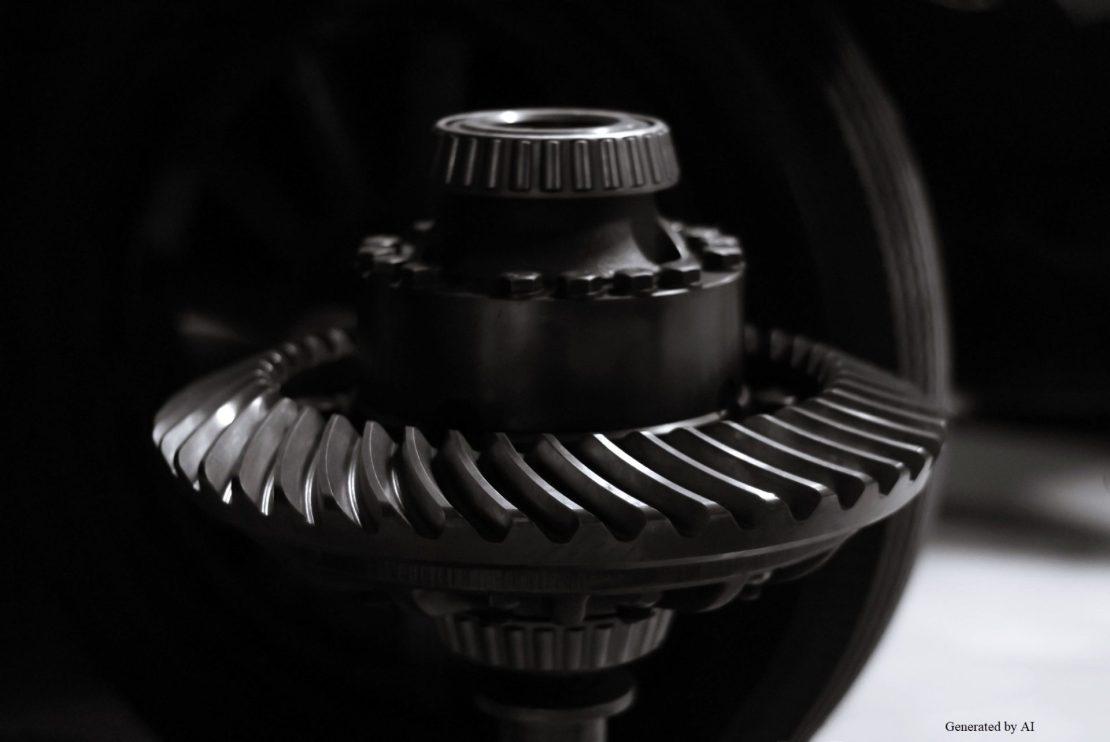
A geared motor is a drive unit that integrates a motor and a gearhead (reduction gear). Its key feature is the ability to achieve low-speed, high-torque output—which cannot be obtained from a motor alone—in a space-saving design.They are used across a wide range of industries, from large-scale equipment such as conveyors, food processing machinery, and industrial robots, to small precision devices like medical equipment, optical equipment, and electronic locks. Various types are available depending on the application, and selecting the right model to match the required performance and installation environment is key to ensuring stable operation.
In this article, we will explain the basic mechanisms and structure of geared motors, the main types of gearheads, and key selection points to consider when implementing them. If you are considering the implementation of a geared motor, please use this as a reference.
| Supervised by: C.I. TAKIRON Corporation Electronic Devices Sales Group This article has been supervised based on the advanced technical expertise and insights we have cultivated since our founding in 1919 as a leading company in plastic processing. Our department continuously analyzes market trends and the latest technologies in ultra-compact, high-precision micro motors, focusing on providing high-value-added information to designers and developers. As a team of experts with in-depth knowledge of product characteristics, we support our customers’ problem-solving and technological innovation by delivering accurate and practical content. |
Mechanism and Basic Structure of Geared Motors
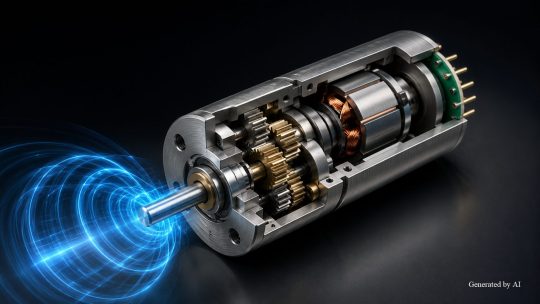
The performance of a geared motor is determined by its structure, which combines a motor and a gearhead. We will explain the mechanism, structure, and the principle of speed reduction in order.
Contents of this section
- Mechanism that achieves low speed and high torque in a compact space
- Internal structure consisting of the gearhead and motor
- The relationship between speed and torque determined by the gear ratio
Understanding the design that resolves the challenges of conventional coupling methods and the basic principles of speed reduction will clarify the advantages of geared motors.
Mechanism for Achieving Low RPM and High Torque in a Compact Design
The ability to achieve low speed and high torque in a compact design is the main feature of geared motors. In conventional coupling systems, the motor, gearhead, and coupling are separate devices, requiring a large installation space. Geared motors resolve this space issue by directly connecting a dedicated gearhead to the motor.
Furthermore, while speed control using an inverter can reduce rotational speed, it does not increase torque. In contrast, since geared motors mechanically reduce speed via gears, they can simultaneously achieve low rotational speed and high torque.
Internal Structure Comprising the Gearhead and Motor
The internal structure, consisting of the gearhead and motor, is broadly divided into two parts: the “gearhead (reduction gear)” section and the “motor” section. The following components are incorporated inside the gearhead.
[Main Components of the Gearhead Section]
- Output shaft
- Various gears
- Bearings
- Oil seal
A gear is mounted on the motor’s output shaft, designed to mesh directly with the gear on the gearhead side. Since the motor and gearhead are integrated without a coupling, power transmission losses are minimized, resulting in a compact design.
The Relationship Between Speed and Torque Determined by the Gear Ratio
Understanding the relationship between speed and torque determined by the gear ratio is fundamental knowledge for selecting a geared motor. The gear ratio (reduction ratio) refers to the ratio of the number of teeth between the input and output gears; the higher the gear ratio, the lower the output speed, and conversely, the greater the torque.
For example, in a geared motor with a reduction ratio of 1/10, the output speed decreases to one-tenth of the original value, while the torque increases approximately tenfold. Torque improvement cannot be expected with inverter-based speed reduction. Mechanical speed reduction using a geared motor is effective for achieving both low speed and high torque.
Types of Gearheads Used in Geared Motors
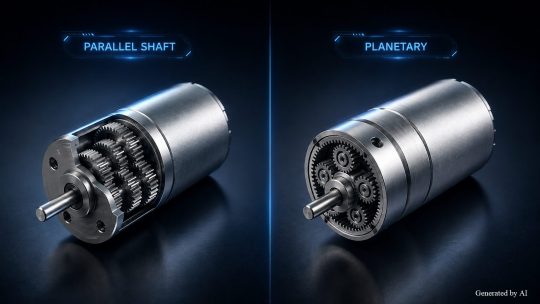
There are several types of gearheads, each with a different structure, that determine the performance of a geared motor.
Topics covered in this section
- Parallel-shaft gearheads are the versatile basic type
- Planetary gearheads are compact and deliver high torque
- Right-angle gearheads are designed for space-saving applications
Output characteristics, quiet operation, precision, and size vary depending on the gear structure and shaft configuration, so selection must be tailored to the specific application.
Parallel-shaft gearheads are the versatile, basic type
Parallel-shaft gearheads are a common type that uses a combination of spur gears for reduction. The input and output shafts are arranged parallel to each other, offering excellent connectivity with equipment and making them suitable for installation on a flat surface. These highly versatile gearheads are used in a wide range of industrial equipment, such as conveyors and transport systems.
On the other hand, they tend to have relatively large backlash (the intentional gap between gear teeth) when the gears mesh, which can cause vibration and drive noise. For applications requiring quiet operation or high-precision positioning, it is necessary to compare them with other types.
Planetary Gearheads: Compact and with High Torque
Planetary gearheads feature a structure in which multiple planetary gears rotate around a central sun gear. Since the gears mesh simultaneously at multiple points, distributing the load, they offer the following advantages not found in standard parallel-shaft types.
[Advantages of Planetary Gearheads]
- High torque output compared to parallel-shaft types of the same size
- High-precision positioning due to minimal backlash
- Improved durability and lifespan due to force distribution
Because they combine high torque and precision in a compact design, they are widely used in applications where performance is required in limited spaces, such as in precision equipment and robot joints.
Right-Angle Gearheads Are Designed for Space-Saving Applications
Orthogonal-axis gearheads feature a structure where the motor’s output shaft and the gearhead’s output shaft intersect at a right angle. Representative types include worm gears and hypoid gears, each with distinct characteristics.
| Item | Worm Gear | Hypoid Gear |
| Contact Method | Sliding contact | Low-friction meshing |
| quiet operation | Excellent | Quieter than bevel gears for quiet operation |
| Transmission efficiency | Slightly lower | High |
| Tendency to heat generation | May occur | Relatively low |
This right-angle layout enables a space-saving design with a compact depth. Depending on installation conditions and efficiency requirements, it is necessary to select either worm gears or hypoid gears.
Application Examples and Selection Criteria for Geared Motors
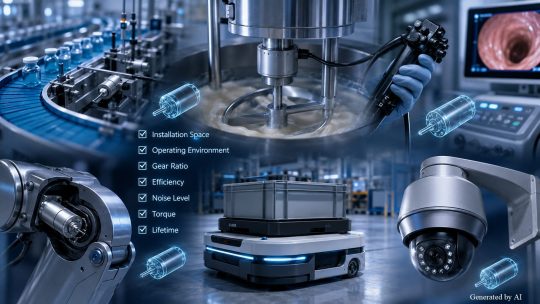
Geared motors are drive units used in a wide range of fields, from industrial equipment to precision instruments.
Topics covered in this section
- Applications in industrial fields such as conveyors and food processing machinery
- Applications in precision fields such as medical equipment and robotics
- Three key selection criteria to consider before installation
Since the required rotational speed, torque, size, and operating environment vary by application, selecting the right model is the foundation for stable operation.
Applications in Industrial Fields Such as Conveyors and Food Processing Machinery
In industrial sectors such as conveyors and food processing machinery, geared motors are widely adopted as the core of drive systems. Typical industrial applications include the following.
[Main Industrial Applications of Geared Motors]
- Conveying drives for general-purpose conveyors
- Agitation and conveying in food processing machinery
- Power transmission in agricultural machinery
- Driving automated guided vehicles (AGVs)
- Opening and closing drives for automatic doors and shutters
Geared motors come in a variety of models, each with distinct characteristics, such as superior water resistance or quiet operation. Selecting a model suited to the operating environment and installation conditions is key to ensuring stable operation.
Applications in Precision Fields Such as Medical Equipment and Robotics
The use of compact geared motors is also expanding in precision fields such as medical equipment and robotics. In medical equipment, they are incorporated into the drive units of endoscopes and pumps, where high-precision rotational control and quiet operation are essential requirements. In the robotics industry, planetary gear-type geared motors—which are compact yet capable of delivering the necessary torque—are utilized as the power source for actuating the joints of arms and limbs.
Furthermore, the range of applications for compact geared motors—which can be installed in limited spaces—is extensive, including pan-tilt mechanisms for security cameras, locking and unlocking mechanisms for electronic locks, and precision positioning in semiconductor manufacturing equipment.
Three Selection Points to Check Before Installation
By keeping these three selection points in mind before installation, you can prevent issues after installing the geared motor.
| Selection Criteria | Items to Check |
| Securing Installation Space | Since the overall dimensions, including the gearhead, are larger than those of the motor alone, verify in advance that it will fit within the equipment |
| Suitability for the Operating Environment | The number of models suitable for outdoor use or high-temperature and high-humidity environments is limited, so check the environmental resistance specifications in the datasheet |
| Setting the Reduction Ratio | Select a reduction ratio that matches the required speed and torque to ensure adequate output |
By clarifying these three points—installation space, operating environment, and reduction ratio—in advance, it becomes easier to narrow down the selection to the optimal geared motor model.
Summary
Geared motors are drive units that combine a motor and a gearhead into a single unit, enabling space-saving designs with low-speed, high torque output. Gearheads come in various types, such as parallel-shaft, planetary, and right-angle configurations, and their output characteristics, quiet operation, precision, and size vary depending on the gear structure and shaft arrangement. When selecting a model, confirm the installation space, operating environment, and reduction ratio in advance.Selecting a model that aligns with your application and installation conditions is essential for ensuring stable operation.
C.I. Takiron Corporation offers two main types of gearheads: spur gearheads (parallel-shaft type) and planetary gearheads (planetary gear type). We also provide application-specific information pages covering fields such as medical, tools, optics, and security.
Product Information & Inquiries
For more details on C.I. Takiron’s micro motor products, please visit the website below.
- Product Site: https://cik-ele.com/en/
- Coreless Motors: https://cik-ele.com/en/products/list/coreless_motor/
- Brushless Motors: https://cik-ele.com/en/products/list/brushless_motor/
- Geared Motors: https://cik-ele.com/en/products/list/gearhead/
- Encoders: https://cik-ele.com/en/products/list/encoder/
If you are having trouble selecting a small motor for your product development, please feel free to contact us via the inquiry form. Our technical staff will discuss your application and requirements with you and propose the optimal solution.
- Inquiries: https://cik-ele.com/en/contact/