



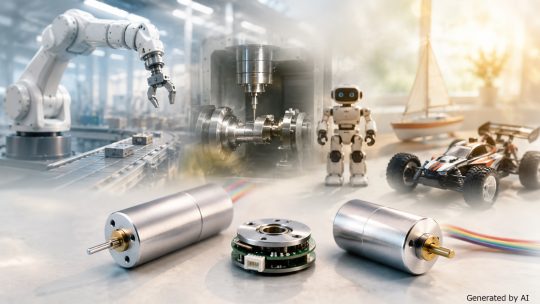
A servo motor is a type of motor capable of performing high-precision motor control for position, speed, and angle. It is used in a wide range of applications, from industrial robots and machine tools to hobbyist projects such as radio-controlled vehicles and robot kits.
However, many people likely have questions such as, “How are they different from ordinary motors?” “Why can they move so precisely?” and “How do I choose the right product for my application?” To use them effectively, it’s important to understand their basic mechanisms and characteristics and to identify the performance required for your specific application.
In this article, we’ll provide a clear and easy-to-understand explanation of how servo motors work, their features, main applications, and key criteria for motor selection.
| Supervised by: C.I. TAKIRON Corporation Electronic Devices Sales Group This article has been supervised based on the advanced technical expertise and insights we have cultivated since our founding in 1919 as a leading company in plastic processing. Our department continuously analyzes market trends and the latest technologies in ultra-compact, high-precision micro motors, focusing on providing high-value-added information to designers and developers. As a team of experts with in-depth knowledge of product characteristics, we support our customers’ problem-solving and technological innovation by delivering accurate and practical content. |
What Is a Servo Motor?
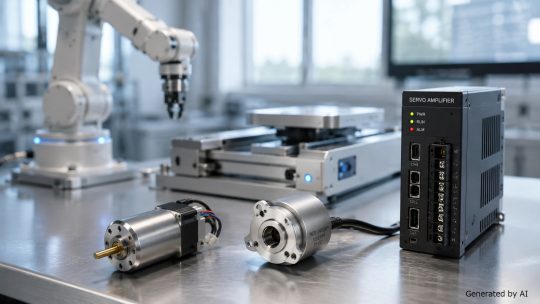
A servo motor is a type of motor that, when combined with components such as encoders and a servo amplifier, can control position and speed with high precision. While general-purpose motors primarily generate power through rotation, servo motors excel at operating precisely in response to commands.
Another key feature is that they are used not as standalone motors, but as part of a “servo system” that includes components such as encoders and servo amplifiers. Here, we’ll explain the basics of servo motors, the composition of a servo system, and how they differ from general-purpose motors.
Overview of Servo Motors
Because servo motors can finely adjust their rotational position and speed in response to commands, they are well-suited for equipment that requires precise motion. The three main control methods are position control, speed control, and torque control.
For example, position control allows the motor to “move precisely to a target position and stop”; speed control allows it to “maintain a set rotational speed”; and torque control allows it to “maintain a constant level of force (torque) required to handle the load.” Since the control method can be selected based on the application, servo motors are used in a wide range of fields, including industrial robots, machine tools, and material handling equipment.
What Is a Servo Mechanism (Servo System)?
A servo mechanism (servo system) is a system that monitors the motor’s status while controlling it to ensure precise operation in response to commands. It primarily consists of a controller that issues commands, a servo amplifier that adjusts operation, a servo motor that provides drive power, and encoders that detect position and speed.
By coordinating these components to continuously adjust the motor’s operation, the system enables highly precise and stable motor control. The specific control mechanism will be explained in detail in the next chapter.
Differences from General-Purpose Motors
The main differences between servo motors and conventional motors lie in their intended applications, control methods, and system configurations.
| Comparison Criteria | Conventional Motors | Servo Motor |
| Primary Purpose | To generate power through rotation | To precisely control position, speed, and angle |
| Control Methods | Operates primarily in a fixed direction and at a fixed speed | Adjusting operation according to setpoint values |
| Configuration | Often used as a standalone motor | Combined with encoders or servo amplifiers |
| Suitable Applications | Fans, pumps, and other equipment for general industrial and household appliance applications | Robots, machine tools, material handling equipment, etc. |
| Features | Relatively simple configuration | High precision but complex construction |
Standard motors are suitable for applications that generate power through continuous rotation. Servo motors are characterized by their ability to detect position and speed using encoders and compensate for deviations from the setpoint.
While they enable precise positioning and speed control, their system configuration is more complex. It is important to select a motor suited to the application, taking into account the required precision and cost.
How Servo Motors Work

Servo motors achieve high-precision operation by detecting actual movement and continuously correcting any deviation from the command. The encoders, which detect the motor’s status, work in conjunction with the servo amplifier, which adjusts the motor’s operation, to bring the motor closer to the target position and speed.
Here, we explain the feedback control mechanism that underpins servo motors, as well as the roles of the encoders and servo amplifier.
How Feedback Control Regulates Position and Speed
Feedback control is a control method that compares the target value with the actual motion and adjusts the output to minimize the difference. In a servo motor, the current position and speed detected by the encoders are sent to the servo amplifier, which checks the difference from the command value.
If there is a difference, the servo amplifier adjusts the electric current supplied to the motor to bring it closer to the target position or speed. Since corrections are made continuously while monitoring operation, this enables highly precise and stable motor control.
The Role of the Encoders
Encoders are sensors that detect the rotational position, speed, and direction of a servo motor. They convert information about “where the motor is” and “how fast it is moving” into electrical signals and transmit them to the servo amplifier.
In a servo system, the encoders act like the human eye. If they can detect even the finest movements, the servo amplifier can more accurately determine the difference from the command value and make appropriate corrections.
The detection accuracy of the encoders is a critical factor that determines the positioning and speed control accuracy of the entire servo system.
The Role of the Servo Amplifier
A servo amplifier is a device that adjusts the power supplied to the servo motor based on commands from the controller and information from the encoders. In a servo system, it is responsible for adjusting the output based on the difference between the command value and the actual motion.
When there is a difference between the command value and the actual operation, the servo amplifier supplies the necessary electric current to the motor to correct the position or speed. Since it can also adjust acceleration and deceleration, it enables smooth and stable control while suppressing jitter caused by sudden movements.
Features and Benefits of Servo Motors

The strength of servo motors lies not only in their ability to precisely control position and speed. Because they respond quickly to commands and maintain stable operation even when the load changes, they are well-suited for equipment that repeats the same movements.
Here, we explain the main features and benefits of servo motors from four perspectives.
High-Precision Positioning
A key feature of servo motors is their ability to move precisely to a specified position and stop there. By using encoders to detect the current position and continuously correcting the difference from the commanded position, even the slightest positional deviation is minimized.
High positioning accuracy is essential for equipment such as placement machines that position electronic components in specific locations and machine tools that perform precision machining. While accuracy varies by model, the greater the need for fine positional adjustments, the more effectively a servo motor’s strengths can be leveraged.
Enables high-speed and stable control
Servo motors are characterized by their ability to respond quickly to commands and maintain stable operation even at high speeds. They enable control that allows for rapid acceleration from a standstill, as well as precise deceleration and stopping from high-speed operation.
During acceleration and deceleration, the output is adjusted while monitoring the difference from the target value, thereby minimizing overshoot—where the motor moves past the target position. They are well-suited for applications that require repeated, precise movements in a short time, such as industrial robots and material handling systems.
Resilient to Load Fluctuations
Servo motors are designed to easily maintain target positions and speeds even when the weight or resistance of the object being moved changes. When the load increases and the rotational speed decreases, the encoders detect the change, and the servo amplifier adjusts the output to the motor.
A key advantage is their ability to maintain stable operation even on production lines where the weight of the transported items varies or on machine tools where resistance changes during machining. Even in applications with variable load conditions, they help minimize variations in precision and production quality.
Excellent Repeatability
Servo motors are characterized by their ability to minimize variations in position and speed even when repeating the same motion multiple times. This is because they detect the current state with each operation and correct any deviation from the command value.
For example, in automated assembly equipment, parts must be repeatedly and accurately moved to specified positions. By leveraging the high repeatability of servo motors, stable operation can be maintained even during long periods of continuous operation, leading to more consistent product quality.
Main Applications of Servo Motors
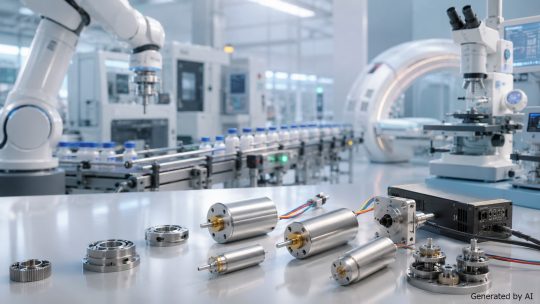
Servo motors are used in a wide range of fields that require high-precision positioning and stable speed control. They are particularly well-suited for automated equipment that must accurately repeat the same motion, as well as for precision instruments that control minute movements.
Here, we introduce some representative applications where servo motors are utilized.
Industrial robot
Servo motors are widely used as the driving force behind the joints of industrial robots. In multi-joint robots and SCARA robots, servo motors are mounted on each axis to finely control the arm’s position and speed.
Because they enable high-precision positioning and rapid response, they are well-suited for tasks that require accuracy and speed, such as welding, assembly, and parts picking. They also help minimize variations in repetitive motions, contributing to stable production line operation and consistent product quality.
Machine Tools
Servo motors are used in machine tools, such as machining centers and NC lathes, to control the position of cutting tools and workpieces. By precisely moving the X, Y, and Z axes, they enable precise machining that follows the designed shape.
During machining, it is necessary to finely adjust the tool’s movement speed and stopping position. Since servo motors respond quickly to commands and can accelerate and decelerate smoothly, they help reduce processing time while maintaining machining accuracy.
Conveyor Systems and Automation Equipment
Servo motors are also utilized in automation equipment for production lines, such as conveyors and transport systems. They are well-suited for applications that require stopping transported items precisely at designated positions or moving them at a constant speed.
A key advantage is their ability to adjust output while detecting actual movement, even when the weight or frictional resistance of the conveyed items changes. They are useful in applications requiring high conveyance precision and stable operation, such as electronic component assembly equipment and food and pharmaceutical packaging lines.
Medical and Precision Equipment
Servo motors are also used in medical equipment and precision equipment that require fine position adjustments and smooth motion. Typical examples include surgical assistance robots, automated analyzers, and optical equipment.
Medical equipment must operate accurately while minimizing sudden movements and positional deviations. In precision instruments as well, even slight vibrations can affect measurement and processing accuracy, making precise control essential.
Servo motors, capable of achieving high-precision and stable operation, support fields that require precise control.
Servo Motors Used in the Hobby Sector

Servo motors are widely used not only in industrial applications but also in the hobby sector, such as radio-controlled vehicles, robotics projects, and model-making. Many hobby-grade products are compact and lightweight, and their angle and movement can be controlled relatively easily by sending signals (PWM signals) from a microcontroller or similar device.
Here, we introduce examples of how servo motors are used in familiar hobby applications.
Radio-Controlled Cars and Airplanes
In radio-controlled cars and airplanes, servo motors are used to change the orientation of the vehicle or aircraft in response to the operator’s commands. Typical applications include steering systems that adjust the front wheels in radio-controlled cars and mechanisms that move the movable parts of the wings and tail surfaces in radio-controlled airplanes.
Because servo motors allow for precise angle adjustments, they enable smooth turns, climbs, and descents in response to the transmitter’s controls. Since the required torque and response speed vary depending on the application, it is important to select a product that matches the size of the vehicle or aircraft and the desired movement.
Robotics Projects
Servo motors are also widely used in robotics projects, such as bipedal robots and robotic arms. In bipedal robots, they are mounted at the hip, knee, and ankle joints; by finely adjusting the angle of each joint, the robot can reproduce movements similar to human walking.
In robotic arms, combining multiple servo motors enables actions such as grasping, moving, and stacking objects. Since complex movements can be achieved by coordinating multiple joints, they are well-suited for educational robot kits and programming education.
Model Making and Electronics Projects
In model-making, servo motors are used for moving mechanisms such as wing movement, opening and closing hatches, and swiveling heads. They are well-suited for applications requiring precise movement within a specified angle range (range of motion), such as the flaps on model airplanes or the turrets on model tanks.
In electronics projects, when combined with a microcontroller, they can be used to build devices such as automatic doors or systems that track the sun’s position. Hobby-grade servo motors are relatively easy to work with and can be moved to specific angles, making them useful as teaching tools for learning programming and motor control mechanisms.
Key Considerations for Servo Motor Selection
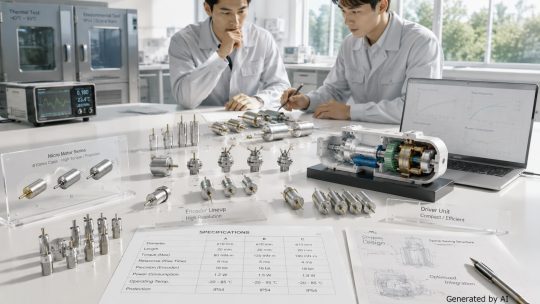
The required performance and operating conditions for servo motors vary depending on the application. Even if a servo meets the required torque, it may not perform adequately if its size, control accuracy, power consumption, or other factors are not appropriate.
Therefore, it is important to clearly define the device and its intended purpose, and then comprehensively compare multiple criteria. Below, we explain the main points to consider during motor selection.
Determine the Required Torque
When selecting a servo motor, it is important to verify the torque required to operate the equipment. Insufficient torque may prevent the system from accelerating to the target speed and could lead to positional errors or overheating.
The required torque is calculated by taking into account the weight of the object being moved, the rate of acceleration and deceleration, friction, and other factors. Our compact motors, including our Micromotors, deliver torque in the mN·m (millinewton-meter) range.
Since using a motor that is larger than necessary leads to increased costs and power consumption, be sure to determine the torque that best suits your application.
Check the Size and Installation Space
The size of a servo motor is a critical factor that determines how easily it can be integrated into a device. Even if a motor meets the required performance specifications, it cannot be used if it does not fit in the installation space.
During motor selection, check its overall length, width, and shaft position, and verify that it will not interfere with surrounding components or wiring. It is also important to consider the heat dissipation characteristics of the installation location (such as heat conduction to surrounding metal frames) and the space required for maintenance.
For equipment requiring compact designs, compact motors with shapes that fit easily into limited spaces are also viable options. Based on the overall design of the equipment, select a product that strikes a balance between performance and size.
Verify Control Accuracy and Response
When performing motor selection for a servo motor, verify the control accuracy and responsiveness required for the application. The performance characteristics you should prioritize will vary depending on whether precise positioning is required or if rapid motion is the priority.
Control accuracy is related to the resolution of the encoders, which indicates how precisely position and speed can be detected. On the other hand, responsiveness refers to how quickly the motor reacts to commands.
Higher performance isn’t necessarily better. It’s important to clearly define the positioning accuracy and operating speed required for your equipment to avoid increased costs due to excessive performance.
Check Power Consumption and Operating Environment
Servo motor selection must take into account power consumption and the operating environment. This is because, in equipment that operates for long periods, motor efficiency affects both electricity costs and heat generation.
In addition to ambient temperature and humidity, if the location is subject to dust, water, or oil, verify that the motor has the appropriate protection rating (such as an IP rating) for the operating environment. For continuous operation, attention must also be paid to heat dissipation conditions and temperature rise.
Rather than basing your decision solely on power consumption, comparing options that take into account operating time, installation environment, and required durability will lead to stable operation.
Summary
Servo motors are capable of controlling position, speed, and angle with high precision. When combined with encoders and servo amplifiers, they can achieve precise motion in response to commands.
However, in motor selection, it is not sufficient to simply choose a servo motor based on the fact that it offers high precision. It is important to confirm the required torque, size, control accuracy, and operating environment, and select a product that suits the application.
Depending on the application, DC motors or Geared motors may be more suitable. After clarifying the required motion and installation conditions, perform motor selection.
Product Information & Inquiries
For more details on C.I. Takiron’s micro motor products, please visit the website below.
- Product Site: https://cik-ele.com/en/
- Coreless Motors: https://cik-ele.com/en/products/list/coreless_motor/
- Brushless Motors: https://cik-ele.com/en/products/list/brushless_motor/
- Geared Motors: https://cik-ele.com/en/products/list/gearhead/
- Encoders: https://cik-ele.com/en/products/list/encoder/
If you are having trouble selecting a small motor for your product development, please feel free to contact us via the inquiry form. Our technical staff will discuss your application and requirements with you and propose the optimal solution.
- Inquiries: https://cik-ele.com/en/contact/