

When selecting a motor control method for Brushless motors, some designers may wonder, “Which is more suitable: sensorless control or motors with encoders?” Since sensorless control eliminates the need for a position sensor, it is well-suited for miniaturization and cost reduction.
However, position estimation can become difficult during low-speed operation or startup. Motors with encoders are well-suited for high-precision position and speed control, but it’s important to note that they tend to increase the number of components and cost.
In this article, we will compare the mechanisms and differences between the two methods and explain how to select the control method best suited for your application from the perspectives of control accuracy, starting performance, reliability, and cost.
| Supervised by: C.I. TAKIRON Corporation Electronic Devices Sales Group This article has been supervised based on the advanced technical expertise and insights we have cultivated since our founding in 1919 as a leading company in plastic processing. Our department continuously analyzes market trends and the latest technologies in ultra-compact, high-precision micro motors, focusing on providing high-value-added information to designers and developers. As a team of experts with in-depth knowledge of product characteristics, we support our customers’ problem-solving and technological innovation by delivering accurate and practical content. |
Determining Rotor Position Is Critical in Control of Brushless Motors
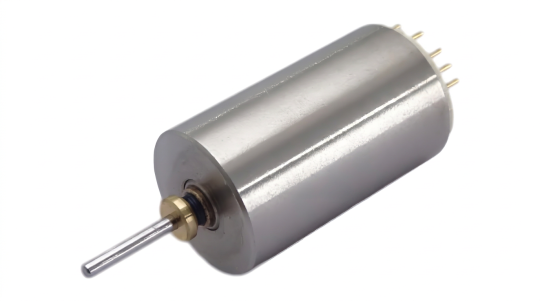
View list of brushless motor products
To ensure stable rotation of a Brushless motor, it is essential to accurately determine the position of the rotor. Brushless motors do not use brushes or commutators; instead, the driver electronically switches the timing of the flow of electric current.
Failure to accurately determine the rotor position can lead to reduced torque or startup failures. Methods for determining rotor position include direct detection using Hall sensors or encoders, as well as sensorless control, which estimates the position based on information such as voltage and electric current.
Note that there are several types of position sensors, and a motor equipped with a sensor does not necessarily mean it is equipped with encoders. When selecting a control method, it is important to consider not only the accuracy of position and speed but also to balance these factors with startup conditions and cost.
Sensorless control estimates rotor position based on electrical data
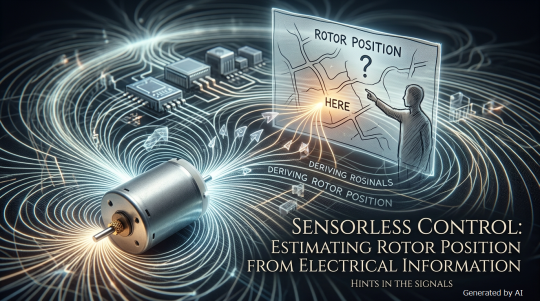
Sensorless control is a method that estimates rotor position based on the motor’s voltage and electric current, without using position sensors such as encoders. While this approach makes it easier to reduce the number of components and lower costs, control performance may be limited depending on rotational speed and load conditions.
Here, we explain the basic mechanism, advantages, and points to note regarding sensorless control.
Estimating Rotor Position Using Back-EMF
In sensorless control, the rotor position and rotational speed are estimated using back-EMF and other signals generated by the motor’s rotation. Back-EMF is a voltage generated as the motor rotates, acting in the opposite direction to the drive voltage.
A typical method is zero-crossing detection of back-EMF. This mechanism monitors the voltage of the phase that is not energized and estimates the rotor position based on the timing at which it crosses a reference voltage.
Based on the estimation results, the system switches which phase is energized and when, thereby maintaining rotation. There are also methods that estimate position by processing voltage and electric current data, allowing selection based on the required control performance.
Sensorless control makes it easier to reduce the number of components and lower costs
A major advantage of sensorless control is that it makes it easy to reduce the number of components and hardware costs by eliminating the need for position sensors. There is no need to install encoders or Hall sensors, and wiring, connectors, and mounting parts for position sensors can also be reduced.
Since it requires less mounting space, it is advantageous for making equipment more compact and lightweight. Furthermore, reducing the number of sensors and wires minimizes physical failure factors such as broken wires and poor contacts.
This advantage of simplifying the configuration is particularly evident in continuous rotation applications—such as fans, pumps, and blowers—that do not require high-precision positioning.
Position Estimation Becomes Difficult at Low Speeds and During Startup
In sensorless control that utilizes back-EMF, it is important to note that estimating the rotor position becomes difficult during low-speed operation and startup. Since back-EMF is generated by the motor’s rotation, it generally cannot be detected when the motor is at a standstill.
Therefore, startup control—such as energizing the motor in a specific sequence to rotate the rotor—is necessary during startup. Additionally, at low speeds, the back-EMF decreases, and the accuracy of position estimation may be compromised by electrical noise or load fluctuations.
For applications requiring startup under heavy loads, stable low-speed operation, or precise positioning, it is important to consider options that include motors equipped with encoders.
Motors with encoders detect and perform motor control for position and speed

Motors equipped with encoders are characterized by their ability to detect rotational position and speed and utilize that information for control. Since they allow for control while monitoring the actual operating conditions, they are well-suited for applications requiring precise positioning and stable low-speed operation.
Here, we explain how encoders work, their benefits, and the challenges to consider when implementing them.
Detecting Rotational Position with Encoders and Utilizing It for Speed Control
Motors with encoders detect the rotational position and amount of rotation of the motor shaft, and this information can also be used to determine rotational speed and direction. The detected information is sent to the driver or controller and used in feedback control to correct deviations from the target value.
There are two types of encoders: the incremental type, which outputs the amount of rotation as pulse signals, and the absolute type, which can detect absolute positions. The incremental type is suitable for speed control and managing displacement, while the absolute type is ideal for applications where you want to simplify position management after a power cycle or simplify homing.
It is important to select the appropriate type based on the required positional accuracy and whether homing is necessary.
Suitable for low-speed control and high-precision positioning
Motors equipped with encoders are well-suited for stable low-speed operation and high-precision positioning. Since position information can be obtained even at low rotational speeds, control can be adjusted according to the actual operating conditions.
For example, precision transport equipment and robots require accurate movement to target positions and suppression of speed fluctuations. Using feedback control via encoders makes it easier to apply corrections in response to load variations and acceleration/deceleration.
Furthermore, since position information can be monitored, this technology is effective for detecting operational abnormalities. It is also a strong choice for applications requiring high precision and operational repeatability, such as medical equipment and analytical instruments.
Tends to Increase the Number of Components and Cost
While encoder-equipped motors are well-suited for high-precision control, it is important to note that they tend to increase the number of components and costs compared to sensorless control. In addition to the encoder unit itself, signal cables, connectors, and corresponding control circuits are required, which also increases the installation space and wiring work.
Furthermore, factors such as broken wires, poor contacts, and false detections caused by electrical noise must be taken into account. Selecting an encoder with higher resolution than necessary may lead to increased costs and over-specified performance.
It is important to assess stopping accuracy, speed accuracy, the operating environment, and whether home position return is required, and then select specifications that meet the necessary performance requirements.
Comparing Sensorless Control and Motors with Encoders
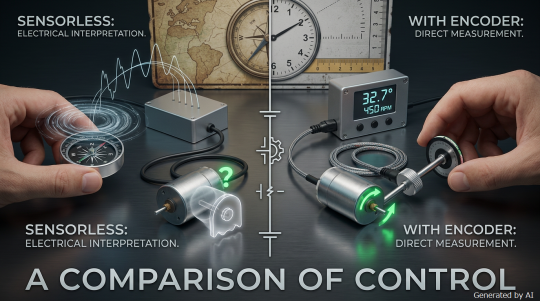
Sensorless control and motors with encoders differ in terms of control accuracy, starting performance, cost, and other factors. Since the suitability of each depends on the application and required performance of the equipment, it is important to understand the characteristics of each.
The table below summarizes the main differences between the two methods.
| Comparison Criteria | Sensorless Control | Motors with Encoders |
| Control Accuracy | Susceptible to operating conditions | Suitable for high-precision control |
| Low-speed and starting performance | Limitations on location estimation | Location data is easily accessible |
| positioning | Generally unsuitable | Suitable for precise positioning |
| Cost and number of components | Easy to keep low | Tends to increase |
| Miniaturization and Wiring | Easy to miniaturize and requires less wiring | Sensors and signal wiring are required |
| Main Applications | Fans, Pumps, Blowers | Robots, medical equipment, precision equipment |
*These are general trends; actual performance varies depending on the control method and product specifications.
If precision and low-speed performance are priorities, motors with encoders are recommended; if cost and simplified design are priorities, sensorless control is a strong option. Furthermore, reliability must be evaluated separately in terms of the risk of failure due to the number of components and the reliability of the control system.
Below, we explain the differences between the two methods in detail from the perspectives of control performance, cost, and reliability.
Motors with Encoders Are Advantageous for High-Precision Positioning and Low-Speed Control
Motors with encoders are advantageous when high-precision positioning or stable low-speed operation is required. Since they can detect rotational position and acquire speed information, it is easier to perform corrections in response to load fluctuations and achieve precise speed control.
In sensorless control, which utilizes back-EMF, a key challenge is that position information cannot be obtained from the back-EMF when the motor is stopped, and estimation accuracy tends to decline even at low speeds. However, even with motors equipped with encoders, the position information available at startup varies depending on the detection method.
In particular, when it is necessary to determine the absolute position from the moment of startup, it is important to consider adopting an absolute type encoder and select a method suitable for the operating speed range and startup conditions.
Sensorless Control Offers Advantages in Cost, Number of Components, and Failure Causes
Sensorless control offers advantages when aiming to minimize cost, the number of components, and physical failure factors. Since position sensors, signal wiring, and connectors can be omitted, this leads to a simpler configuration and a more compact design.
Motors equipped with encoders require additional wiring and connection components, which increases the number of design verification items, such as measures against wire breaks, poor contacts, and electrical noise. However, a lower number of components does not necessarily guarantee higher reliability.
Motors with encoders offer the advantage of detecting actual position and speed to monitor the control status. It is important to distinguish between the risk of physical failure and the reliability of control, and to evaluate them according to the specific application.
Selecting the Appropriate Control Method Based on Application and Performance Requirements

When selecting a motor control method, it is important to make a decision based on the equipment’s application and operating conditions. The appropriate method differs between applications centered on continuous rotation and those requiring high-precision positioning or low-speed operation.
Here, we explain how to select a control method by categorizing applications into three groups: fans and pumps, medical equipment and precision equipment, and low-speed, high-load starts.
Sensorless Control for Continuous Rotation Applications Such as Fans and Pumps
Sensorless control is suitable for applications such as fans, pumps, and blowers that rotate continuously at or above a certain speed. This is because, when high-precision positioning or extremely low-speed operation is not required, it is easier to take advantage of the benefit of being able to omit position sensors.
Since it eliminates the need for the sensor unit, wiring, and connectors, it also contributes to smaller, more cost-effective equipment. It is a particularly strong option for equipment where the motor must be installed in a limited space.
However, caution is required in applications with high startup loads or sudden load fluctuations. Be sure to verify that the system can start up and rotate stably based on actual operating conditions.
Choose Motors with Encoders for High-Precision Applications Such as Medical Equipment and Precision Equipment
Motors with encoders are suitable for applications that require high-precision positioning and repeatable motion, such as medical equipment, precision equipment, and robots. Since the encoder detects rotational position and speed and corrects deviations from target values, these motors are advantageous for fine positioning and stable low-speed operation.
For example, analytical instruments and precision conveyance systems require the ability to repeatedly stop at the same position and minimize speed fluctuations. However, even for medical equipment and precision equipment, encoders are not always necessary.
It is important to clearly define stopping accuracy, speed accuracy, and the operating environment, and then select a system that meets the required performance specifications.
Prioritize Start-up Conditions When Low-Speed Operation or High-Load Start-ups Are Required
When low-speed operation or startup under heavy loads is required, it is essential to prioritize the method of detecting the rotor position and the starting performance. In sensorless control that utilizes back-EMF, back-EMF cannot be detected while the motor is stopped; therefore, startup control—such as energizing the motor in a predetermined sequence—is necessary.
Furthermore, position estimation tends to become unstable at low speeds, and depending on load conditions, this may lead to startup failures. Motors equipped with encoders are a strong option because they allow position information to be utilized for control.
However, starting performance varies depending on the type of encoders and the driver’s control method. Be sure to evaluate the system, taking into account the required torque, starting time, and load conditions.
Organize the Required Specifications Before Selecting a Control Method
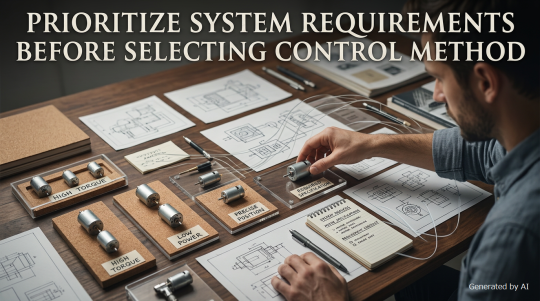
Before deciding whether to use sensorless control or a motor with encoders, it is important to clarify the equipment’s requirements. The main items to verify are as follows:
| Items to Verify | Main Considerations |
| Control Accuracy | Positioning accuracy, speed accuracy, stopping accuracy |
| Operating Condition | Minimum and maximum rotational speeds, load at startup, required torque |
| Load Characteristics | Load fluctuations, acceleration and deceleration times, load moment of inertia |
| Installation conditions | Operating Environment, Installation Space, Wiring Constraints |
| Cost | Initial costs for motors, drivers, etc. |
If continuous rotation is the primary requirement, sensorless control is a good option; if high-precision positioning or low-speed operation is required, a motor with encoders would be a suitable candidate. However, the decision cannot be based solely on the performance of the motor itself. An evaluation that includes the driver, control method, and load conditions is necessary.
If multiple requirements overlap, seeking technical advice from the manufacturer can be helpful. By sharing the required performance and operating conditions, it becomes easier to avoid overspecification or underperformance.
Summary
Since sensorless control eliminates the need for position sensors, it makes it easier to reduce the number of components and lower costs, making it well-suited for continuous-rotation applications such as fans and pumps. Motors with encoders can detect position and speed, making them a strong choice for applications requiring high-precision positioning and stable low-speed operation.
When selecting a control method, it is essential to consider not only accuracy, starting performance, and cost, but also the risk of failure due to component configuration and the reliability of the control system. Organize the equipment’s required specifications and make a comprehensive decision that includes the motor and driver.
At C.I. Takiron Corporation, we offer consultation services to help you with motor selection based on your specific applications and performance requirements. If you have any questions regarding control methods or motor specifications, please feel free to contact us.
Product Information & Inquiries
For more details on C.I. Takiron’s micro motor products, please visit the website below.
- Product Site: https://cik-ele.com/en/
- Coreless Motors: https://cik-ele.com/en/products/list/coreless_motor/
- Brushless Motors: https://cik-ele.com/en/products/list/brushless_motor/
- Geared Motors: https://cik-ele.com/en/products/list/gearhead/
- Encoders: https://cik-ele.com/en/products/list/encoder/
If you are having trouble selecting a small motor for your product development, please feel free to contact us via the inquiry form. Our technical staff will discuss your application and requirements with you and propose the optimal solution.
- Inquiries: https://cik-ele.com/en/contact/