



A motor’s power consumption affects not only electricity costs but also the heat generation by the equipment and battery runtime. However, many people likely wonder, “How is it calculated?” or “Why does power consumption vary even among motors with the same output?”
In reality, power consumption varies depending on various factors, including voltage, electric current, load, motor efficiency, and operating conditions. In this article, we’ll explain the factors that determine a motor’s power consumption, how to calculate it, and energy saving measures, as well as how to approach power consumption for power tools and key points for motor selection.
| Supervised by: C.I. TAKIRON Corporation Electronic Devices Sales Group This article has been supervised based on the advanced technical expertise and insights we have cultivated since our founding in 1919 as a leading company in plastic processing. Our department continuously analyzes market trends and the latest technologies in ultra-compact, high-precision micro motors, focusing on providing high-value-added information to designers and developers. As a team of experts with in-depth knowledge of product characteristics, we support our customers’ problem-solving and technological innovation by delivering accurate and practical content. 。 |
What Is Motor Power Consumption?
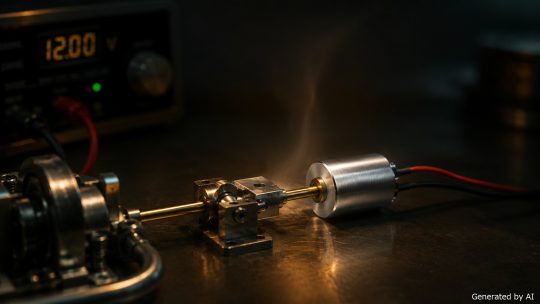
To accurately understand a motor’s power consumption, it is important to grasp the difference between the power supplied by the power source and the output actually used as motive power. Motor efficiency influences the relationship between these two, and even with the same output, the required power consumption varies depending on efficiency.
First, we will explain the basic concept of power consumption and its relationship to output and motor efficiency.
What Is Power Consumption?
A motor’s power consumption refers to the electrical power supplied from the power source to drive the motor. Not all of the supplied power is converted into mechanical power; some is lost as heat or noise due to electrical resistance within the motor, magnetic changes, friction, and other factors.
Power consumption is influenced not only by voltage and electric current but also, in the case of AC motors, by factors such as power factor. Furthermore, since the electric current varies depending on the load during actual operation, power consumption is not necessarily constant.
When determining actual power consumption, it is important to check not only the rated values but also the electric current and load during operation. We will explain the detailed calculation methods later.
The Difference Between Output and Power Consumption
A motor’s output and power consumption are not the same. The main differences between the two are as follows.
| Item | Output | Power Consumption |
| Meaning | The power transmitted by the motor to an external load | Electric power supplied from the power source to drive the motor |
| Common Notations | Rated Output [W] [kW] | Power Consumption [W] [kW] |
| Relationship to Motor Efficiency | The higher the efficiency, the greater the output obtained relative to the supplied power | The higher the efficiency, the easier it is to minimize the power required to produce the same output |
Not all of the supplied power is converted into output; some is lost within the motor as heat or other forms of energy. Therefore, power consumption is generally greater than output.
Motor efficiency determines the relationship between these two values. The more efficient the motor, the fewer the losses, and the same output can be achieved with less power consumption.
Main Factors Determining Motor Power Consumption
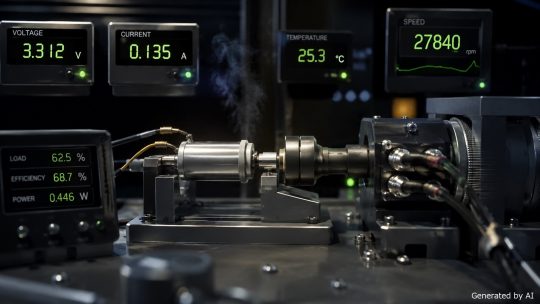
A motor’s power consumption is not constant; it varies depending on the load and operating conditions. For appropriate motor selection and minimization of unnecessary power consumption, it is important to understand the factors that influence power consumption.
Here, we will explain the four main factors.
Voltage and Electric Current
A motor’s power consumption varies significantly depending on voltage and electric current. For DC motors, power consumption is determined by the relationship between voltage and electric current, while for AC motors, it is determined by the relationship between voltage, electric current, and power factor. In either case, care must be taken to avoid operating outside the rated range.
If you attempt to maintain the required torque or output while the voltage is lower than the rated value, the electric current may increase depending on the operating conditions and control method, which can lead to greater losses due to electrical resistance and increased heat generation. Conversely, if the voltage is too high, internal losses and heat generation within the motor will increase, potentially leading to reduced efficiency or failure.
To ensure stable operation and energy saving, it is important to adhere to the voltage range specified for the motor.
Load Size
As a general rule, a motor’s power consumption increases as the load increases. As the load increases, the required torque increases, causing more electric current to flow, which in turn increases power consumption.
On the other hand, selecting a motor that is larger than necessary and operating it under a light load does not necessarily result in energy saving. Motors have a specific load range within which they operate most efficiently, and efficiency may decrease under light or excessive loads.
To minimize unnecessary power consumption, it is important to select a motor with a capacity that matches the actual load.
Motor Efficiency
The higher the motor efficiency, the less power is consumed to produce the same output. Motor efficiency refers to the percentage of power supplied by the power source that is actually utilized as mechanical power.
In motors with an iron core (cored type), losses occur inside the motor due to copper losses caused by electrical resistance, iron losses caused by magnetic fluctuations, and mechanical losses caused by friction in bearings and other components. The greater the losses, the more power is converted into heat and other forms of energy, resulting in lower efficiency.
To minimize power consumption, it is important to select a motor that operates efficiently under actual load conditions, rather than relying solely on its rated efficiency.
Speed and Operating Conditions
A motor’s power consumption also varies depending on operating conditions such as speed, operating time, and ambient temperature. Care must be taken when operating at speeds higher than necessary for the load, as this can lead to excessive power consumption.
Particularly with pumps and fans, significant energy saving can be achieved by adjusting the speed using an inverter. In addition, prolonged continuous operation, frequent starts and stops, and high-temperature environments can all affect efficiency and heat generation.
Adjusting the speed and operating time to match the load and using the motor in an appropriate environment will lead to energy saving.
How to Calculate a Motor’s Power Consumption
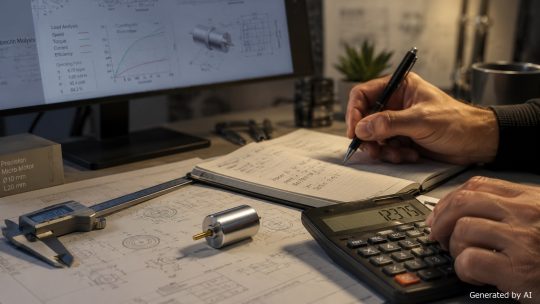
A motor’s power consumption can be calculated based on values such as voltage, electric current, and power factor, depending on the motor type. Furthermore, by calculating the amount of electricity consumed based on power consumption, it is possible to estimate monthly or annual electricity bills.
Here, we explain the basic calculation formula and how to estimate electricity costs.
Basic Formula for Power Consumption
A motor’s power consumption can be calculated using values such as voltage and electric current, depending on the type of motor. For DC motors, voltage and electric current are used, while for AC motors, it is calculated using voltage, electric current, and power factor. The power factor is a numerical value that indicates the ratio of active power actually consumed to apparent power in an AC circuit.
The basic calculation formulas for each type of motor are as follows.
- DC motors: Power Consumption [W] = Voltage [V] × Electric Current [A]
- Single-phase AC motor: Power consumption [W] = Voltage [V] × Electric current [A] × Power factor
- Three-phase AC motor: Power consumption [W] = √3 × Voltage [V] × Electric current [A] × Power factor
To convert W to kW, divide the calculated value by 1,000.
If you know the rated output and motor efficiency, you can also calculate the input power using the following formula:
- Input Power [kW] = Rated Output [kW] ÷ (Efficiency [%] ÷ 100)
It is important to choose the appropriate calculation method depending on your purpose.
How to Estimate Electricity Costs
You can estimate the electricity cost for a motor by multiplying the power consumption by the operating time and the electricity rate. The basic formula is as follows:
- Electricity cost per hour [yen] = Power consumption [kW] × Electricity rate [yen/kWh]
- Monthly electricity cost [yen] = Electricity cost per hour × Operating hours per day × Number of operating days per month
If a motor with a power consumption of 1 kW operates for 8 hours a day, 20 days a month, the monthly electricity consumption is 160 kWh. Assuming an electricity rate of 31 yen/kWh, the estimated monthly electricity cost is approximately 4,960 yen (160 kWh × 31 yen).
To determine the actual electricity cost more accurately, consider not only the contracted electricity rate but also fluctuations in the load factor and actual measured power consumption.
Ways to Reduce Motor Power Consumption
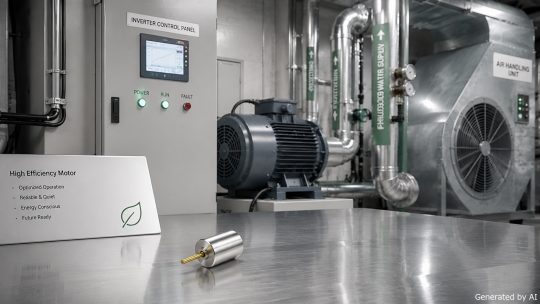
To achieve energy saving in motor operation, it is important not only to install products of high efficiency but also to select models suited to the specific application and load. Furthermore, reviewing the load, operating conditions, and control methods can help reduce unnecessary power consumption.
Here, we explain typical methods for reducing motor power consumption.
Motor Selection for the Application
To reduce power consumption, it is important to select a motor with an output suitable for the application. If you choose a motor that is larger than necessary in an effort to provide a margin of safety, operation under light loads will increase, which may actually reduce efficiency.
When selecting a motor, determine the required torque, speed, and actual load, and consider the appropriate power rating. Checking the efficiency curve—which shows how efficiency varies with load—will also make it easier to choose a model suited to your actual operating conditions.
Avoiding excessive performance leads to a reduction in unnecessary power consumption.
Adopting High-Efficiency Motors
Adopting motors of high efficiency is also an effective way to reduce power consumption. Inside a motor, losses occur due to electrical resistance, magnetic fluctuations, friction, and other factors, causing some of the electrical power to be lost as heat.
High-efficiency motors are designed to reduce internal losses, allowing them to deliver the same output with less power. For industrial motors, efficiency classes such as IE3 and IE4 are defined by international standards.
The longer a piece of equipment operates, the easier it is to achieve energy saving and reduce electricity costs.
Reviewing Loads and Operating Conditions
In some cases, power consumption can be reduced simply by reviewing the load and operating conditions, without replacing the motor. This is because excessive loads and prolonged idling lead to wasted power consumption.
For example, with pumps and blowers, the load can be reduced by adjusting excessive flow rates or airflow. Methods such as shutting them down during periods of non-use or managing operating times with timers are also effective.
Verifying actual loads and operating conditions and ensuring the equipment operates at the necessary output only when needed leads to energy saving.
Optimize Control Methods
In applications with significant load fluctuations, optimizing control methods is an effective way for energy saving. Operating at a constant speed at all times may result in unnecessary power consumption even when the load is low.
By using inverters or motor drivers, you can adjust the motor’s speed according to the load. For equipment such as pumps and fans, where the required output varies depending on operating conditions, reducing the speed can sometimes yield significant energy savings.
It is important to review not only the efficiency of the motor itself but also the motor control methods.
Considerations for Motor Power Consumption in Power Tools
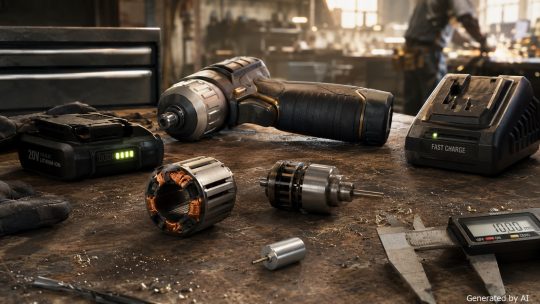
In power tool applications, motor power consumption affects not only battery runtime but also heat generation and work efficiency. Particularly for cordless tools and portable devices, it is crucial to select a motor that can deliver the required performance within limited power constraints.
Here, we explain power consumption from a perspective unique to power tool applications.
Power Consumption Determines Runtime in Cordless Tools
In cordless tools, the motor’s power consumption determines the battery’s runtime. Even when using batteries of the same capacity, tools with higher power consumption will have shorter runtime.
Furthermore, when high torque is required for tasks such as drilling or tightening, the electric current flowing through the motor increases, which tends to drain the battery more quickly. It is important to select a combination of motor and battery that suits the application, taking into account the torque and speed required of the tool, as well as the expected work time.
Making the right selection ensures you can continue working smoothly.
It also affects heat generation and work efficiency
The motor’s power consumption also affects the tool’s heat generation and work efficiency. Part of the supplied power is converted into heat due to electrical resistance and friction within the motor.
Prolonged use under high loads causes the motor temperature to rise, which may result in reduced output or a shutdown triggered by protective mechanisms. To prevent overheating, it is important to select a motor suited to the operating conditions and to adhere to the recommended continuous operating time.
A high-efficiency motor with low power loss makes it easier to maintain stable performance while minimizing heat generation.
Using compact motors can sometimes lead to energy saving
Depending on the tool’s application, selecting a compact motor that matches the required performance can lead to energy saving. A motor with more power than necessary increases power consumption and weight, which can compromise the overall usability of the tool.
For cordless tools and portable devices, it is important to select a compact, high-efficiency motor that delivers the necessary torque and speed. Using Brushless motors, for example, makes it easier to minimize losses and heat generation, and can also extend battery runtime.
Selecting compact motors that are appropriately sized for the application helps achieve both energy saving and improved usability.
Key Points for Energy Saving Motor Selection

To achieve energy saving, it is important to consider not only power consumption figures but also the balance with the performance required for the application. It is necessary to comprehensively evaluate multiple factors, such as torque, size, and efficiency.
Below, we explain the key points for motor selection that promotes energy saving.
Determine the Required Torque
When performing motor selection, it is important to accurately determine the torque required for the application. If you estimate a torque that is larger than necessary, the motor will be oversized, and efficiency may decrease due to operation under light loads.
Particularly with power tools and small devices, it is necessary to distinguish between the torque required during normal operation and the torque temporarily required during startup or under high loads. Do not base your decision solely on the maximum value; be sure to also consider the typical workload and operating time.
Selecting a motor based on the torque required for the actual application helps reduce unnecessary power consumption.
Check the Size and Installation Space
When performing motor selection, it is necessary to check the available mounting space and mounting dimensions inside the product in advance. Even a motor with high efficiency cannot be used if its size, shaft diameter, or other specifications do not match the product design.
For tools and small devices that must be installed in limited spaces, it is crucial to balance miniaturization with the required output. However, simply making the motor smaller is not the solution; heat generation and heat dissipation conditions must also be taken into account.
It is important to verify mounting dimensions, ambient temperature, and cooling methods to select a size that is suitable for the overall product design.
Balancing Efficiency and Power Consumption
When considering energy saving, it is important to verify not only low power consumption but also how efficiently the motor can deliver the required performance. Even if a motor has a high rated efficiency, it may not deliver sufficient performance under actual load conditions.
When comparing motors, check their efficiency and operating time under the anticipated load conditions. For tools and portable devices, weight, noise, vibration, and ease of control are also important selection criteria.
By comprehensively evaluating power consumption and required performance, it becomes easier to achieve both energy saving and ease of use.
Summary

A motor’s power consumption varies not only with voltage and electric current but also with load size, motor efficiency, rotational speed, and operating conditions. To minimize power consumption, it is important to understand how to calculate power consumption, select a motor suited to the application, and review the load and control methods.
In power tool applications in particular, power consumption affects battery runtime, heat generation, and work efficiency. Be sure to verify the balance between the required torque, size, and efficiency, and perform motor selection for the application.
Product Information & Inquiries
For more details on C.I. Takiron’s micro motor products, please visit the website below.
- Product Site: https://cik-ele.com/en/
- Coreless Motors: https://cik-ele.com/en/products/list/coreless_motor/
- Brushless Motors: https://cik-ele.com/en/products/list/brushless_motor/
- Geared Motors: https://cik-ele.com/en/products/list/gearhead/
- Encoders: https://cik-ele.com/en/products/list/encoder/
If you are having trouble selecting a small motor for your product development, please feel free to contact us via the inquiry form. Our technical staff will discuss your application and requirements with you and propose the optimal solution.
- Inquiries: https://cik-ele.com/en/contact/