


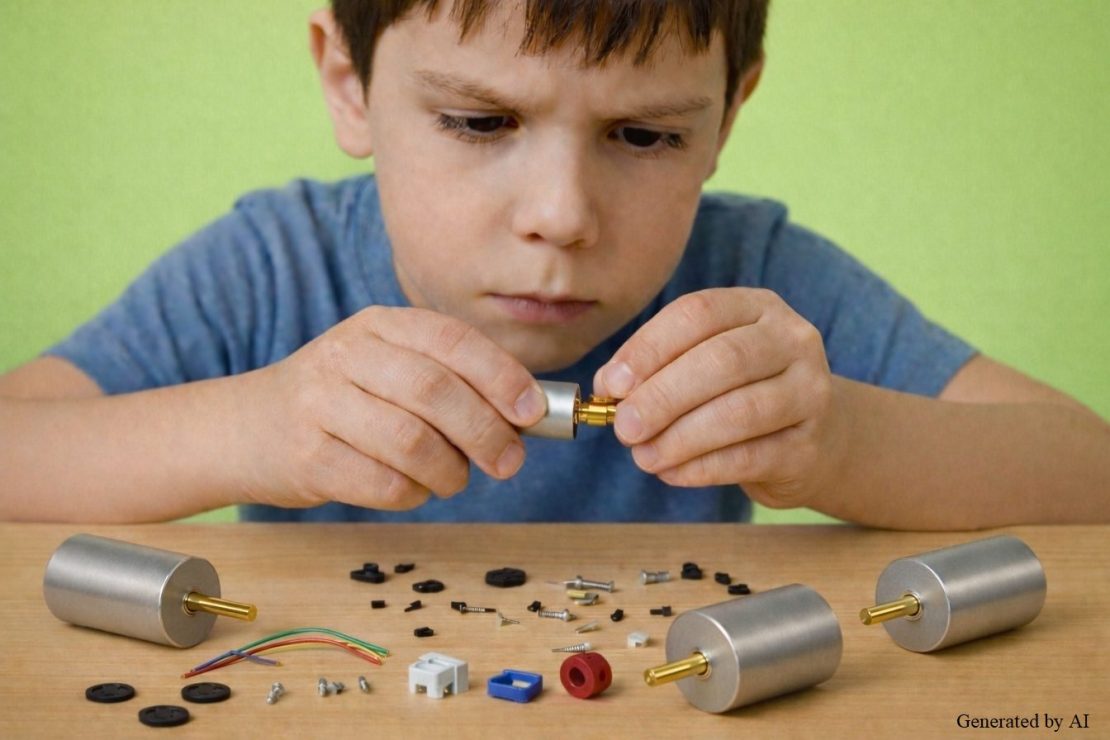
A motor is a device that converts electrical energy into rotational motion and is used in a wide range of fields, including medical equipment, optical devices, and industrial tools. When selecting a motor, understanding the basic operating principles provides the basis for determining which product is best suited for your application.
Since the structure and characteristics vary depending on the type—such as DC motors, brushless motors, and coreless motors—it is essential to understand the differences between them. This article explains the basic structure and rotational principles of motors, the characteristics of major motor types, and key selection criteria for industrial applications. We hope this serves as a reference for engineers responsible for motor selection in product development, providing a technically grounded basis for their decisions.
| Supervised by: C.I. TAKIRON Corporation Electronic Devices Sales Group This article has been supervised based on the advanced technical expertise and insights we have cultivated since our founding in 1919 as a leading company in plastic processing. Our department continuously analyzes market trends and the latest technologies in ultra-compact, high-precision micro motors, focusing on providing high-value-added information to designers and developers. As a team of experts with in-depth knowledge of product characteristics, we support our customers’ problem-solving and technological innovation by delivering accurate and practical content. |
目次:
Basic Motor Structure and Rotation Mechanism
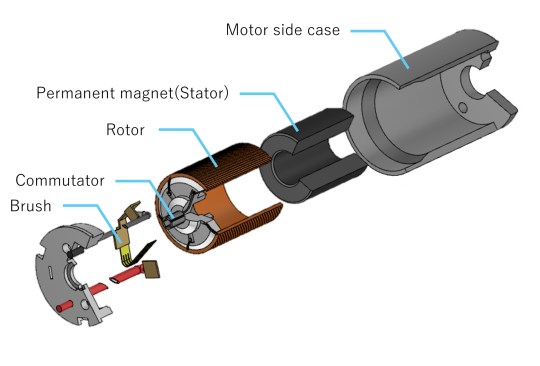
To understand how a motor rotates, it is necessary to grasp its components and the basic principles of electromagnetism.
Contents of this section
- Major Components of a Motor
- The Mechanism of Rotation Based on Electromagnetic Force (Lorentz Force)
- The Roles of the Commutator and Brushes
Here, using a DC motor as an example, we will explain the mechanism behind rotation step by step.
Major Components of a Brush-Type Motor
A motor operates through the combination of multiple components. The main components are as follows.
| Component Name | Role |
| Stator | The stationary part that does not rotate. It generates a magnetic field using permanent magnets. |
| Rotor | The rotating part. It contains windings that generate torque through interaction with the magnetic field |
| Windings (Coils) | Generates a magnetic field when current flows, producing rotational force |
| Permanent magnet | Located in the stator, it supplies a constant magnetic field |
| Commutator | Switches the direction of the current in the windings in response to rotation, enabling continuous rotation |
| Brushes | Sliding contacts that supply current from an external power source to the commutator |
These components work together to convert electrical energy into mechanical rotational motion.
Mechanism of Rotation Due to Electromagnetic Force (Lorentz Force)
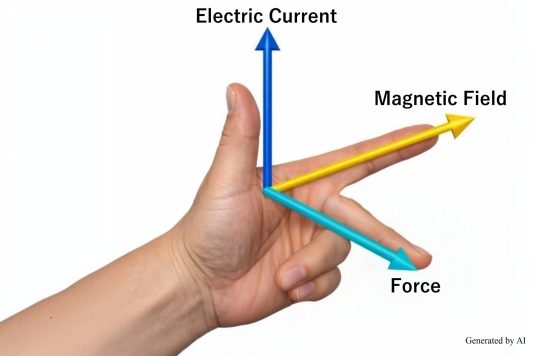
When current flows through a coil, a magnetic field is generated around it. This magnetic field interacts with the magnetic field of the permanent magnet, generating an electromagnetic force. According to Fleming’s left-hand rule, once the direction of the magnetic field and the direction of the current are determined, the direction of the force is uniquely defined.
Specifically, if you align your middle finger with the direction of the current and your index finger with the direction of the magnetic field, a force acts in the direction of your thumb. This force pushes the rotor, initiating rotational motion. The coil positioned between the north and south poles of the magnet receives a force in a specific direction every time current flows, leading to continuous rotation.
The Role of the Commutator and Brushes
When the rotor completes half a revolution, the relative positions of the coils reverse. If current continues to flow in the same direction, the direction of the force will also reverse, causing the rotation to stop. The commutator is the component that solves this problem.
The commutator consists of segmented metal pieces mounted on the rotation shaft, which automatically switches the direction of the current in sync with the rotor’s rotation. The brushes are contact points that remain in contact with the commutator from a fixed position, continuously supplying current from an external power source. Thanks to this mechanism, current always flows in the correct direction through the coils, allowing the motor to continue rotating in the same direction.
Differences in Motor Types and Operating Principles
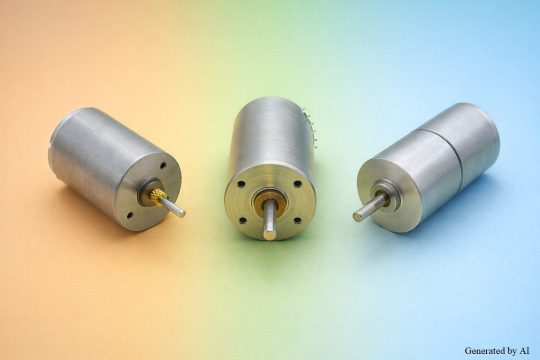
There are many types of motors used in industrial applications, but specific motor types are widely adopted in fields such as small precision equipment, medical devices, and optical equipment.
Topics Covered in This Section
- DC Coreless Motors
- Brushless Motors
- Geared Motors (Products with an integrated motor and gearhead)
Understand the operating principles and characteristics of each type to select the one best suited for your application.
DC Coreless Motors
Unlike conventional DC motors, coreless motors do not have an iron core (core) in the rotor. The coil is formed into a cylindrical or flat shape, and the coil itself functions as the rotor. Because there is no iron core, cogging (rotational irregularities) caused by magnetic resistance is virtually eliminated.
| Characteristics | Advantages of Coreless Motors |
| Smooth Rotation | Extremely low vibration and noise due to the absence of cogging |
| Responsiveness | Low moment of inertia for fast start-up and stop |
| Size | Compact design is possible by eliminating the iron core |
| Efficiency | No iron loss, resulting in high energy efficiency |
Suitable for applications requiring high precision and low vibration, such as endoscope drives in medical equipment and lens focus mechanisms in optical devices.
Brushless Motors
As the name suggests, a brushless motor has a structure without brushes or a commutator. In conventional DC motors, the switching of current was handled mechanically by brushes and a commutator, but in brushless motors, electronic circuits perform this function. Permanent magnets are arranged on the rotor, and the current flowing through the stator coils is switched via electronic control.
| Characteristics | Advantages of Brushless Motors |
| Lifespan | No brush wear, long service life, and maintenance-free |
| Quiet Operation | Quiet operation due to the absence of friction with brushes |
| Electrical Noise | No sparks from brush contact, resulting in low noise |
| Control | Electronic control enables precise control of rotational speed and position |
Widely used in applications requiring stable, long-term operation, such as industrial equipment and home appliances. Also suitable for use with noise-sensitive electronic devices.
Geared Motors (Products with an integrated motor and gearhead)
A geared motor is a product that combines a motor body with a gearhead (reduction gear). Even if a standalone motor has a high rotational speed and low torque, the gearhead can reduce the rotational speed and increase the torque.
The main advantages of geared motors are as follows.
[Features of Geared Motors]
- Achieves low-speed, high-torque output
- Eliminates the hassle of procuring the motor and gearhead separately
- Space-saving design for easy integration into equipment
- Torque characteristics can be adjusted by selecting the reduction ratio and efficiency
Ideal for applications requiring strong force at low speeds, such as industrial tools, security equipment, and material handling systems. Since the motor and gearhead are integrated, there is no need to consider combinations during the design phase, which helps shorten development time.
Key Considerations for Motor Selection in Industrial Applications
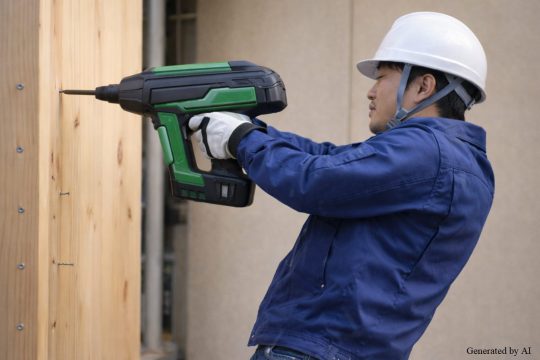
When selecting a motor, it is necessary to clearly define the performance requirements for each specific application.
Topics covered in this section
- Requirements for Motors in Medical and Optical Equipment
- Requirements for Motors in Industrial and Security Equipment
- Why C.I. Takiron’s Micro Motors Are Chosen
Understand the characteristics required in each field and select the optimal motor for your product development.
Requirements for Motors Used in Medical and Optical Equipment
In medical and optical equipment, control precision and stability determine product performance. In the camera drive unit of an endoscope, even slight vibrations can cause image blur. Autofocus mechanisms also require the ability to move the lens quickly and accurately.
| Required Characteristics | Specific Requirements |
| Smooth Rotation | Cogging-free operation to minimize vibration and noise |
| Responsiveness | Ensure positioning accuracy with fast start-up and stop |
| Compact | Designed to fit within the limited space inside equipment |
| Reliability | Long-term stable operation and quality control system |
Coreless motors are widely adopted to meet these requirements. Their core-less structure allows them to achieve both smooth rotation and high-speed response.
Requirements for Motors in Industrial and Security Equipment
Industrial tools and security equipment require different characteristics than medical and optical devices. Electric screwdrivers and nail guns require high torque despite their compact size. Electronic locks and smart locks require long-term operation on battery power.
The characteristics required for industrial tools are as follows.
[Requirements for Motors in Industrial Tools]
- Balancing High Torque Output and Compact Size
- Durability against drops and impacts
- High-efficiency design to minimize battery consumption
On the other hand, security equipment prioritizes low-voltage startup and power efficiency. A motor that starts reliably even at low voltages of around 1.0V can continue operating even when the battery is nearly depleted. By selecting a geared motor appropriate for the application, low-speed, high-torque output can also be achieved.
Why C.I. Takiron’s Micro Motors Are Chosen
C.I. Takiron offers a wide range of products, including coreless motors, brushless motors, and geared motors. We are chosen for our technical superiority and flexible responsiveness.
Our coreless motors feature smooth, cogging-free rotation and high-speed response due to low inertia, meeting the precision requirements of medical and optical equipment manufacturers. Another strength is their high reliability, achieved through in-house design and quality control.
We provide samples starting from the prototyping stage and offer customization tailored to specific applications. Our willingness to consult with customers even before specifications are finalized is highly valued by many engineers.
Summary
A motor is a device that converts electrical energy into rotational motion based on the principle of electromagnetic induction. Components such as the stator, rotor, coils, and permanent magnets work together, and electromagnetic forces based on Fleming’s left-hand rule generate rotation.
Coreless motors achieve smooth, cogging-free rotation and are suitable for medical and optical equipment. Brushless motors offer a long service life and are maintenance-free, while geared motors are ideal for industrial equipment requiring low-speed, high-torque operation.
When selecting a motor, it is essential to clearly define requirements such as torque, responsiveness, vibration levels, and power consumption, and choose a product suited to the application. In the precision equipment sector, selection based on technical grounds determines product performance.
Product Information & Inquiries
For more details on C.I. Takiron’s micro motor products, please visit the website below.
- Product Site: https://cik-ele.com/en/
- Coreless Motors: https://cik-ele.com/en/products/list/coreless_motor/
- Brushless Motors: https://cik-ele.com/en/products/list/brushless_motor/
- Geared Motors: https://cik-ele.com/en/products/list/gearhead/
- Encoders: https://cik-ele.com/en/products/list/encoder/
If you are having trouble selecting a small motor for your product development, please feel free to contact us via the inquiry form. Our technical staff will discuss your application and requirements with you and propose the optimal solution.
- Inquiries: https://cik-ele.com/en/contact/