


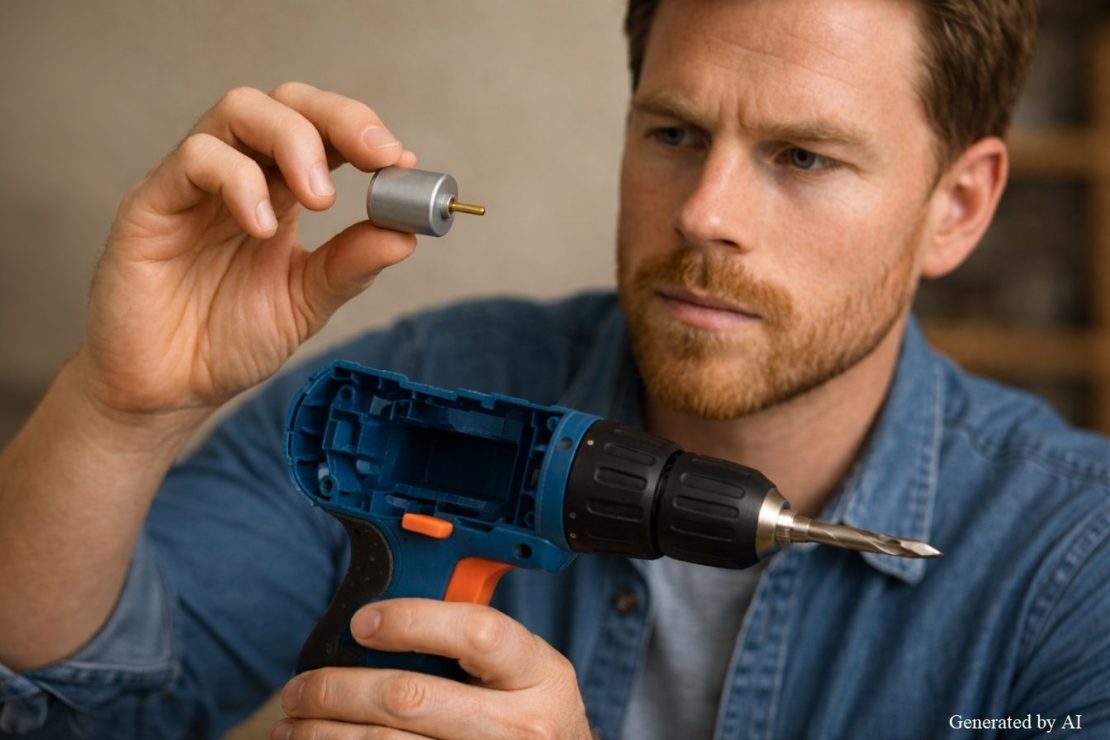
Electric motors are an indispensable power source in our daily lives and industrial activities. They are utilized across a wide range of fields, from home appliances to industrial machinery, medical equipment, and precision instruments. However, few people may have a systematic understanding of how electric motors work or the different types available.
In this article, we provide an easy-to-understand explanation for engineers covering the basic mechanisms, operating principles, historical development, and major types of electric motors. For those considering motor selection in product development, this content serves as a first step toward organizing foundational knowledge and selecting the optimal product.
| Supervised by: C.I. TAKIRON Corporation Electronic Devices Sales Group This article has been supervised based on the advanced technical expertise and insights we have cultivated since our founding in 1919 as a leading company in plastic processing. Our department continuously analyzes market trends and the latest technologies in ultra-compact, high-precision micro motors, focusing on providing high-value-added information to designers and developers. As a team of experts with in-depth knowledge of product characteristics, we support our customers’ problem-solving and technological innovation by delivering accurate and practical content. |
目次:
Basic Mechanism and Operating Principles of Electric Motors
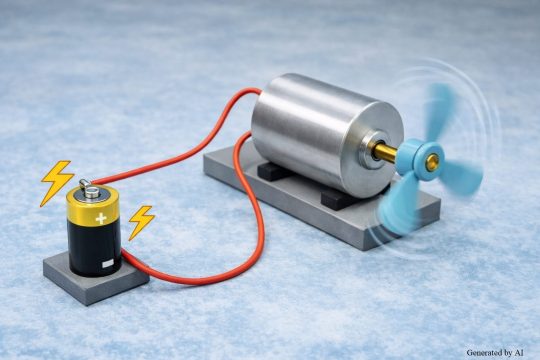
An electric motor is a device that converts electrical energy into mechanical rotational motion, and its operating principles are deeply rooted in the laws of physics. When selecting a motor for industrial applications, a correct understanding of these operating principles is essential.
By understanding how electric motors convert electricity into force, as well as their basic structure and operating mechanisms, you will be able to select the most appropriate motor for your product development.
Topics Covered in This Section
- What Is an Electric Motor?
- Basic Structure of Electric Motors
- The Rotation Principle of Electric Motors
Understanding this foundational knowledge provides the basis for making optimal motor selection decisions in product development.
What Is an Electric Motor?
An electric motor is a general term for a device that converts electrical energy into mechanical energy. Known as a “electric motor” in Japanese, it generates rotational motion by utilizing the interaction between a magnetic field and an electric current.
According to various studies, motor drive systems account for approximately 50% of global electricity consumption. As a critical component supporting modern society, they are utilized in every field, from household appliances to industrial machinery, medical equipment, and precision instruments. They come in a wide range of sizes, from micro-motors measuring just a few millimeters to large industrial motors spanning several meters and can handle power outputs ranging from a few milliwatts to several megawatts. In product development, selecting the right motor for the application determines the overall performance of the equipment.
Basic Structure of Electric Motors
Electric motors are primarily composed of two main components. (The roles of some motor parts differ from those described below.)
| Component Name | Role and Characteristics |
| Stator (Stator) | The stationary part that does not rotate. It generates a magnetic field and consists of permanent magnets or coils (electromagnets). |
| Rotor (Rotor) | The part that rotates within the magnetic field. It is wound with coils, and a magnetic field is generated when an electric current is passed through them. |
There is a small gap called the “air gap” between the stator and the rotor, and magnetic force is transmitted through this gap. Although the structure of the stator and rotor differs depending on the type of motor, the basic principle of generating rotational force through the interaction of magnetic fields remains the same.
The Principle of Rotation in Electric Motors
An electric motor rotates by utilizing the Lorentz force generated when an electric current flows through a conductor (coil) placed within a magnetic field. When the magnetic field and the electric current are perpendicular to each other, a force is generated in a direction perpendicular to both. The direction of this force is determined by Fleming’s left-hand rule. This force is used to generate torque on the rotor, enabling continuous rotation.
In the case of brushed motors, the commutator and brushes work together to switch the direction of the current at the appropriate timing, enabling the rotor to continue rotating in a single direction. The rotor’s rotational speed can be controlled by adjusting the supplied voltage and current.
Furthermore, the magnitude of the generated torque (rotational force) varies depending on the number of turns in the coils attached to the rotor and the strength of the magnets. By optimizing these factors, it is possible to design motors with performance tailored to specific applications.
History and Development of Electric Motors
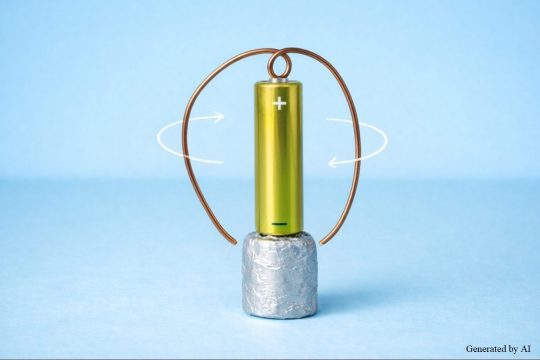
The history of electric motors dates back to the early 19th century, and they have evolved through continuous technological innovation from the era of the Industrial Revolution to the present day. Motor technology, which was researched as a new power source to replace the steam engine, was put into practical use thanks to the efforts of many inventors and researchers.
Continuous improvements have been made since then, leading to the high-performance motors of today. Understanding this historical progression clarifies the challenges that modern motor technology has addressed.
Topics Covered in This Section
- The Dawn of Electric Motors (1820s–1880s)
- The Path to Practical Application (1880s–Early 1900s)
- Evolution into Modern Motor Technology
Motor technology, which was researched as a new power source to replace the steam engine, was put into practical use through the efforts of many inventors and researchers and has evolved into today’s high-performance motors.
The Dawn of the Electric Motor (1820s–1880s)
In 1821, British scientist Michael Faraday discovered the basic principles of motors and generators. Faraday observed the phenomenon of a conductor carrying an electric current moving within a magnetic field, thereby demonstrating the principle of electromagnetic rotation.In 1831, he discovered the law of electromagnetic induction, which became the foundation for later motor development. This law explains the phenomenon whereby a changing magnetic field generates an electric current, and it is the fundamental principle applied to both generators and motors.
In 1834, Thomas Davenport of the United States built a battery-powered direct current motor, taking the first step toward practical motors. Davenport succeeded in powering a printing press using a small electric motor, demonstrating the potential of electric power to the world.
This period was a crucial era in which the relationship between electricity and magnetism was scientifically elucidated and the foundations of motor technology were established.
The Road to Practical Application (1880s–Early 1900s)
In 1888, Nikola Tesla invented the two-phase AC induction motor, ushering in the era of practical motors. Following the controversy between Tesla and Thomas Edison known as the “War of Currents,” AC power transmission systems became the mainstream.
Although Edison advocated for direct current (DC), the alternating current (AC) system offered a decisive advantage for long-distance power transmission because it allowed voltage to be freely adjusted using transformers. The AC system was well-suited for long-distance transmission, serving as a catalyst for the rapid expansion of industrial motor applications.
At the 1893 Chicago World’s Fair, the AC power transmission system was adopted, and its superiority was widely recognized. AC motors played a vital role as the power source for lighting and exhibition equipment within the venue, impressing visitors with the future of electrical technology.
From this point onward, the use of motors in industrial sectors such as factories and transportation began in earnest, accelerating the transition to an electrified society.
Evolution to Modern Motor Technology
Entering the 20th century, motor technology became increasingly diverse and high-performance. Advances in materials science and electronics significantly drove improvements in motor performance. The main directions of technological innovation are as follows.
[Key Points in the Evolution of Modern Motor Technology]
- The emergence of powerful permanent magnets (such as neodymium magnets)
- Achievement of compact and high-efficiency designs
- Development of application-specific motors
- Integration with electronic control technology
In particular, the advent of powerful permanent magnets, such as neodymium magnets, has made it possible to develop motors that are compact yet capable of high output. Neodymium magnets, invented and put into practical use in the 1980s, possess approximately 10 times the magnetic force (energy product) compared to conventional ferrite magnets, revolutionizing the miniaturization of motors.
In recent years, specialized motors tailored to specific applications—such as coreless motors and brushless motors—have been successively put into practical use, expanding their scope of application in the fields of medical equipment and precision instruments. Combined with advances in semiconductor technology, it has also become possible to achieve more precise and efficient motor control.
Main Types and Characteristics of Electric Motors
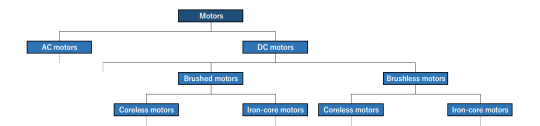
Electric motors are classified into many types based on differences in drive mechanisms and structure. Broadly, they are divided into direct current (DC) motors and alternating current (AC) motors, and there are further subcategories based on various structural features, such as brushed and brushless, and iron-core and coreless (core-less) types.
Contents of this section
- Differences Between DC Motors and AC Motors
- Brushed Motors and Brushless Motors
- Features and Industrial Applications of Coreless Motors
Each type of motor has its own unique characteristics, and selecting the optimal type based on the application and required performance is key to successful product development.
Differences Between DC Motors and AC Motors
Electric motors are broadly classified into DC motors (direct current motors) and AC motors (alternating current motors) based on the type of power source. Understanding the characteristics of both types enables the selection of the most suitable motor for product development.
DC motors offer excellent controllability and are suitable for applications requiring precise speed control and positioning. Since rotational speed can be adjusted simply by changing the voltage, designing the control circuit is relatively straightforward.
On the other hand, AC motors feature a simple structure and high durability, making them widely used in industrial machinery. Another advantage is that they can utilize commercial power directly, helping to reduce operating costs for large-scale equipment.
| Item | DC motor | AC motor |
| Power supply | DC power supply (Battery, DC power supply) | AC power (Mains power) |
| Controlability | Precise speed control is easy | Requires an inverter for control |
| Structure | Relatively complex (commutator, brushes) | Simple and robust |
| Main Applications | Precision equipment, medical devices, mobile devices | Industrial machinery, home appliances, pumps |
| Maintenance | Brush replacement required (If equipped with brushes) | Maintenance-free |
Please select the optimal motor based on the application and power supply environment.
Brushed Motors and Brushless Motors
DC motors are classified as brushed or brushless based on their current commutation method.
| Item | Brushed Motors | Brushless Motor |
| Current Commutation Method | Via brushes and a commutator Mechanical commutation | Electrical switching via electronic circuits |
| Control method | Simple (voltage control only) | Requires electronic control |
| Service life | Short due to brush wear | No wear parts; long service life |
| Maintenance | Requires periodic brush replacement | Maintenance-free |
| Efficiency | Slightly low (friction loss) | High efficiency |
| Noise | Generates electrical noise | Low electrical noise |
| Cost | Low cost | Slightly higher cost |
Brushed motors are simple to control and low-cost, but their service life is limited due to brush wear. Brushless motors have a long service life and high efficiency, but require electronic control circuits. Selection should be based on factors such as maintainability, service life, and noise characteristics, depending on the application.
Features and Industrial Applications of Coreless Motors
Coreless motors (ironless motors) have a structure in which the rotor lacks an iron core, giving them superior characteristics distinct from conventional motors.
[Main Features of Coreless Motors]
- No cogging torque, ensuring smooth rotation
- Compact and lightweight design
- High efficiency and energy savings
- High-speed response due to low inertia
- Capable of starting at low voltages
Thanks to these characteristics, they are widely used in fields requiring high-precision control, such as medical equipment (endoscopic cameras, surgical drills, pumps), precision instruments (camera lens drives, autofocus mechanisms), industrial robots, and security equipment (electronic locks, smart locks).
In particular, the cogging-free characteristic is a major advantage in vibration-sensitive optical and medical equipment. The absence of an iron core makes magnetic saturation less likely, and since a linear output characteristic is obtained relative to the input current, precise control can be achieved.
Furthermore, due to the rotor’s low moment of inertia, startup and stop response times are fast, making them ideal for applications requiring frequent acceleration and deceleration. As motors that meet modern industrial needs for miniaturization and energy efficiency, their adoption is expanding.
Summary
An electric motor is a device that converts electrical energy into mechanical energy, generating rotational motion through the interaction of magnetic fields and electric currents. Since the inventions of Faraday and Tesla in the 19th century, it has continued to evolve as a key technology underpinning the Industrial Revolution, and today, a wide variety of motors are used for specific applications.
DC motors and AC motors, brushed and brushless, coreless and cored—each has its own characteristics, and selecting the appropriate type based on the required performance and operating environment is key to successful product development. Coreless motors, in particular, offer cogging-free operation and excellent high-speed responsiveness, making them suitable for precision control applications in the medical, industrial, optical, and security fields.
Product Information & Inquiries
For more details on C.I. Takiron’s micro motor products, please visit the website below.
- Product Site: https://cik-ele.com/en/
- Coreless Motors: https://cik-ele.com/en/products/list/coreless_motor/
- Brushless Motors: https://cik-ele.com/en/products/list/brushless_motor/
- Geared Motors: https://cik-ele.com/en/products/list/gearhead/
- Encoders: https://cik-ele.com/en/products/list/encoder/
If you are having trouble selecting a small motor for your product development, please feel free to contact us via the inquiry form. Our technical staff will discuss your application and requirements with you and propose the optimal solution.
- Inquiries: https://cik-ele.com/en/contact/