

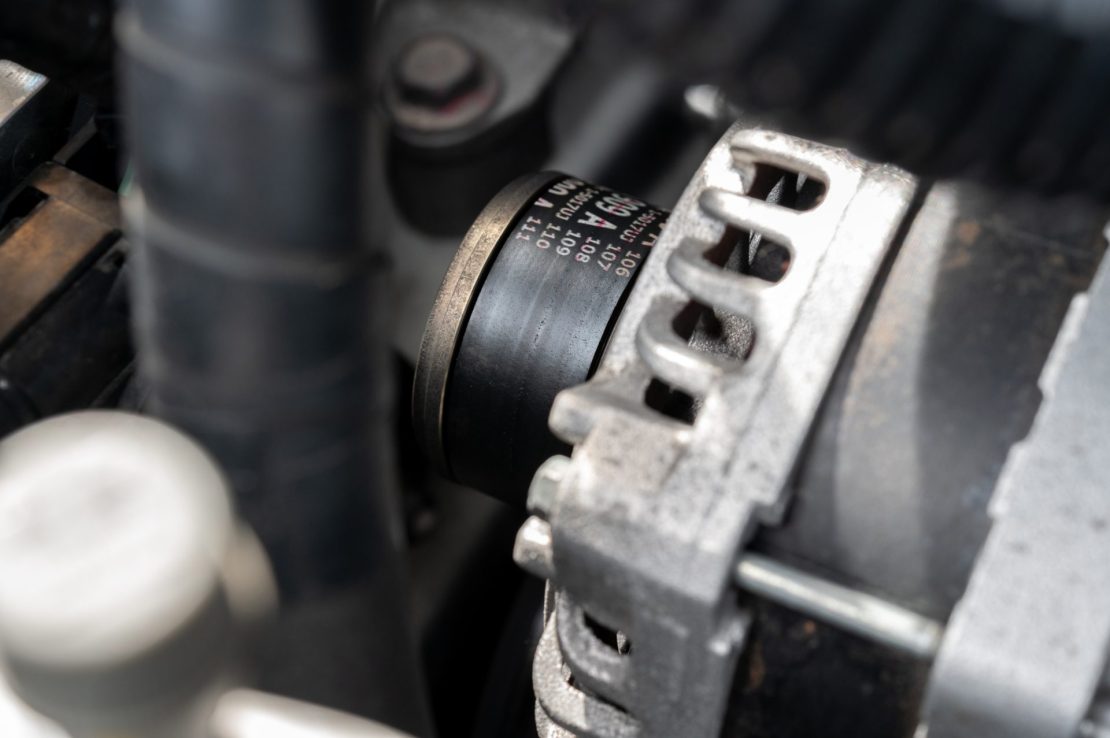
A dynamo is a direct-current generator that converts mechanical energy—such as rotational energy—into electrical energy. While they were once used as charging devices in automobiles, the basic principles of power generation are also applied in modern motors and regenerative systems.
A motor is typically a device that uses electricity to generate rotational force. However, when its shaft is rotated by an external force, it can function as a generator, making it useful for regenerative braking, energy recovery, and small-scale power generation.
In this article, we’ll explain how dynamos work, how they differ from alternators, and their relationship to motors, and we’ll cover key considerations for motor selection suitable for power generation and regenerative applications.
| Supervised by: C.I. TAKIRON Corporation Electronic Devices Sales Group This article has been supervised based on the advanced technical expertise and insights we have cultivated since our founding in 1919 as a leading company in plastic processing. Our department continuously analyzes market trends and the latest technologies in ultra-compact, high-precision micro motors, focusing on providing high-value-added information to designers and developers. As a team of experts with in-depth knowledge of product characteristics, we support our customers’ problem-solving and technological innovation by delivering accurate and practical content. |
What Is a Dynamo? A DC Generator That Converts Mechanical Energy into Electricity

A dynamo is a DC generator that converts mechanical energy—such as rotational force applied from an external source—into electrical energy. It utilizes “electromagnetic induction,” which generates voltage through the relative motion of magnets and coils, and extracts DC power via a commutator and brushes.
In the past, they were used to charge automotive batteries and power electrical components. Today, alternators—which generate alternating current (AC) and convert it to direct current (DC)—are the mainstream choice.
Note that power generation devices for bicycles are also generally referred to as dynamos, though some models generate alternating current (AC). Technically, however, the term “dynamo” refers specifically to a generator that extracts direct current (DC) via a commutator. The fundamental principle of electromagnetic induction is common to modern motors and regenerative systems as well, and is applied in a wide range of applications.
Dynamos Generate Electricity Using Electromagnetic Induction
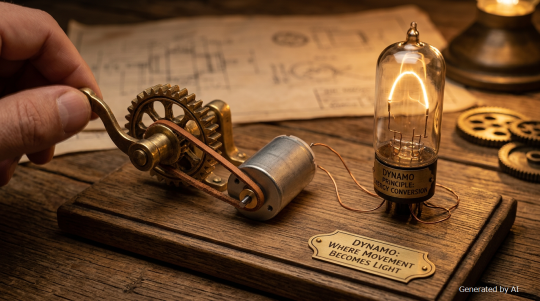
Dynamos generate electricity using “electromagnetic induction,” which produces voltage through the relative motion of a magnetic field and a coil. In DC generators, the generated electricity is extracted as direct current via a commutator and brushes.
Here, we will explain the principle by which voltage is generated through electromagnetic induction and the mechanism for extracting it as direct current.
Moving a Conductor Within a Magnetic Field Generates Voltage
The basis of power generation is “electromagnetic induction,” in which a voltage is generated by changes in the magnetic flux passing through a coil. Electromagnetic induction can be induced by rotating a coil within a magnetic field or by moving a magnet relative to the coil.
In a dynamo, rotational force generated by an engine or turbine is used to continuously create relative motion between the magnet and the coil. As long as the rotation continues, voltage is continuously generated.
The voltage generated varies depending on factors such as the strength of the magnetic field, the number of coil windings, and the rotational speed. However, the actual amount of power that can be extracted also depends on the connected load and internal resistance.
Extracting Direct Current via the Commutator
In a dynamo, a commutator and brushes are used to extract the electricity generated in the coil as direct current (DC). Since the voltage generated in the rotating coil reverses direction every half-rotation, it would be alternating current (AC) if left as is.
The commutator is a component that rotates along with the rotor, while the brushes are stationary contacts that draw electric current into the external circuit. By switching connections in sync with the rotation, the commutator maintains a consistent direction of electric current flow to the external circuit.
However, since periodic fluctuations remain in the output, it is not completely smooth direct current. Additionally, because the commutator and brushes operate in contact with each other, wear and poor contact can occur, requiring regular inspection and replacement.
Dynamos and Alternators Use Different Power Generation Methods
Both dynamos and alternators are generators that convert mechanical energy into electrical energy, but they differ in structure and rectification methods. A dynamo is a DC generator that uses a commutator and brushes to produce direct current.
An alternator generates alternating current (AC), which is then converted to direct current (DC) by rectifiers such as diodes. The main differences between the two are summarized in the table below.
| Item | Dynamo | Alternator |
| Classification | DC Generator | AC Generator |
| How Power Is Generated and Output | The voltage generated in the coil is commutated by the commutator and brushes, and then extracted as direct current | AC is generated in the coil and converted to DC using diodes or similar components |
| Main Rectification Methods | Mechanical rectification using a commutator and brushes | Rectification using diodes |
| Maintenance Characteristics | Since the commutator and brushes are subject to brush wear, they require inspection and replacement | Some models do not use a commutator but are equipped with brushes |
| Current Role in Automobile | Not the mainstream choice in typical passenger cars | They are the mainstream choice for general-purpose internal combustion engine vehicles |
In the past, dynamos were used for charging car batteries and other purposes, but today alternators are the mainstream choice due to their superior power generation performance and ease of maintenance. However, both share the fundamental role of converting mechanical energy into electrical energy.
Motors and dynamos convert energy in opposite directions
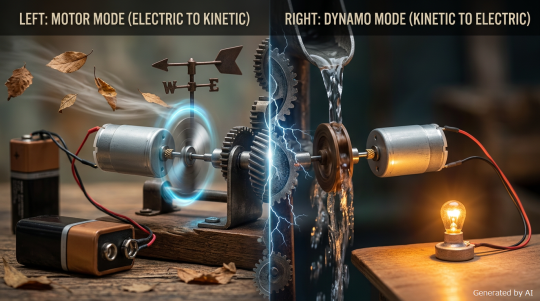
Motors and dynamos are both devices that convert electrical energy into mechanical energy and vice versa. However, while a motor uses electricity to generate rotational force, a dynamo converts rotational force applied from an external source into electricity.
Here, we will explain the basic operation of a motor and how it functions as a generator when driven by an external force.
Motors Convert Electricity into Rotation
A motor is a device that converts electrical energy into mechanical energy, such as rotational motion. It works by utilizing the electromagnetic force exerted on an electric current flowing through a magnetic field to drive a rotating shaft.
For example, in a cored type of brushed DC motor—which has an iron core—an electric current is passed through coils wound around the rotor’s iron core within the magnetic field created by the stator. The electromagnetic force generated causes the rotor to move, and the rotational force is transmitted to the outside.
Furthermore, motors in general are used as power sources for a wide range of equipment, including conveyor systems in manufacturing facilities, robots, pumps, and fans. Note that there is also a coreless type of brushed DC motor that does not have an iron core.
When rotated by an external force, a motor functions as a generator
A motor can function as a generator when its shaft is rotated by an external force. In this case, the direction of energy conversion is reversed compared to normal operation, and the mechanism converts mechanical energy into electrical energy.
For example, when rotational force from a wheel, windmill, or waterwheel is transmitted to the motor shaft, voltage is generated by the relative motion of the internal magnets and coils. The basic principle of power generation is electromagnetic induction, which is the same as that used in dynamos.
Depending on the type of motor, circuits for excitation, rectification, and control may be required, so it is necessary to verify whether the configuration is suitable for power generation applications. However, the key factor is not rotation in the opposite direction, but rather the application of an external force to rotate the shaft.
The motor’s power-generating function is utilized for regenerative braking and energy recovery
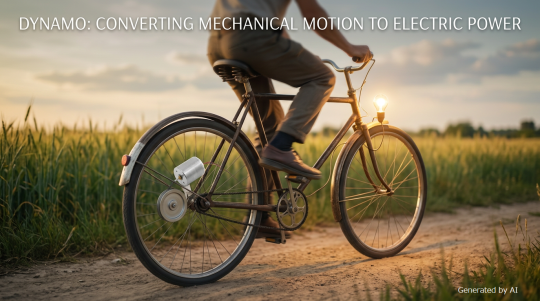
The property whereby a motor functions as a generator when rotated by an external force is utilized in regenerative braking and energy recovery. Since it allows the kinetic energy generated during machine deceleration and other processes to be converted into electricity, this enables the effective use of energy.
Here, we explain the mechanism of regenerative braking and how the recovered electrical energy is utilized.
Regenerative Braking Converts Kinetic Energy During Deceleration into Electricity
Regenerative braking is a mechanism that converts the kinetic energy generated when machinery or vehicles decelerate into electrical energy via a motor. Normally, electricity is used to rotate the motor, but during regenerative braking, the motor functions as a generator and produces electricity.
When the motor acts as a generator and sends electricity to an external source, torque is generated in the direction that opposes rotation, thereby slowing down the machine. Another key feature is that kinetic energy can be converted into electricity, which can then be recovered and reused in some cases.
Regenerative braking is used not only in the braking systems of EVs, hybrid vehicles, and railcars, but also in the descent of elevators and cranes, as well as in the deceleration of material-handling equipment.
Recovered Electricity Can Be Reused or Stored
The electricity generated by regenerative braking can be utilized in various ways, such as charging batteries, powering other equipment, or feeding it back into the power grid. For example, in railways, a system has been introduced where electricity recovered during deceleration is stored in batteries and reused when the train accelerates.
However, if there is no equipment capable of accepting regenerative power, there is a risk of excessive voltage rise. While there are methods that use regenerative resistors to dissipate the power as heat, these do not contribute to energy reuse.
To recover power efficiently, it is important to design a system that encompasses not only the motor but also the inverter that converts the power, the energy storage device, and the control circuit.
Compact motors Can Also Be Used for Small-Scale Power Generation and Energy Recovery
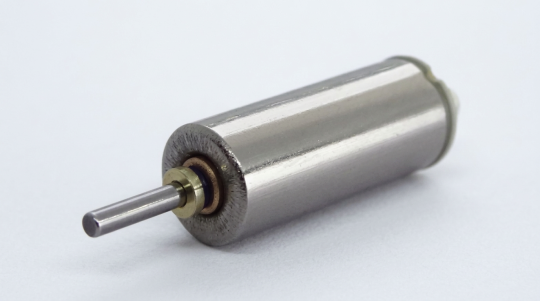
View list of coreless motor products
Compact motors can also be used for small-scale power generation and energy recovery by applying an external rotational force. Typical applications include small-scale power generation using the rotation of windmills or water wheels, recovery of excess energy from the rotating shafts of machinery, and experimental and measurement equipment.
However, not all motors are suitable for power generation applications. In addition to the rotational speed required to achieve the necessary voltage and output, it is essential to verify load conditions, heat generation during continuous operation, and durability.
In wind and hydroelectric power generation in particular, since rotational speed fluctuates depending on wind speed and water flow, control circuits that stabilize the voltage are also important. To achieve stable power generation, design must take into account not only the performance of the motor itself but also its integration with the rotational source, power conversion circuits, and energy storage devices.
Key Considerations for Motor Selection for Power Generation and Regenerative Applications
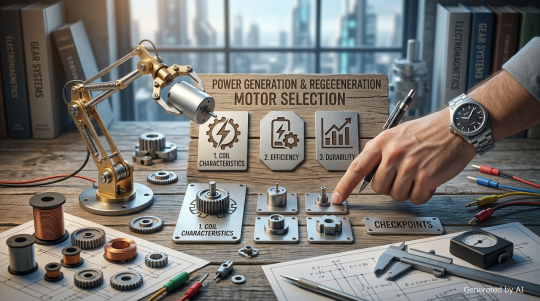
When using a motor for power generation or regenerative braking applications, it is necessary to consider not only the rotational speed, generated voltage, and output but also efficiency, losses, and durability. Furthermore, compatibility with the control circuit and load is crucial for stable power extraction.
The main points to verify during motor selection for power generation and regeneration applications are as follows.
| Checkpoints | Main Considerations |
| Speed, Output Voltage, and Power | Can the required voltage and power be obtained at the operating speed? |
| Torque and Load Conditions | Can the rotational force required for power generation be maintained continuously? |
| Efficiency and Losses | Do losses and heat generation during power generation remain within acceptable limits? |
| Size and Durability | Can it be integrated into equipment and handle continuous operation? |
| control circuit | Can it handle rectification, voltage conversion, and charge control? |
In the following sections, we will explain the key points to consider during motor selection for power generation and regenerative braking applications.
Check the Relationship Between Speed, Output Voltage, and Power
When selecting a motor for power generation applications, it is important to verify that the required voltage and output can be obtained at the anticipated rotational speed. The generated voltage varies depending on the motor type, winding specifications, rotational speed, and other factors.
Additionally, since drawing power generates torque that opposes rotation, the rotation source must have sufficient power. Be sure to verify not only the rotational speed but also whether the motor can supply the necessary power while a load is connected.
Even if voltage is generated under no-load conditions, the voltage and rotational speed may decrease under actual operating conditions. For power generation and regenerative applications, evaluation that includes load conditions and temperature rise is essential.
Checking Efficiency and Losses
For power generation and regenerative applications, it is necessary to verify the motor’s efficiency and energy loss. This is because not all of the input mechanical energy is converted into electrical power; some is lost as heat or in other forms.
Major losses include copper losses due to the electrical resistance of the coils, iron losses generated in the iron core of cored motors, and mechanical losses caused by bearing friction and air resistance. Under the same input conditions, a motor with lower losses can recover more electrical power, which also helps reduce heat generation.
However, even a motor with high efficiency during drive operation may not achieve the same efficiency during power generation. It is important to evaluate not only the actual rotational speed and load conditions but also the losses in the power conversion circuit.
Select Based on Size, Durability, and Control Circuits
When performing motor selection for power generation and regenerative applications, consider not only the size and weight that can be incorporated into the equipment but also durability and compatibility with the control circuit. Particularly for continuous operation, it is essential to verify the lifespan of the bearings, heat generation, and operating temperature.
For applications with significant fluctuations in speed or load, measures to prevent overspeed and overvoltage are also necessary. Furthermore, to utilize the generated power, components such as rectifier circuits, voltage conversion circuits, and battery charge control must be combined according to the specific application.
To achieve stable power generation, it is important to conduct a comprehensive evaluation that includes not only the motor’s individual specifications but also the conditions of the rotation source and power supply. If the requirements are complex, consulting with the manufacturer is advisable.
Summary
A dynamo is a DC generator that uses electromagnetic induction to convert mechanical energy into electrical energy. Motors can also function as generators when their shafts are rotated by an external force, and they are used in applications such as regenerative braking, energy recovery, and small-scale power generation.
When performing motor selection for power generation or regenerative braking applications, it is important to comprehensively evaluate not only the rotational speed, generated voltage, and output but also efficiency, losses, and durability. Motors with high efficiency and low losses during power generation contribute to the effective utilization of energy.
C.I. Takiron Corporation handles compact motors. Please feel free to contact us for consultation regarding motor selection and specifications for power generation and regenerative braking applications.
Product Information & Inquiries
For more details on C.I. Takiron’s micro motor products, please visit the website below.
- Product Site: https://cik-ele.com/en/
- Coreless Motors: https://cik-ele.com/en/products/list/coreless_motor/
- Brushless Motors: https://cik-ele.com/en/products/list/brushless_motor/
- Geared Motors: https://cik-ele.com/en/products/list/gearhead/
- Encoders: https://cik-ele.com/en/products/list/encoder/
If you are having trouble selecting a small motor for your product development, please feel free to contact us via the inquiry form. Our technical staff will discuss your application and requirements with you and propose the optimal solution.
- Inquiries: https://cik-ele.com/en/contact/