


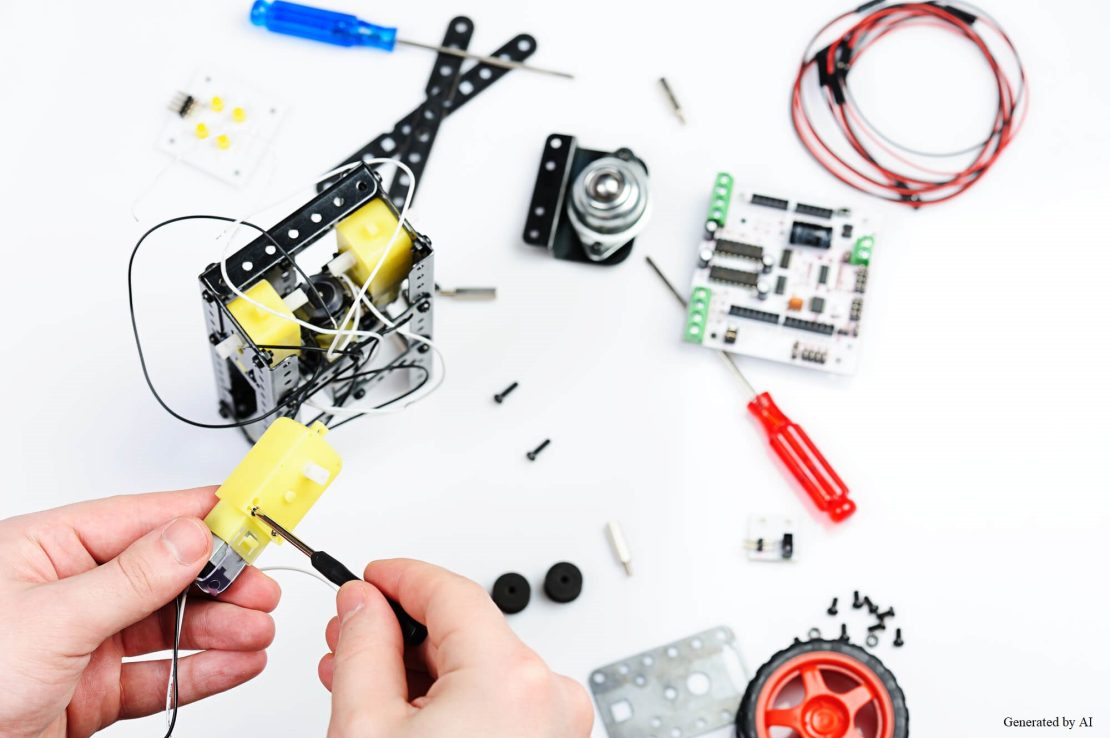
Motors are devices that convert electrical energy into mechanical energy, and they are essential components in the development of B2B products such as medical equipment, industrial robots, and optical equipment. However, many developers likely face technical challenges such as “Which motor is best suited for medical device applications?”, “Which type should be chosen to minimize vibration and noise?”, and “How can we achieve both miniaturization and high torque?”
This article explains everything from the basic principle of motor operation to specific application examples by industry sector, as well as the optimal motor selection criteria for each application. We will also introduce, with real-world examples, how Coreless motors can solve challenges in the development of medical equipment and precision equipment, where compact size, high precision, and low vibration are particularly required.
| Supervised by: C.I. TAKIRON Corporation Electronic Devices Sales Group This article has been supervised based on the advanced technical expertise and insights we have cultivated since our founding in 1919 as a leading company in plastic processing. Our department continuously analyzes market trends and the latest technologies in ultra-compact, high-precision micro motors, focusing on providing high-value-added information to designers and developers. As a team of experts with in-depth knowledge of product characteristics, we support our customers’ problem-solving and technological innovation by delivering accurate and practical content. |
Principle of Motor Operation and Performance Requirements by Application | How Electricity Is Converted into Power
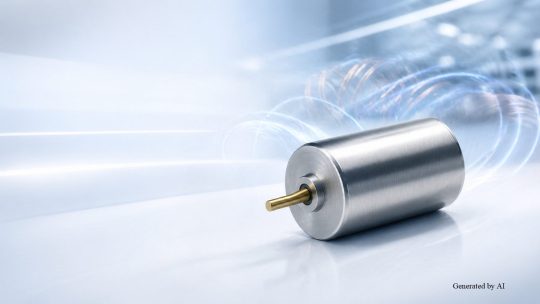
Motors utilize the principle of electromagnetic force (Lorentz force) to generate rotational motion through the interaction between the magnetic field created by an electric current flowing through a coil and the magnetic field of a permanent magnet. This simple principle enables motors to accommodate a wide range of applications through variations in size, structure, and control methods.
Topics Covered in This Section
・Basic structure of motors and how they rotate
・Performance requirements for motors by application
Below, we will take a closer look at the key performance requirements for various applications.
Basic Structure of Motors and How They Rotate
A motor consists of a stator and a rotor; when electric current flows through the coils, a magnetic field is generated. The rotor rotates due to the repulsive and attractive forces between this magnetic field and permanent magnets. Since conventional motors have an iron core, cogging torque (uneven rotation) can occur due to the attractive force that draws the iron core toward the permanent magnets.
In contrast, C.I. Takiron Corporation’s Coreless motors have a structure without an iron core, enabling a significant reduction in cogging. This characteristic allows for smooth rotation and high-speed response, making them ideal for medical equipment and optical equipment that requires precise control.
Motor Performance Requirements by Application
The required performance varies greatly depending on the application. The main performance requirements by industrial sector are as follows.
[Key Performance Requirements by Industry Sector]
- Medical equipment: Quiet operation, precise control, high reliability (patient safety is the top priority)
- Industrial robots: High torque, high-speed responsiveness, positioning accuracy (to improve productivity)
- Optical equipment: Low vibration, compact size, high-speed responsiveness (to prevent image quality degradation)
- Battery-powered devices: Low-voltage startup, low power consumption, long service life (maintenance-free)
- Safety equipment: Explosion-proof, durability, low electric current consumption (for use in hazardous environments)
Development engineers must clearly define the operating environment of their products and the performance requirements that take priority in order to perform motor selection.
In this way, understanding the basic principle of motor operation enables the selection of products that meet the performance requirements for each application, leading to successful product development.
Examples of Motor Applications by Industry | Track Record in Medical Equipment, FA, and Optical Equipment
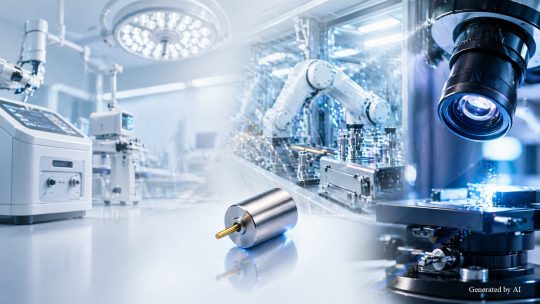
Motors address different technical challenges in each industrial sector. In medical equipment, reliability and quiet operation are top priorities for patient safety, while in the FA sector, high-speed, high-precision control is essential to maximize production efficiency. In optical equipment, low vibration is prioritized to prevent image quality degradation, and in security equipment, long-term maintenance-free operation is emphasized. *
Topics Covered in This Section
- Motor Applications in the Medical Equipment Sector | Endoscopes, Dialysis Machines, and Electric Surgical Instruments
- Motor Applications in FA and Industrial Equipment | Robots, Machine Tools, Conveyor Systems
- Motor applications in optical equipment and security equipment
Let’s now look at specific application examples in each industrial sector.
*Our motors are not designed with maintenance in mind.
Motor Applications in the Medical Equipment Sector | Endoscopes, Dialysis Machines, and Electric Surgical Instruments
In medical equipment, patient safety and comfort are the top priorities, requiring motors to offer high reliability and quiet operation. The required performance specifications for major medical equipment are as follows.
| medical equipment | Key Performance Requirements | Advantages of Coreless motors |
| Endoscopes | Low vibration, precise positioning | Cogging-free operation prevents image degradation |
| Dialysis Machine Pump | Long-term stable operation, high reliability | Maintains stable output even during continuous operation |
| Electric surgical instruments | Compact, high torque, lightweight | Compact design achieved through a coreless structure |
C.I. Takiron Corporation’s Coreless motors produce virtually no cogging due to the absence of an iron core, delivering the precise control and quiet operation required in medical settings. We also offer customization tailored to specific applications and provide technical support from the product development stage. If you are having difficulty with motor selection for medical equipment development, please utilize our technical consultation service via the C.I. Takiron Corporation website (https://cik-ele.com/).
Motor Applications in FA and Industrial Equipment | Robots, Machine Tools, and Conveyors
In the FA sector, high-speed, high-precision motion to improve productivity and high reliability to reduce downtime are essential. For joint drives in industrial robots, high-response motors are required to control multiple axes simultaneously. Furthermore, axis control in machine tools demands positioning accuracy to ensure machining precision, while AGV (Automated Guided Vehicle) drives require low power consumption and long operating times.
While AC motors and servo motors are the mainstream choice for large equipment, the following types of compact motors are used in small robots and precision assembly equipment.
[Compact motors used in the FA field]
- Coreless motors: Ideal for high-speed response, low vibration, and precise control
- Brushless motors: Long service life, maintenance-free, high efficiency
- Geared motors: Torque amplification and flexible reduction ratio settings
Motor Applications in Optical and Security Equipment
In optical equipment, such as camera autofocus, image stabilization, and microscope lens drives, low-vibration motors are essential because even slight vibrations directly affect image quality. Digital cameras require high-speed responsiveness for high-speed autofocus, making the characteristics of Coreless motors particularly well-suited.
In electronic locks for security equipment, which are battery-powered, low-voltage startup and power efficiency are critical. Additionally, a product with a long service life that can withstand frequent locking and unlocking operations is required. C.I. Takiron Corporation’s products include models capable of starting at a minimum of 1.0V, and as products that meet these requirements, they are adopted in electronic locks.
In this way, by conducting appropriate motor selection for the distinct technical challenges of each industrial sector, you can enhance product performance and achieve differentiation.
Motor Selection Criteria by Application | 5 Checkpoints to Avoid Mistakes
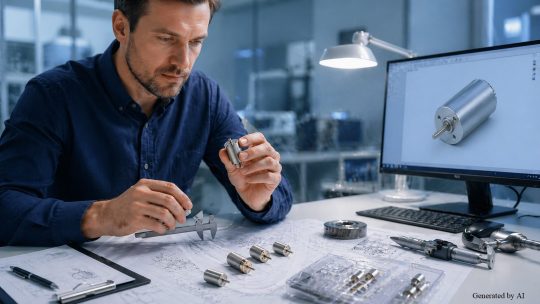
When performing motor selection, it is necessary to consider not only specifications but also the actual operating environment and future scalability. Since a selection error can lead to insufficient product performance or delays in the development schedule, careful judgment is required.
Contents of this section
- ・5 Checkpoints for Motor Selection
- ・Coreless motors Ideal for Small, Precision Applications
Below, we explain practical selection criteria along with specific examples.
5 Checkpoints for Motor Selection
When performing motor selection, check the following five points in order.
| Check Item | Details |
| ① Required Torque and Rotational Speed | Calculate the load torque and select a motor by applying a safety factor of approximately 1.2 to 2.0 times, depending on the application |
| ② Operating Environment | Confirm the temperature range (e.g., -20 to +70°C), humidity, and vibration levels |
| ③ Control Method | Verify compatibility with PWM control, analog, and digital control |
| ④ Size and Weight Constraints | Consider installation space and cable routing |
| ⑤ Cost and Delivery Time | Balance development time and mass production costs |
Motor selection based on confirmation of these five checkpoints leads to successful product development.
Coreless motors: Ideal for Compact Precision Applications
Coreless motors feature a structure without an iron core, achieving cogging-free operation and contributing to smooth motion, high-speed response, and miniaturization. These characteristics make them suitable for applications requiring precise control, such as medical equipment, optical equipment, and security equipment.
C.I. Takiron Corporation provides high-quality Micromotors and has a proven track record of adoption across diverse fields, including medical equipment, optical equipment, and security equipment. We offer customization tailored to specific applications, technical support from the prototyping stage, and small-lot production. By combining these Micromotors with gearheads or encoders, we can also support torque amplification and feedback control. For product selection and specification consultations, please visit our website at https://cik-ele.com/
Summary
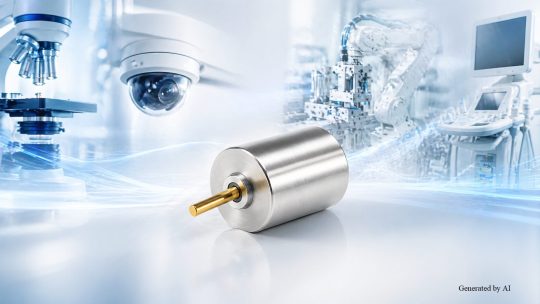
Motors generate power based on the principle of electromagnetic force (Lorentz force) and meet the varying performance requirements of different industrial sectors. In medical equipment, quiet operation and reliability are prioritized; in factory automation (FA), high-speed and high-precision control is essential; and in optical equipment, low vibration is critical.When performing motor selection, it is important to verify five key points (torque calculation, operating environment, control method, size constraints, and cost) to choose the type and structure best suited for the application. Coreless motors are a particularly strong option for applications requiring compact size and precise control. C.I. Takiron Corporation leverages its extensive track record and technical expertise to provide optimal Micromotors solutions.
Product Information & Inquiries
For more details on C.I. Takiron’s micro motor products, please visit the website below.
- Product Site: https://cik-ele.com/en/
- Coreless Motors: https://cik-ele.com/en/products/list/coreless_motor/
- Brushless Motors: https://cik-ele.com/en/products/list/brushless_motor/
- Geared Motors: https://cik-ele.com/en/products/list/gearhead/
- Encoders: https://cik-ele.com/en/products/list/encoder/
If you are having trouble selecting a small motor for your product development, please feel free to contact us via the inquiry form. Our technical staff will discuss your application and requirements with you and propose the optimal solution.
- Inquiries: https://cik-ele.com/en/contact/