

Motors are critical components that determine a device’s performance, precision, durability, and energy saving capabilities. However, since the required torque, rotational speed, size, lifespan, and other specifications vary depending on the application and operating environment, many people likely struggle with the question, “Which motor should I choose?”
When performing motor selection, you must first clarify the required specifications and compare them with the characteristics of each motor and its suitability for the intended application. In this article, we’ll provide an easy-to-understand explanation of the key points to keep in mind during motor selection, the main types of motors, and how to choose the right one based on specific applications.
| Supervised by: C.I. TAKIRON Corporation Electronic Devices Sales Group This article has been supervised based on the advanced technical expertise and insights we have cultivated since our founding in 1919 as a leading company in plastic processing. Our department continuously analyzes market trends and the latest technologies in ultra-compact, high-precision micro motors, focusing on providing high-value-added information to designers and developers. As a team of experts with in-depth knowledge of product characteristics, we support our customers’ problem-solving and technological innovation by delivering accurate and practical content. |
Key Points for Motor Selection

When performing motor selection, it is important to first clarify the application and operating environment and define the performance required for the equipment. Selecting a motor without clearly defining these conditions may lead to issues such as insufficient torque, excessive performance, heat generation, or reduced lifespan.
Here, we explain the basic principles you should review before making a selection
Identifying the Application and Operating Environment
The performance required of a motor varies depending on the object being driven, the operating method, and the location of use. Therefore, it is necessary to clarify the equipment to be used, the installation environment, and the load conditions before performing motor selection.
Before motor selection, you should primarily verify the following conditions:
- Equipment to Be Used and Object to Be Driven
- Continuous or Intermittent Operation
- Is the load constant or variable?
- Temperature and humidity of the operating environment
- Presence or absence of dust and vibration
- Indoor or outdoor use
By clearly defining the operating conditions, you can clarify the role required of the motor and more easily avoid underperformance or over-specification. After identifying the necessary conditions for the application and installation environment, narrow down the list of candidate motors.
Clarify the Required Performance
When performing motor selection, the fundamental step is to clearly define the torque and rotational speed required for the equipment. Selecting a motor without understanding the necessary performance can lead to problems such as the motor being unable to move the load or failing to reach the desired speed.
If precise operation is required, also verify the ease of speed control, responsiveness to acceleration and deceleration, and positioning accuracy. Additionally, confirming that the motor’s characteristics match the actual load conditions makes it easier to prevent heat generation, overloads, and underperformance.
It is important to specify the required operations and systematically organize the necessary performance criteria one by one.
Points to Check During Motor Selection
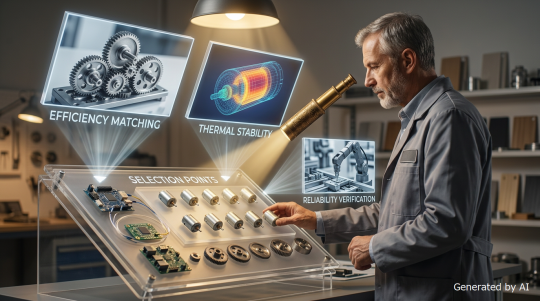
When selecting a motor, it is necessary to comprehensively evaluate not only torque and rotational speed but also size, weight, lifespan, maintainability, and cost. Particularly in small or precision equipment, even slight differences in specifications can affect the overall performance and design flexibility of the system.
Here, we explain the key factors to consider during motor selection.
Torque and Speed
The required torque and rotational speed are the fundamental metrics for motor selection. Torque represents the force that rotates the shaft, while rotational speed indicates the number of revolutions the shaft makes per minute. It is necessary to verify that both requirements can be met under actual operating conditions.
Generally, since a motor’s speed and torque vary in tandem, selecting a motor based solely on its maximum values may result in insufficient performance during actual operation. In particular, Micromotors for Small Precision Equipment Applications—such as those provided by C.I. Takiron Corporation—are extremely compact; consequently, their torque is measured not in the standard Nm (newton-meter) range, but in mN·m (millinewton-meter), which is one-thousandth of a newton-meter.
Be sure to check the units listed in the specifications and compare motors based on the actual combination of rotational speed and torque you intend to use.
Size and Weight
The size and weight of a motor affect not only the installation space but also the design of the entire device. In small devices in particular, a larger motor reduces the flexibility in component layout and may hinder product miniaturization.
In addition, if the motor mounted on a moving part is heavy, the force required to start or stop it tends to be greater. Do not base your decision solely on external dimensions; be sure to check the weight, mounting method, and positional relationship with surrounding components as well.
When considering size and weight, it is important to select a motor that meets the required torque and rotational speed while fitting comfortably within the equipment.
Lifespan and Maintainability
For equipment intended for long-term use, motor lifespan and maintainability are also important selection criteria. In brushed motors, the brushes experience brush wear with rotation, so lifespan is influenced by factors such as operating time and rotational speed.
Especially when used for continuous operation or at high speeds, you must select a motor based on the anticipated operating time. If you want to minimize maintenance burdens, check the availability of replacement parts, inspection intervals, and whether the motor has a design that makes replacement easy.
By considering post-installation operation, you can more easily prevent sudden shutdowns and frequent replacements.
Cost and Power Consumption
When comparing motors, it is important to consider not only the purchase price but also power consumption and maintenance costs. Even if a motor is inexpensive at the time of purchase, low efficiency and high power consumption can increase total costs over the long term.
In addition, frequent part replacements and maintenance will incur maintenance costs and require labor time. Especially for equipment that operates continuously, even a slight difference in efficiency can lead to significant differences in long-term electricity costs.
Make your decision based on the total cost—including the period after installation—taking into account operating hours and lifespan.
Common Motor Types and Characteristics

There are several types of motors, including Brushed motors, Brushless motors, and stepper motors, each differing in structure, lifespan, controllability, and suitable applications. To select a motor suited to your application, it is important to compare the characteristics of each type and determine whether they meet your performance requirements.
The characteristics of common motor types are as follows.
| Type | Main Characteristics | Lifespan and Maintainability | Main Applications |
| Brushed motors (Wound-Rotor Type) | Relatively simple structure and easy to control | Brush wear occurs | Small appliances, general-purpose equipment |
| Brushed motors (Coreless Type) | Compact and lightweight, and highly responsive | Brush wear occurs | Medical equipment, precision equipment |
| Brushless motors | High efficiency and long service life | Low maintenance requirements | Industrial equipment, conveyors, pumps |
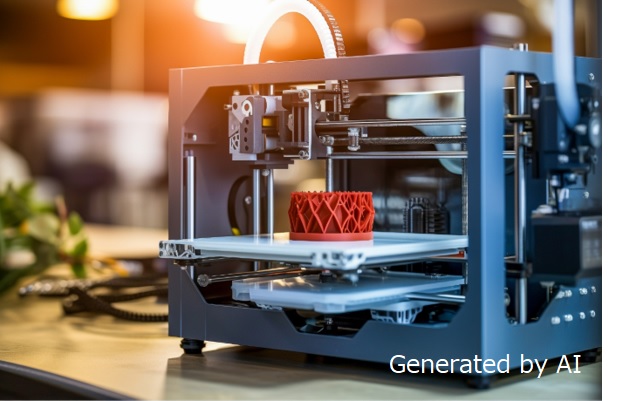
| Stepper motors | Excellent for positioning control | Relatively long lifespan | 3D printers, measuring instruments, and conveying equipment |
The comparison table can be used as a guide during motor selection. However, since performance and specifications vary by product even within the same type, it is important to ultimately select a motor based on the intended application and required specifications. Let’s take a closer look at the characteristics of each motor.
Brushed motors (Core-Type and Coreless-Type)
There are two types of brushed motors: those with an iron core (cored type) and those without an iron core (coreless type). Both types use brushes and a commutator to reverse the direction of the electric current and generate rotation. With their relatively simple structure, they are easy to control and are used in a wide range of devices.
The cored type features a standard design with a coil wound around an iron core. In contrast, the coreless type lacks an iron core in the rotating part, making it lightweight and offering excellent responsiveness during start-up and stop-up, as well as smooth rotation.
While they are suitable for small and precision devices, keep in mind that there is brush wear in both types, so be sure to consider operating time and replacement frequency when selecting a motor.
Brushless motors
Brushless motors are suitable for applications that prioritize long service life, high efficiency, and ease of maintenance. This is because they do not use brushes or commutators; instead, an electronic circuit switches the electric current, resulting in fewer parts subject to wear.
They do not require brush replacement, are well-suited for long periods of continuous operation, and are also effective at minimizing energy loss and heat generation. Due to these characteristics, they are widely adopted in applications requiring stable operation, such as industrial equipment, automated guided vehicles (AGVs), pumps, and precision instruments that demand a long service life and low heat generation.
These motors are a strong choice for equipment designed for long-term operation.
Stepper Motors
Stepper motors are well-suited for applications requiring precise control of stopping positions. Since they rotate in fixed rotational angles in response to input pulse signals, they make it easy to control the amount of rotation and stopping positions.
Furthermore, under appropriate load conditions, positioning can be achieved with a relatively simple mechanism even in open-loop control without using a sensor to verify position. They are widely used in applications requiring precise movement to a specified position, such as 3D printers, conveyors, measuring instruments, and automated equipment.
Understand their structural and control characteristics, and select the appropriate motor based on the required positioning accuracy.
How to Select a Motor by Application
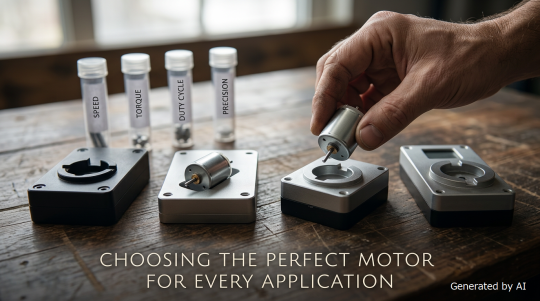
When performing motor selection, the key considerations vary depending on the application. For example, the appropriate motor type and specifications differ depending on whether the priority is on compactness and lightweight design or on a long service life and ease of maintenance.
Here, we explain how to select motors based on their primary applications and objectives.
When Prioritizing Compact and Lightweight Design
When prioritizing compact and lightweight design, compact motors with reduced external dimensions and weight—such as flat-type motors or Micromotors—are suitable. Since medical equipment and portable devices have limited installation space, using compact motors increases flexibility in component layout. Additionally, reducing the weight of moving parts is effective in reducing the load on the entire mechanism.
However, prioritizing size alone may result in insufficient torque or excessive heat generation. Be sure to verify the required torque, rotational speed, and heat dissipation capabilities, and select a motor that strikes a balance with the entire device.
When High-Precision Control Is a Priority
When high-precision control is a priority, suitable options include stepper motors—which are well-suited for positioning—motors that can control position and speed when combined with encoders, and motors with excellent response to start and stop commands. This is because precision instruments and factory automation (FA) equipment require the ability to move accurately to a specified position and stop at the required moment.
Stepper motors are suitable when positioning accuracy is a priority, while motors with excellent responsiveness are ideal when rapid starts and stops are required. Be sure to check the resolution and whether feedback control is available, and select a motor that matches the precision and operational characteristics required by your system.
When prioritizing long service life and maintainability
When prioritizing long service life and maintainability, Brushless motors—which have few wear-prone parts—are suitable. Since they do not use brushes, there is no need to replace parts due to wear, and they are well-suited for long periods of continuous operation.
In industrial equipment in particular, since motor shutdowns and replacement work lead to reduced productivity, maintenance frequency—not just the lifespan—is a critical selection criterion. Be sure to verify the expected operating hours, replacement cycles, and the time required for maintenance, and compare options while factoring in post-installation operating costs.
Coreless and Brushless motors are leading choices for medical equipment and industrial equipment

Medical and industrial equipment require motors that simultaneously meet multiple criteria, such as compact size, high-precision control, long service life, and ease of maintenance. For these applications, Coreless motors—which offer excellent responsiveness—and Brushless motors—which provide long service life and high efficiency—are leading choices.
Below, we explain the characteristics and applications of each type of motor suitable for medical equipment and industrial equipment.
Applications Suitable for Coreless Motors
Coreless motors are well-suited for medical equipment, measuring instruments, and precision equipment that require compact and lightweight design and rapid response. Their design—which omits an iron core from the rotating parts—makes them lightweight and enables quick response to start and stop commands.
They also facilitate smooth rotation, making them suitable for applications where vibration must be minimized. Since they can be easily installed in confined spaces, they are effective for space-saving designs.
If you need to balance compact size with responsiveness, be sure to verify the required torque and rotational speed before selecting a model.
Applications Suitable for Brushless Motors
Brushless motors are suitable for industrial equipment and automation systems that require long periods of continuous operation and stable performance. Their brushless design results in minimal brush wear, leading to a long service life and reduced maintenance frequency.
Another key advantage is that they make it easier to minimize energy loss and heat generation, leading to more efficient operation. They are a strong choice for equipment—such as pumps, conveyors, and fans—where you want to reduce the burden caused by shutdowns or part replacements.
When to Choose a Geared Motor
Geared motors are effective when high torque or stable rotation at low speeds is required. By combining a motor with a gearhead (reduction gear), it is possible to achieve high driving force while reducing the rotational speed.
They are well-suited for conveying equipment, lifting mechanisms, and high-load drive units where a motor alone often lacks sufficient power; a key advantage is that even compact motors can easily provide the necessary driving force.
When high torque is required in a limited space, be sure to select a model based on the required rotational speed and reduction ratio.
Summary
To perform effective motor selection, it is important to first clarify the application and operating environment, and then make a comprehensive assessment of the required torque, rotational speed, size, lifespan, and cost. Additionally, understanding the characteristics of different motor types—such as Brushed motors, Brushless motors, and stepper motors—and selecting the appropriate one for each application will lead to improved equipment performance and reliability.
In particular, for medical equipment and industrial equipment that requires compact size, high precision, and long service life, Coreless motors and Brushless motors are strong options for motor selection. If you are having trouble with motor selection, please feel free to contact C.I. Takiron Corporation—we will propose the optimal product tailored to your application and specifications.
Product Information & Inquiries
For more details on C.I. Takiron’s micro motor products, please visit the website below.
- Product Site: https://cik-ele.com/en/
- Coreless Motors: https://cik-ele.com/en/products/list/coreless_motor/
- Brushless Motors: https://cik-ele.com/en/products/list/brushless_motor/
- Geared Motors: https://cik-ele.com/en/products/list/gearhead/
- Encoders: https://cik-ele.com/en/products/list/encoder/
If you are having trouble selecting a small motor for your product development, please feel free to contact us via the inquiry form. Our technical staff will discuss your application and requirements with you and propose the optimal solution.
- Inquiries: https://cik-ele.com/en/contact/