



Brushless motors are classified into inner-rotor and outer-rotor types based on the rotor’s position. Since structural differences affect torque, responsiveness, rotational stability, and heat dissipation, selecting a type that doesn’t match the application may prevent the motor from delivering the desired performance.
When performing motor selection, it is important to understand the characteristics of each type and compare them based on required speed, torque, installation space, and other factors. In this article, we’ll provide a clear explanation of the structural and performance differences between inner-rotor and outer-rotor motors, their pros and cons, main applications, and how to choose the right one.
| Supervised by: C.I. TAKIRON Corporation Electronic Devices Sales Group This article has been supervised based on the advanced technical expertise and insights we have cultivated since our founding in 1919 as a leading company in plastic processing. Our department continuously analyzes market trends and the latest technologies in ultra-compact, high-precision micro motors, focusing on providing high-value-added information to designers and developers. As a team of experts with in-depth knowledge of product characteristics, we support our customers’ problem-solving and technological innovation by delivering accurate and practical content. |
What Are Inner-Rotor and Outer-Rotor Motors?
View the Coreless motors product list
Inner-rotor and outer-rotor classifications are based on the relative positions of the rotor and stator within the motor. In an inner-rotor motor, the rotor is located inside the stator, while in an outer-rotor motor, it is positioned outside the stator.
Both types share the common principle of utilizing the magnetic force generated between the rotor and the stator to rotate. However, because the position and rotational radius of the rotor differ, their characteristics—such as torque, responsiveness, moment of inertia, and heat dissipation—are not the same.
To select a motor suited to a specific application, it is important to understand the structure and characteristics of both types.
What Is an Inner-Rotor Motor?
An inner rotor is a structure in which the rotor is positioned inside the stator, causing the center of the motor to rotate. In Brushless motors, it is common to have permanent magnets in the rotor and coils in the stator, though the arrangement of magnets and coils may vary by product.
A key feature is that it is easier to reduce the “moment of inertia”—which indicates resistance to rotation—because the rotor can be made smaller in diameter. The smaller the moment of inertia, the more quickly the motor can respond to starting, stopping, accelerating, and decelerating.
Furthermore, a design in which the stator is positioned on the outer periphery facilitates heat dissipation, making it suitable for applications involving high-speed rotation or frequent speed changes.
What Is an Outer Rotor?
An outer rotor is a structure in which the rotor is positioned on the outside of the stator, causing the outer circumference of the motor to rotate. In Brushless motors, it is common for the outer rotor to contain permanent magnets and the inner stator to contain coils, though the specific arrangement varies by product.
A key feature is that it is easy to secure a large rotor rotation radius, making it easier to achieve high torque. On the other hand, because the rotating part extends outward, the moment of inertia tends to be larger, which can be a disadvantage for sudden acceleration and deceleration.
It is also easy to design in thin and flat configurations, and is used in fans, blowers, and direct-drive mechanisms.
Differences Between Inner and Outer Rotors
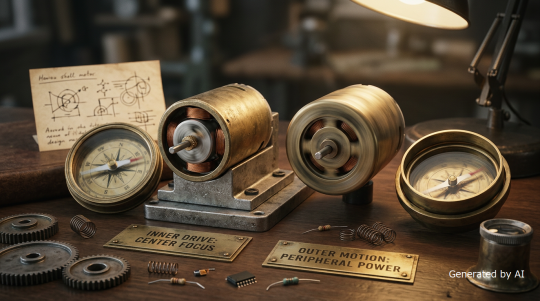
Inner rotors and outer rotors differ in characteristics such as torque characteristics, responsiveness, and shape due to their structural differences. The main differences are as follows.
| Comparison Criteria | Inner Rotor | Outer Rotor |
| Rotor Position | Inside the stator | Outside the stator |
| Moment of inertia | Easier to reduce | Tends to be large |
| Torque | Requires ingenuity to achieve high torque | Easy to increase |
| Responsiveness | Easy to increase | Tends to be at a relative disadvantage |
| Changes in rotational speed | Easy to respond to quickly | Easier to suppress sudden changes |
| Rotational speed | Easier to design for high-speed rotation | Requires verification of rotor strength, etc. |
| Heat dissipation | It is easy to ensure heat dissipation pathways | Cooling design is critical |
| Shape | Easy to design with a small diameter and cylindrical shape | Easy to design with a large diameter and thin profile |
*These are general structural trends; actual performance varies depending on product design and operating conditions.
Inner rotors tend to be suitable for applications requiring high-speed rotation and responsiveness, while outer rotors are better suited for applications where torque and sudden changes in rotational speed need to be minimized. Let’s take a closer look at the differences in each category.
Differences in Structure and Moment of Inertia
The placement of the rotor in inner-rotor and outer-rotor designs results in differences in moment of inertia. Moment of inertia is a value that represents the “resistance to motion” when changing the speed of a rotating object.
Since inner rotors place a small-diameter rotor inside the stator, it is easier to reduce their moment of inertia, making them well-suited for rapid acceleration and deceleration. In contrast, outer rotors place the rotor on the outer periphery, so their moment of inertia tends to be larger.
Although this can be a disadvantage during acceleration and deceleration, the higher inertia tends to make it easier to suppress sudden changes in rotational speed.
Differences in Torque
Generally, outer-rotor designs are better suited for generating high torque. Torque is the force that causes an object to rotate; even when the same force is applied, the torque increases as the distance from the center of rotation to the point where the force acts becomes longer.
Since outer-rotor motors can more easily achieve a large rotor radius, their design is well-suited for applications requiring high torque at low speeds. Inner-rotor motors tend to have smaller rotor diameters, which can be a disadvantage when attempting to achieve high torque under similar external dimensions.
However, since actual torque is also influenced by factors such as magnets, windings, motor dimensions, electric current, and cooling conditions, it cannot be determined based on rotor type alone.
Differences in Speed and Responsiveness
If speed and responsiveness to acceleration and deceleration are priorities, the inner rotor is the more suitable design. This is because the smaller rotor diameter makes it easier to reduce the moment of inertia, allowing for quick responses to starting, stopping, and speed changes.
Outer-rotor motors tend to have higher moments of inertia and are relatively less advantageous during rapid acceleration and deceleration; however, they tend to better suppress sudden changes in rotational speed caused by load fluctuations. However, it is not necessarily true that “inner-rotor = high speed” and “outer-rotor = low speed.”
Since the maximum rotational speed depends on factors such as rotor strength, magnet mounting method, bearings, and heat generation, it is necessary to check the specifications for each specific product.
Differences in Size and Heat Dissipation
The shape of the motor also has distinct characteristics. Inner-rotor motors are easier to design with a small rotor diameter and are well-suited to a slender cylindrical shape. Since the stator—which engages in heat generation—is located on the outer periphery, it is easier to ensure heat dissipation pathways through the housing or mounting surface.
Outer-rotor motors are characterized by the placement of the rotor on the outer circumference, making it easier to achieve large-diameter, slim profiles. This advantage is particularly useful in equipment where axial installation space is limited.
Heat dissipation performance is not determined by the rotor type alone. It must be evaluated after considering factors such as the case material, mounting method, ambient temperature, load factor, and cooling method.
Advantages and Disadvantages of Inner Rotors
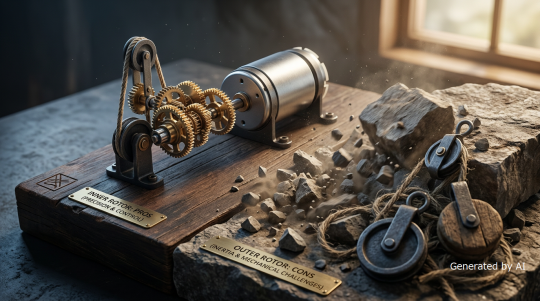
The inner rotor design makes it easier to reduce the rotor’s diameter and minimize its moment of inertia. While this improves responsiveness during acceleration and deceleration and enhances suitability for high-speed rotation, it may require special design considerations to achieve high torque.
Here, we will explain the advantages and considerations of the inner rotor.
Advantages of the Inner Rotor
The main advantage of an inner rotor is that it facilitates improved responsiveness to acceleration and deceleration. Because the rotor has a small diameter and is located close to the center of the rotation axis, it is easier to minimize the moment of inertia.
Consequently, this design is well-suited for applications requiring rapid starts and stops or frequent speed changes. Another advantage is that the stator, which contains the windings, is located on the outer periphery, making it easier to dissipate heat through the housing or mounting surface.
It is used in applications that require responsiveness and heat dissipation, such as fans, pumps, and conveying mechanisms that operate at high speeds or with variable speeds.
Disadvantages of Inner Rotors
When compared under similar external dimensions, inner rotors tend to have a harder time achieving the same level of torque as outer rotors. This is because the rotor has a smaller diameter, making it difficult to secure sufficient distance between the center of rotation and the point where the electromagnetic force acts.
To achieve both high torque and compact size, careful design of the magnets, windings, and magnetic circuit is required. It is also important to note that high-speed rotation subjects the rotor and magnets to significant centrifugal forces.
Rather than judging solely by maximum rotational speed, it is necessary to verify whether the specifications are suitable for the intended operating conditions, taking into account factors such as the method of securing the magnets, the strength of the rotor, and the bearings.
Advantages and Disadvantages of Outer Rotors
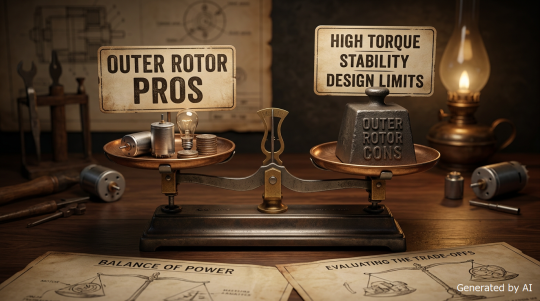
Outer rotors are designed to easily secure a large rotational radius for the rotor, making it easier to achieve high torque. Furthermore, because they tend to have a large moment of inertia, they are characterized by their ability to suppress sudden changes in rotational speed.
On the other hand, there are points to be mindful of when dealing with frequent acceleration and deceleration or when integrating the motor into equipment. Here, we summarize the advantages and disadvantages of outer rotors.
Advantages of Outer Rotors
The main advantage of an outer rotor is its ability to generate high torque. Because the rotor is positioned toward the outer circumference, it is easier to ensure a sufficient distance between the center of rotation and the point where the electromagnetic force acts, making it suitable for applications that require torque at low speeds.
Another characteristic is that the rotor’s moment of inertia tends to be large, making it easier to suppress sudden changes in rotational speed. Furthermore, since it is easy to design them with a thin, flat shape that minimizes axial length, they are a viable option even for equipment with limited installation space.
Disadvantages of Outer Rotors
Outer rotors tend to have a high moment of inertia, which can be a disadvantage for applications involving sudden acceleration or deceleration, or frequent speed changes. Since significant force is required for starting, stopping, and reversing, it is essential to consider load inertia when designing for applications that require rapid operational switching.
Furthermore, because the outer periphery rotates, safety measures to prevent contact with operators or surrounding components are crucial. In addition to installing guards and covers, be sure to check for interference with wiring and sensors, as well as the installation space required for the rotating parts.
In environments requiring dust and drip protection, it is necessary to consider protective structures and cooling methods as well.
Main Applications of Inner Rotors and Outer Rotors
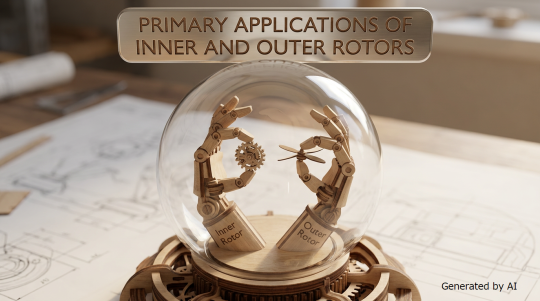
Inner rotors and outer rotors are selected based on the required rotational characteristics and installation conditions. The following are general guidelines for their main applications.
| Key Considerations | Guidelines for Suitable Designs | Application Examples |
| Rapid Acceleration and Deceleration | Inner Rotor | Servo, positioning mechanisms, transport mechanisms |
| Frequent speed changes | Inner Rotor | Variable-speed fans, pumps, and actuators |
| High-speed rotation | Inner Rotor | Fans, blowers, spindles, etc. |
| High torque | Outer rotor | Low-speed drive, direct drive, etc. |
| Constant-speed rotation | Outer rotor | Fans, constant-speed drive mechanisms, etc. |
| Thinner design in the axial direction | Outer rotor | Flat-type drive units, slim-profile equipment |
*The table shows general structural trends. When making an actual selection, factors such as torque, rotational speed, dimensions, and cooling conditions must also be verified.
Inner rotors tend to be suitable for applications requiring responsiveness and acceleration/deceleration performance, while outer rotors are better suited for applications where torque and sudden changes in rotational speed need to be minimized. Let’s take a closer look at some typical applications.
Applications Suitable for Inner Rotors
Inner rotors are suitable for equipment that requires rapid starting, stopping, and speed changes. Their strengths lie in the ease of reducing the rotor’s moment of inertia and their ability to respond quickly to changes in rotational speed.
Typical examples include positioning mechanisms, actuators, and conveying mechanisms that use servo motors. They are also well-suited for high-speed rotation and variable-speed operation, making them a viable option for fans, pumps, and blowers.
Since the required rotational speed and torque vary depending on the application, it is important to check the specifications of each individual product before selecting one.
Applications Suitable for Outer Rotors
For equipment where high torque and stable rotation are priorities, outer rotors are a strong choice. They allow for a larger rotor radius, making it easier to achieve high torque, and are characterized by their ability to minimize sudden changes in rotational speed.
Major applications include fans, blowers, and direct-drive mechanisms that require high torque at low speeds. Because they are easy to design in a slim profile, they can be used in equipment with limited axial space.
When selecting a motor, be sure to consider not only torque but also acceleration and deceleration performance, outer diameter, cooling conditions, and safety.
Which Should You Choose—Inner Rotor or Outer Rotor?
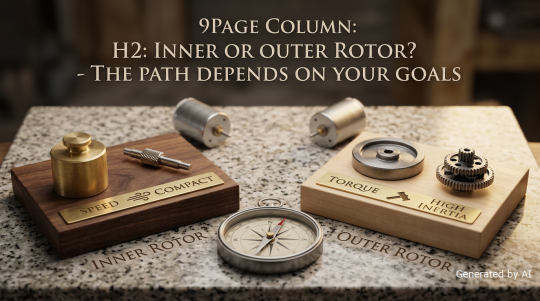
Neither inner-rotor nor outer-rotor designs is inherently superior in all cases. The appropriate design depends on the specific application requirements, such as the required rotational speed, torque, frequency of acceleration and deceleration, and available installation space.
The main selection criteria are summarized as follows.
| Key Considerations | Structure Best Suited for the Application | Key Considerations |
| High-speed rotation and frequent acceleration/deceleration | Inner Rotor | Rotational Speed, Moment of Inertia, Torque |
| High torque | Outer Rotor | Rated and maximum torque, outer diameter, cooling |
| Rotational Stability | Outer Rotor | Rotational Fluctuations, Load Fluctuations, Control Methods |
| Thinner design in the axial direction | Outer Rotor | Outer diameter, interference in rotating parts, safety |
| Ensuring Heat Dissipation Paths | Comparison of the Two Types | Stator position, mounting surface, cooling method |
| High load inertia | Comparison of the Two Types | Allowable Load Inertia, Acceleration Torque, and Safety Factor |
*The table shows general structural trends. Actual performance varies depending on the motor’s design, specifications, and operating conditions.
If speed and responsiveness are priorities, an inner rotor is the primary choice; if high torque and stable rotation are required, an outer rotor is the primary choice. However, the decision should not be based solely on the rotor type; it must be made by comprehensively evaluating the required specifications.
Consider an inner-rotor motor if speed and responsiveness are priorities
Inner-rotor motors are a strong choice when frequent starts, stops, acceleration, deceleration, or speed changes are required. Since the rotor can be designed with a smaller diameter, reducing the moment of inertia, these motors can respond quickly to changes in rotational speed. They are well-suited for high-speed operation and variable-speed applications, making them an ideal choice for equipment that requires rapid operational switching.
However, it is not appropriate to base your selection solely on responsiveness. It is important to also verify the rated torque, instantaneous maximum torque, and the load’s moment of inertia to ensure you select a product that meets the required performance criteria.
Consider an outer rotor if torque and stable rotation are priorities
If high torque and stable rotation are priorities, consider an outer rotor. This design makes it easier to secure a large rotor rotation radius, allowing for higher torque under comparable conditions. While the moment of inertia tends to be higher, this makes it a viable option for applications where you want to minimize sudden changes in rotational speed caused by load fluctuations.
However, since they can be at a disadvantage during rapid acceleration and deceleration or frequent speed changes, striking a balance with responsiveness is essential. Be sure to also consider the outer diameter, cooling conditions, and the safety of rotating parts.
Make a Comprehensive Decision Based on Application and Specifications
When making the final motor selection, it is important not to base the decision solely on whether to use an inner or outer rotor, but rather to clearly define the performance required for the application. The rotor type is merely one selection factor; actual performance is also influenced by operating conditions, load, cooling methods, and other factors.
When making a selection, be sure to verify the following items in particular:
- Required Speed and Torque
- Frequency of starts, stops, and acceleration/deceleration
- Load moment of inertia
- Operating conditions, such as continuous or intermittent operation
- Dimensions and installation space
- Operating temperature and cooling method
- Rated torque and peak torque
It is important to compare multiple conditions and perform motor selection to ensure that the motor meets the application and required specifications.
Summary

Inner-rotor and outer-rotor motors have different characteristics—such as torque, responsiveness, rotational stability, and shape—depending on the rotor configuration. Generally, inner-rotor motors are a strong choice for high-speed operation and frequent acceleration and deceleration, while outer-rotor motors are a strong choice for high torque and stable, constant-speed operation.
However, when performing motor selection, it is important not to base the decision solely on structure, but to comprehensively evaluate factors such as the required speed, torque, load, installation space, and cooling conditions.
At C.I. Takiron Corporation, we provide support for motor selection tailored to your specific applications and requirements. If you are having trouble choosing the optimal product or with product development, please feel free to contact us.
Product Information & Inquiries
For more details on C.I. Takiron’s micro motor products, please visit the website below.
- Product Site: https://cik-ele.com/en/
- Coreless Motors: https://cik-ele.com/en/products/list/coreless_motor/
- Brushless Motors: https://cik-ele.com/en/products/list/brushless_motor/
- Geared Motors: https://cik-ele.com/en/products/list/gearhead/
- Encoders: https://cik-ele.com/en/products/list/encoder/
If you are having trouble selecting a small motor for your product development, please feel free to contact us via the inquiry form. Our technical staff will discuss your application and requirements with you and propose the optimal solution.
- Inquiries: https://cik-ele.com/en/contact/