

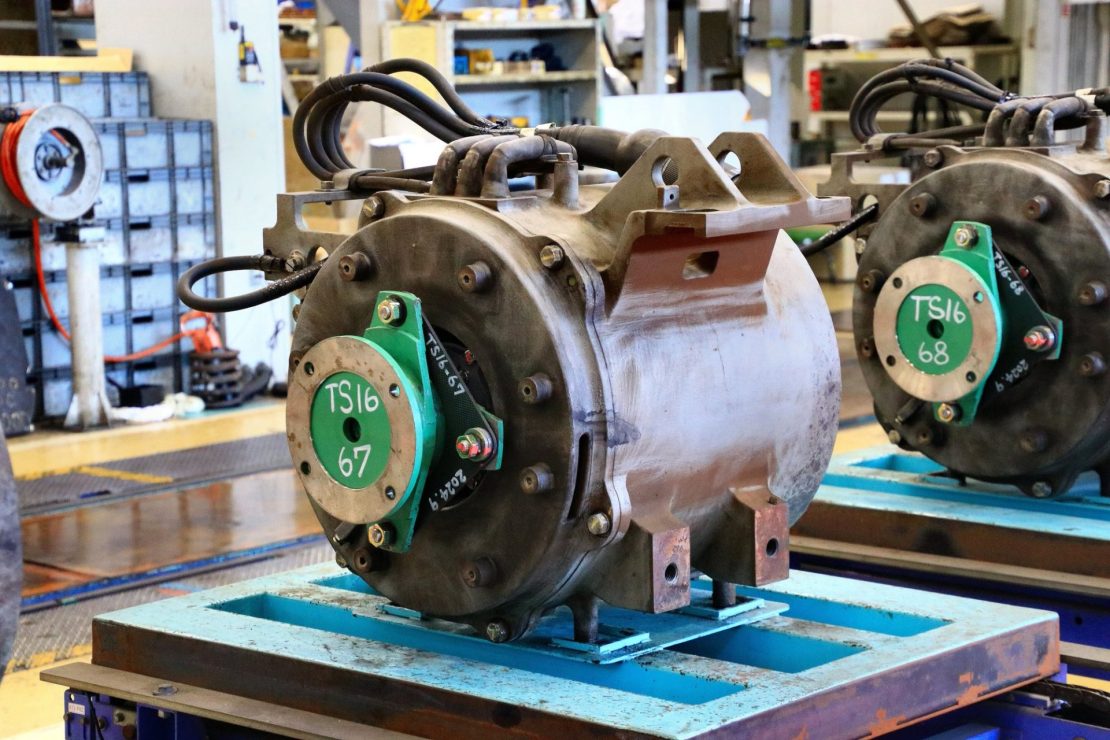
Industrial motors are used as power sources for a wide range of equipment, including conveyor systems, robots, and medical equipment. However, with so many types available—such as DC motors, AC motors, and Brushless motors—it’s not uncommon for design and procurement personnel to struggle with the question, “How do I choose the right motor for my application?”
Motor selection can result in an inability to achieve the required torque or rotational speed, which could lead to reduced equipment performance and increased costs. To choose the right product, it is important to understand the characteristics of each type and comprehensively compare factors such as output, size, durability, and control performance.
In this article, we will outline the main types and characteristics of industrial motors and explain key points to consider during motor selection, as well as how to choose the right motor for specific applications.
| Supervised by: C.I. TAKIRON Corporation Electronic Devices Sales Group This article has been supervised based on the advanced technical expertise and insights we have cultivated since our founding in 1919 as a leading company in plastic processing. Our department continuously analyzes market trends and the latest technologies in ultra-compact, high-precision micro motors, focusing on providing high-value-added information to designers and developers. As a team of experts with in-depth knowledge of product characteristics, we support our customers’ problem-solving and technological innovation by delivering accurate and practical content. |
Select Industrial & Automation Motors Based on Application and Required Performance
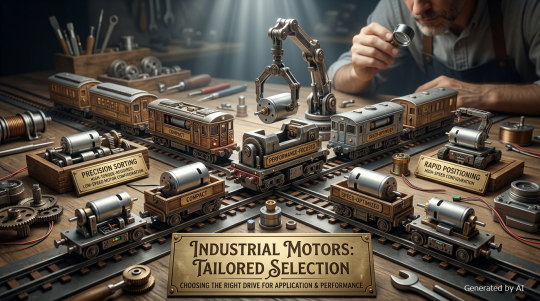
When selecting an industrial motor, it is important to clearly define the equipment’s application and required performance. While industrial motors are used in a wide range of fields—including industrial equipment, factory automation (FA) equipment, conveyor systems, robots, and medical equipment—the required rotational speed, torque, positioning accuracy, and operating time vary depending on the application.
For example, conveyors require stable rotation and the ability to handle continuous operation, while robot joints require high-precision position control. When making a selection, you should primarily check the following items.
| Classification | Key Considerations | Purpose of Verification |
| Operating Conditions | Rotational Speed, Torque, and Positioning Accuracy | To determine the required drive performance |
| Operating Conditions | Acceleration/deceleration, operating time, load fluctuations | Determine the performance required for operation |
| Installation Conditions | Installation Space, Power Supply Voltage, Operating Environment | Verifying Integration into Equipment and Stable Operation |
Just because a motor has high output does not necessarily mean it is suitable for the equipment. It is important to first verify that it meets the required torque and rotational speed and can handle the operating conditions before comparing types and specifications.
The Five Main Types of Industrial & Automation Motors and Their Characteristics
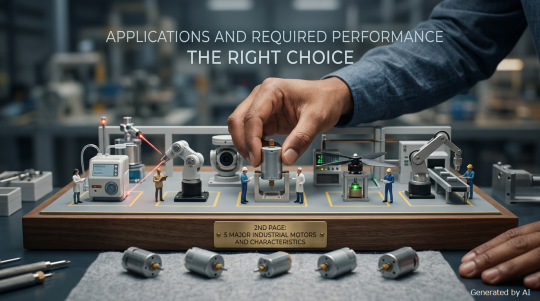
Industrial motors include DC motors, AC motors, Brushless motors, stepper motors, and servo motors. Since each type differs in drive mechanism, control method, and optimal operating conditions, motor selection must be based on the specific application.
Here, we explain the characteristics of these five representative types, their suitable applications, and key considerations for selection.
DC motors and AC motors | Used for General-Purpose Rotational Drive
DC motors are powered by a DC power supply, while AC motors are powered by alternating current. Although both are used in a wide range of industrial equipment, their characteristics and suitable applications differ.
Brushed DC Motors allow for easy adjustment of rotational speed via voltage and are suitable for small devices and simple drive systems. However, because their design involves contact between the brushes and the commutator, their lifespan is limited by wear. When selecting a motor, consider maintenance requirements and electrical noise.
AC motors are well-suited for applications requiring continuous operation or high output, such as pumps, fans, and conveyors. Perform motor selection based on the required rotational speed, load conditions, and operating method.
Brushless motors | Suitable for Applications Requiring High Efficiency and a Long Service Life
Brushless motors are suitable for industrial equipment that requires high efficiency and a long service life for drive systems. They are characterized by a design that does not use brushes or a commutator; instead, the driver electronically switches the electric current to generate rotation.
Since there is no brush wear, they reduce the maintenance burden associated with replacements. Furthermore, their design minimizes losses, making it easier to achieve high efficiency and low heat generation, and they are easily miniaturized, which is why they are also used in medical equipment, robots, and precision equipment.
However, a compatible driver is required for operation. When performing motor selection, be sure to consider not only the motor’s individual performance but also its speed range, control accuracy, power supply specifications, and installation space.
Stepper Motors and Servo Motors | Suitable for Positioning and Precision Control
For equipment requiring precise positioning, stepper motors and servo motors are viable options. The appropriate type varies depending on the required accuracy, speed, and load conditions.
Stepper motors rotate with a fixed rotational angle in response to pulse signals, allowing for positioning with a relatively simple configuration. However, if the load or acceleration is too high, “loss of synchronization”—where the motor fails to rotate as commanded—may occur.
Servo motors perform motor control based on position and speed information detected by devices such as encoders. While they are well-suited for high-precision positioning and high-speed response, it is important to consider the costs associated with peripheral equipment and calibration when performing motor selection.
Comparing the Differences Among 5 Types of Industrial & Automation Motors
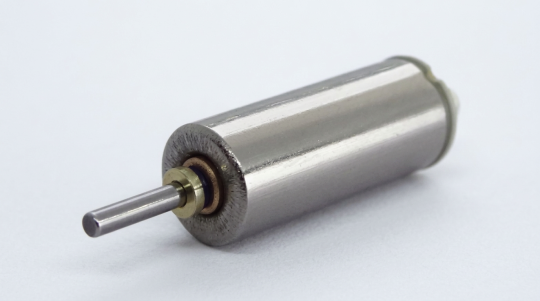
View list of coreless motor products
Industrial & Automation motors differ in terms of torque, rotational speed, output, control performance, and durability. To select the product best suited for your application, refer to the comparison table below to review the characteristics of five representative types.
Note that the classification of DC and AC motors is based on their power supply type, and the classification criteria differ from those used for Brushless motors and other types. In the comparison table, Brushed DC motors are featured as a representative example of DC motors.
| Type | Main Features | Control and Positioning | Maintenance Characteristics | Main Applications |
| Brushed DC Motors | Compact and easy to adjust speed | Simple speed control | Be mindful of brush wear | Small Devices and Simple Drives |
| AC motors (induction motors, etc.) | Suitable for continuous operation and high output | Rotational speed varies with frequency | No brush replacement required | Pumps, Fans, and Conveyors |
| Brushless motor | High efficiency and long service life | Supports precise speed control | No brush replacement required | Industrial equipment and medical equipment |
| Stepper Motors | Rotates with fixed rotational angles | Simple positioning | No brush replacement required | Positioning and low-speed operation |
| Servo Motor | High-speed response and high precision | High-precision position and speed control | Depending on configuration | Machine Tools and Robots |
If continuous operation is a priority, AC motors or Brushless motors are good options; for relatively simple positioning tasks, stepper motors are suitable. For applications requiring high-speed, high-precision positioning, servo motors are the best choice.
However, even within the same type, performance varies depending on rated output, rotational speed, the presence or absence of a gearhead, and the control method. After narrowing down your options, check the specifications of individual products, taking into account the torque, precision, operating time, and operating environment required for your equipment.
Key Points to Consider When Selecting an Industrial & Automation Motor
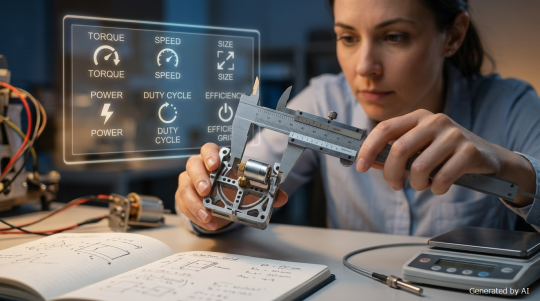
Once you’ve narrowed down the types of motors, the next step is to confirm the performance requirements and operating conditions of your equipment. In addition to the relationship between torque, rotational speed, and output, it’s important to compare factors such as installation space, control performance, and cost to select a product that meets your specifications.
Here, we explain the main points to consider during motor selection.
Checking Torque, Speed, and Power
When selecting an industrial & automation motor, it is important to understand the relationship between torque, speed, and power. Torque is the force that rotates the shaft; speed indicates the number of revolutions per minute; and power is proportional to the product of these two values.
The unit for torque is N·m (newton-meter), and for compact motors, mN·m (millinewton-meter)—equivalent to one-thousandth of 1 N·m—is also used . Caution is required because higher torque may be needed during startup and acceleration than when operating at a constant speed.
When calculating the required torque, take into account the force needed to move the load and the force required for acceleration, and allow for a margin of safety. Additionally, if high torque is required at low speeds, Geared motors are one option to consider.
It is important not to base your decision solely on output power, but to verify that sufficient torque can be maintained at the required rotational speed.
Check Size, Durability, and Operating Environment
When selecting an industrial motor, it is essential to choose a product suited to the installation space, operating conditions, and operating environment. If using a Geared motor, be sure to check the overall dimensions of the combined motor and gearhead assembly.
It is also important to consider the required installation space for peripheral devices such as encoders and drivers. If long periods of continuous operation are required, rated output, heat generation, component lifespan, and maintainability are also important factors.
For example, Brushed DC motors require consideration of brush wear, while Brushless motors reduce the burden of brush replacement. Additionally, ambient temperature, humidity, vibration, dust, and moisture can all affect operation and lifespan.
Do not prioritize miniaturization alone; instead, select specifications that ensure the necessary performance and durability.
Verify Control Performance and Cost
When performing motor selection, it is important to evaluate both the required control performance and the post-installation costs. Determine whether the motor simply needs to rotate at a constant speed, or if it must also handle speed changes, forward/reverse operation, and precise positioning.
If high-precision positioning or high-speed response is required, you’ll need to consider a control system that includes components such as encoders and drivers. Costs associated with peripheral equipment, configuration, and adjustment vary depending on the type of motor.
It is also important to compare not only the price of the motor itself but also power consumption and maintenance and replacement costs. Avoid selecting a motor with higher performance than necessary, and make your selection by balancing long-term costs with the required performance.
How to Select Industrial & Automation Motors Based on Application and Performance Requirements

The appropriate motor differs depending on whether the equipment prioritizes continuous operation or requires high-precision positioning. Selection criteria must also be adjusted when compact size or energy efficiency is a priority.
In the following sections, we will examine typical applications and explain how to select a motor based on required performance.
Consider AC motors for Continuous Operation and High Power Output
For applications such as pumps, fans, and conveyors—which require long periods of continuous operation or high output—AC motors are a strong candidate. Powered by alternating current, many AC motors offer excellent robustness and durability, making them widely used as power sources for industrial equipment.
In addition to operating at a constant speed, some AC motors also support forward/reverse operation and speed control. Depending on the load conditions and operating method, you should also check whether a gearhead or brake is required.
However, when high-precision positioning or rapid acceleration and deceleration are required, standard induction motors may not be suitable; in such cases, stepper motors or servo motors should also be considered. It is important to select the appropriate motor based on the required control performance and operating conditions.
Consider Stepper Motors or Servo Motors When Positioning Is a Priority
For applications where positioning is a priority, choose between stepper motors and servo motors based on the required precision, speed, and load conditions. For relatively simple positioning tasks, stepper motors—which rotate in fixed rotational angles in response to pulse signals—are suitable.
However, caution is required because if the load or acceleration is too high, “loss of synchronization”—where the motor fails to rotate as commanded—may occur. Servo motors are the preferred choice when high-speed, high-precision positioning or the ability to handle load fluctuations is required.
Servo motors can control rotation using position data from encoders. When performing motor selection, be sure to consider the costs of peripheral equipment and setup as well.
Consider Brushless motors or Coreless motors for compact size, high efficiency, and a long service life
For medical equipment, precision instruments, robots, and other applications requiring miniaturization and low power consumption, Coreless motors are a strong choice; for applications requiring a long service life, Brushless motors are a strong choice. Since Brushless motors do not suffer from brush wear, they help reduce maintenance burdens and are well-suited for high efficiency operation.
Furthermore, Coreless motors—which lack an iron core in the rotor—feature a lightweight rotating assembly and a design well-suited for rapid acceleration and deceleration, as well as compact and lightweight construction. Since Brushless motors are classified by their commutation method and Coreless motors by the presence or absence of an iron core, it is essential to verify their structure and performance based on the specific application.
Compare factors such as required torque, rotational speed, responsiveness, control methods, and cost to select a product that meets the performance requirements of your equipment.
Summary
There are several types of industrial motors, including DC motors, AC motors, and Brushless motors, each with different characteristics and suitable applications. When performing motor selection, it is important to comprehensively evaluate not only torque, rotational speed, and output but also size, durability, control performance, and cost.
In particular, for industrial equipment that requires miniaturization, high efficiency, and a long service life, Brushless motors and Coreless motors are strong options. Clearly define the required performance of your equipment and select a product suited to your application.
C.I. Takiron Corporation offers a range of compact motor products, including Coreless motors, Brushless motors, and Geared motors. If you have any questions regarding motor selection or specifications for industrial motors, please feel free to contact us.
Product Information & Inquiries
For more details on C.I. Takiron’s micro motor products, please visit the website below.
- Product Site: https://cik-ele.com/en/
- Coreless Motors: https://cik-ele.com/en/products/list/coreless_motor/
- Brushless Motors: https://cik-ele.com/en/products/list/brushless_motor/
- Geared Motors: https://cik-ele.com/en/products/list/gearhead/
- Encoders: https://cik-ele.com/en/products/list/encoder/
If you are having trouble selecting a small motor for your product development, please feel free to contact us via the inquiry form. Our technical staff will discuss your application and requirements with you and propose the optimal solution.
- Inquiries: https://cik-ele.com/en/contact/