


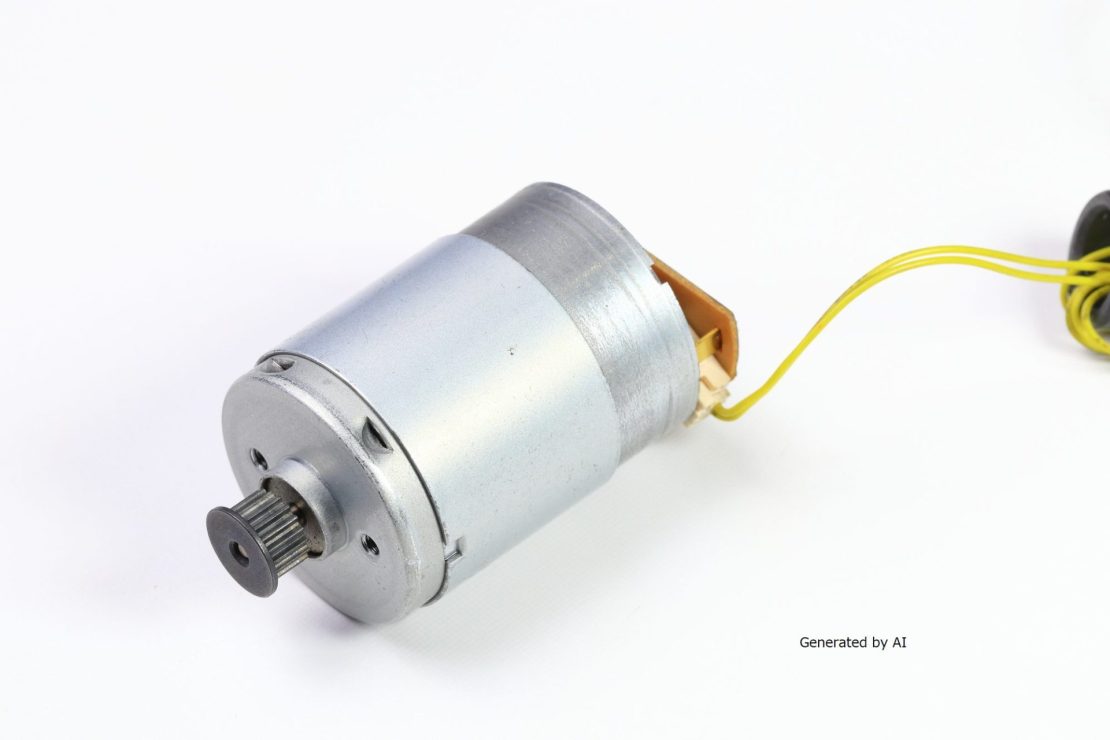
DC motors are motors that use a DC power supply to generate rotational motion.They convert electrical energy into mechanical energy and are used in a wide range of fields, from industrial equipment to medical equipment and automotive electrical components. DC motors come in brushed and Brushless DC Motors varieties, each with different structures and characteristics. Brushed DC motors require no drive circuit and are low-cost, while Brushless DC Motors offer a long service life and excellent quiet operation; they can be selected based on the application and required performance.
Furthermore, a clear understanding of the differences between DC motors and AC motors—which operate on alternating current—will help you with motor selection for your application. While DC motors offer greater flexibility in speed control through voltage control and are compatible with battery power, AC motors feature a robust structure and are designed for long periods of continuous operation.
In this article, we will provide an easy-to-understand explanation of the basic principles of motor operation and structure of DC motors, the characteristics of Brushed DC motors and Brushless DC motors, and a comparison with AC motors. We hope you find this useful as a reference for motor selection.
| Supervised by: C.I. TAKIRON Corporation Electronic Devices Sales Group This article has been supervised based on the advanced technical expertise and insights we have cultivated since our founding in 1919 as a leading company in plastic processing. Our department continuously analyzes market trends and the latest technologies in ultra-compact, high-precision micro motors, focusing on providing high-value-added information to designers and developers. As a team of experts with in-depth knowledge of product characteristics, we support our customers’ problem-solving and technological innovation by delivering accurate and practical content. |
How DC motors Work and Their Basic Structure
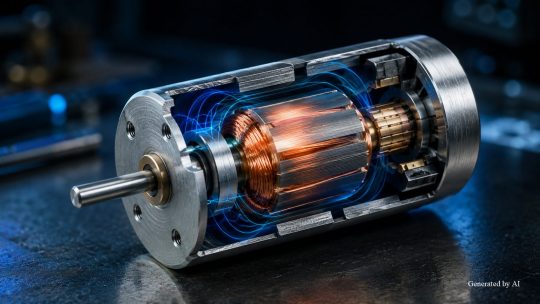
A DC motor is a motor that converts electrical energy from a DC power supply into rotational motion. A proper understanding of the physical laws underlying its operation, the roles of its major components, and methods of speed control forms the foundation for the proper use of DC motors. Below, we will explain these three points in order.
Contents of This Section
- Principle of Rotation Based on Fleming’s left-hand rule
- Roles of the Rotor, Stator, Commutator, and Brushes
- Speed Control via Voltage Control and PWM control
Here, we will explain the principle of motor operation for DC motors, their components, and the basics of speed control.
Principle of Rotation Based on Fleming’s left-hand rule
Fleming’s left-hand rule is the fundamental principle underlying the principle of motor operation for DC motors. In Brushed DC Motors, permanent magnets or electromagnets are placed on the stator side to create a magnetic field. When a coil is placed within this magnetic field and a direct current is passed through it, an electromagnetic force is generated due to the interaction between the magnetic field and the electric current.The magnitude of the force generated is represented by the equation F = BLI (B: magnetic flux density; L: length of the wire in the magnetic field; I: electric current), which describes the force acting on a conductor carrying an electric current within a magnetic field.
This equation shows that the force generated increases as the magnetic flux density increases, as the length of the wire in the magnetic field increases, and as the electric current increases. In actual motors, multiple coils are arranged to generate continuous torque; while the calculations become complex, the basic principle is based on this equation.
The direction of the force is determined by Fleming’s left-hand rule, where the thumb points in the direction of the force (F), the index finger in the direction of the magnetic flux (B), and the middle finger in the direction of the electric current (I). The electromagnetic force generated in the coil causes the rotor to rotate, but if the direction of the electric current remains the same after half a revolution, the rotation will stop.The commutator and brushes automatically reverse the direction of the electric current flowing through the coils in sync with the rotation, thereby generating continuous rotational motion.
Roles of the Rotor, Stator, Commutator, and Brushes
The rotor, stator, commutator, and brushes are the four main components that make up Brushed DC Motors. Each component plays a distinct role, and it is through their coordinated operation that the DC motor is able to maintain continuous rotational motion. The roles of each component are as follows.
| Component Name | Role |
| Rotor | Composed of coils and an iron core, this is the part that rotates under the influence of electromagnetic force. It is connected to the output shaft. |
| Stator (Fixed Part) | Contains permanent magnets or electromagnets to generate a magnetic field inside |
| Commutator | Mounted on the rotor; it rotates while changing its contact position with the brushes to switch the direction of the electric current |
| Brushes | Connected to the power source; these are consumable parts that supply electric current to the rotor coils via the commutator |
Electric current is supplied to the rotor coils via the commutator and brushes, and because the direction of the electric current automatically reverses, the rotor can maintain continuous rotation in a single direction. The commutator is a component that switches the direction of the electric current; without this commutation function, the motor cannot continue rotating, and the shaft remains stationary.
Furthermore, because the brushes are in constant contact with the rotating commutator, friction occurs, causing them to wear out over time. Since long-term use requires periodic replacement and inspection, this is a key consideration when designing Brushed DC Motors*.
*Parts in our motors cannot be replaced.
Speed Control via Voltage Control and PWM Control
Voltage control is the basic method for controlling the rotational speed of a DC motor. Changing the applied voltage alters the rotational speed. The actual electric current is affected by rotational speed and load; as the load increases and the rotational speed decreases, the counter-EMF decreases, allowing more electric current to flow. While basic speed control is possible by changing the voltage, it is important to note that torque is affected by load conditions and counter-EMF.
Back EMF is the voltage generated within the coils in the opposite direction of the applied voltage as the motor rotates. As the rotational speed increases, the back EMF also increases, and the electric current flowing through the coils decreases. Conversely, when the rotational speed decreases due to an increase in load, the back EMF decreases, the electric current increases, and the torque rises.Understanding the relationship between voltage, counter-EMF, electric current, and torque is fundamental to understanding the speed characteristics of DC motors.
For applications requiring more precise speed and torque control, PWM (Pulse Width Modulation) technology is widely used. PWM control is a method that adjusts the effective voltage applied to the motor by rapidly switching the power supply on and off to vary the duty cycle.
A higher duty cycle increases the power supplied to the motor, raising the rotational speed, while a lower duty cycle reduces the power supplied, lowering the rotational speed. Because it results in low power loss and enables highly precise speed control, its use is expanding across a wide range of fields, including industrial equipment and precision instruments.
Types and Characteristics of DC motors
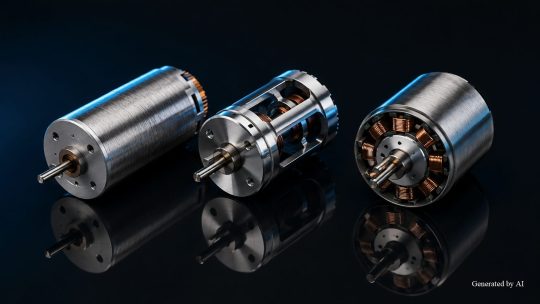
DC motors are broadly classified into two types based on the presence or absence of brushes: “Brushed DC Motors” and “Brushless DC Motors.” Since the two types have different structures, they also differ in characteristics such as cost, lifespan, noise, and heat dissipation. To perform motor selection for a specific application, it is important to correctly understand the characteristics and selection criteria of each type.
Topics Covered in This Section
- Structure and Characteristics of Brushed DC Motors
- Structure and Characteristics of Brushless DC Motors
- Selection Criteria for Brushed and Brushless Motors
Below, we will outline the structure and characteristics of each type and introduce the key points to consider when making a selection.
Structure and Characteristics of Brushed DC Motors
Brushed DC motors are designed to supply electric current to the rotor coils via a commutator and brushes. They are broadly classified into “permanent magnet field-wound” types, which use permanent magnets in the stator, and “electromagnet field-wound” types, which use electromagnets. Permanent magnet field-wound types are further classified into the following three categories based on the armature configuration.
[Classification of Permanent Magnet Field-Wound Motors]
- Slotted type: A type with grooves (slots) in the magnetic core, which causes cogging (resistance torque)
- Slotless Type: A type with no slots, which prevents cogging and is characterized by smooth rotation
- Coreless Type: A type without an iron core (core), featuring a low moment of inertia and excellent responsiveness and acceleration
The coreless type is also known as the moving-coil type. Because it lacks an iron core, the rotor is lightweight, resulting in excellent response speed during start-up and stopping. Its low moment of inertia makes it well-suited for repeated acceleration and deceleration, and this type is frequently adopted in fields requiring precise operation, such as medical equipment and optical equipment.
On the other hand, the electromagnetically field-excited type generates a field flux using an electromagnet instead of a permanent magnet and is classified into three types: separately wound, series-wound, and shunt-wound. It is often used in medium-sized and larger motors, and its speed and torque characteristics vary depending on the combination of field electric current and armature electric current.
Brushed DC motors rotate simply by connecting them to a power source, so they can operate without an electronic drive circuit. Their advantages include low cost and ease of control. On the other hand, because the commutator and brushes are in constant contact, the brushes wear out, requiring regular maintenance. They also generate electrical and mechanical noise due to friction, so caution is required in applications where noise suppression is a priority.
Structure and Characteristics of Brushless DC Motors
Brushless DC Motors feature a structure in which permanent magnets are arranged on the rotor and coils on the stator, with electric current controlled by an electronic circuit. It does not use brushes or a commutator; instead, the drive circuit (driver) detects the position of the rotor’s magnetic poles and controls the timing of electric current flow to each coil to rotate the rotor.
Since they have no brushes or commutators, these motors do not suffer from a reduced lifespan due to brush wear and therefore have a long service life. They are also less prone to electrical and mechanical noise caused by brush contact, providing them with quiet operation. Brushless DC motors are often chosen when a long-lasting motor is required.
Furthermore, because the coils in Brushless DC motors are located in the stator (the housing side), heat generated by the coils is easily dissipated to the outside through the housing, resulting in a structure with higher heat dissipation efficiency compared to brushed motors. This makes it easier to suppress temperature rise even during continuous operation, allowing for stable performance.
Although the overall system cost tends to be higher than that of brushed motors due to the need for a drive circuit, Brushless DC Motors are well-suited for applications that require high power efficiency and continuous operation.
Key Considerations for Selecting Between Brushed and Brushless Motors
The choice between brushed and brushless motors depends on requirements such as cost, lifespan, noise, and controllability. The table below compares the main differences between the two types.
| Comparison Criteria | Brushed DC Motors | Brushless DC Motors |
| Drive Circuit | Not required (rotates when connected to power) | Required (controlled by the control circuit) |
| lifespan | Relatively short due to brush wear | Long service life with no brush wear |
| Electrical noise | Generated by brush contact | Minimal due to the absence of mechanical contacts |
| Heat dissipation | Relatively low | High, as the coil is located on the case side |
| cost | Simple structure and relatively low cost | Requires a drive circuit, so costs tend to be higher |
Brushed motors are suitable for applications where initial costs need to be kept low or where simple operation without a drive circuit is desired. For applications requiring a long service life, brushless motors are a strong choice.
For continuous operation in high-temperature environments, brushless motors—with their high heat dissipation efficiency—offer an advantage. In fields requiring quiet operation, such as medical equipment and optical equipment, low-noise brushless motors are often the preferred choice. Conversely, for intermittent use where a long service life is not an absolute requirement, brushed motors—with their cost advantages—are a reasonable choice. Consulting with the manufacturer is an effective way to perform motor selection for your specific application.
Differences and Applications of DC motors and AC motors
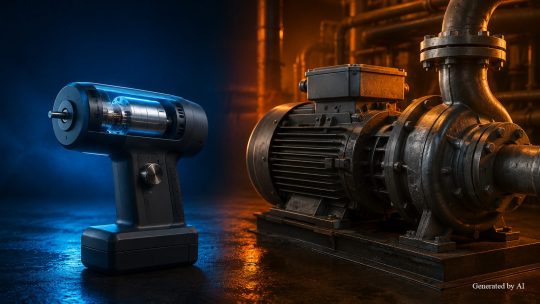
The fundamental difference between DC motors and AC motors lies in the type of power supply they use. DC motors operate on a DC power supply, while AC motors operate on alternating current; this difference in power supply results in variations in structure, control methods, and suitable applications.
Below, we explain the differences in power supply and structure, variations in control performance, and the primary applications for which DC motors are used.
Contents of This Section
- Comparing Differences in Power Supply and Structure
- Understanding Differences in Control Methods and Performance
- Main Applications of DC motors
Here, we will explain the differences between the two and the main applications of DC motors.
Comparing Differences in Power Supply and Structure
Differences in power supply and structure are the most fundamental points when comparing DC motors and AC motors.DC motors operate on a DC power supply. In Brushed DC motors, the commutator and brushes switch the direction of the coil electric current, while in Brushless DC Motors, a rotating magnetic field is generated by controlling the timing of current flow via electronic circuits. On the other hand, AC motors utilize the characteristics of an alternating current (AC) power supply to generate a rotating magnetic field in the stator, resulting in a simple and robust design.
The difference in structure stems from the differing properties of the electric current. Since the direction of the electric current in an AC power source reverses periodically, this characteristic can be directly utilized to generate a rotating magnetic field.Since electric current in a DC power source always flows in only one direction, controlling the electric current direction—using a commutator and brushes or electronic circuits—is essential for generating a rotating magnetic field. Because AC motors require fewer additional mechanisms, they tend to have fewer parts and a more robust structure.
The main differences between the two are summarized in the table below.
| Comparison Criteria | DC motors | AC motors |
| Power Supply | Direct Current (DC) | Alternating Current (AC) |
| Characteristics of Electric Current | Flows in a single direction | Flows in alternating directions |
| Typical Structures | Brushed: Commutator and brushes Brushless: Requires an electronic circuit | Simple structure utilizing the characteristics of an AC power source |
| Ruggedness | Compared to AC motors, there are more components | Simple and robust design |
Differences in power supply and structure lead to differences in controllability, durability, and maintainability.
Understanding the Differences in Control Methods and Performance
Differences in control methods and performance are key criteria for motor selection. A key feature of DC motors is their ability to achieve highly flexible control, including speed and torque control via voltage or PWM control, braking functions, and rotational angle control. DC electric current often offers advantages over AC electric current in manipulating electrical signals, enabling precise control that is difficult to achieve with AC motors.
Specifically, in addition to speed and torque control, DC motors can incorporate functions such as fault detection and specification of the rotational angle. While speed control is also possible with AC motors, DC motors often offer greater accuracy and flexibility in many applications.
AC motors use inverters and other devices to implement frequency-based speed control; however, depending on the system configuration, they may not be as well-suited for fine-grained torque control or control that prioritizes responsiveness as DC motors are. On the other hand, AC motors have a simple structure, offering excellent durability and characteristics well-suited for continuous operation. For factory equipment such as pumps and conveyors that require stable rotation over long periods, AC motors are a strong choice.
When performing motor selection, it is important to first clarify the control accuracy and responsiveness required for the application, and then determine whether DC motors or AC motors best meet those requirements.
Main Applications for DC motors
One reason DC motors are widely adopted across various fields is their compatibility with battery power. Since they can use portable batteries as a power source, they are well-suited for applications requiring portability, such as automotive electrical equipment, power tools, and electric-assist bicycles. The range of applications for DC motors is also expanding in both the residential and industrial sectors. The main applications are as follows.
[Main Applications of DC motors]
- Automotive electrical equipment (power windows, windshield wipers, seat motors, etc.)
- Medical equipment (pumps, endoscope drive units, etc.)
- Air conditioning and water heating equipment (air conditioners, refrigerators, etc.)
- Optical equipment (cameras, projectors, etc.)
- Industrial equipment (robots, conveyors, measuring instruments, etc.)
- Security equipment (such as electronic locks)
In everyday life, DC motors are incorporated into household appliances such as air conditioners, refrigerators, and water heaters. In the workplace, they are used inside projectors installed in offices and ATM terminals at financial institutions, and their use is expanding into residential equipment, particularly ventilation systems. In the industrial sector, their adoption is also progressing in robots and material-handling equipment that require precise control.
Note that when a device with a structure nearly identical to that of a DC motor is used for power generation, it is generally referred to as a “dynamo.” While DC motors convert electrical energy into rotational motion, a dynamo is a device that generates direct current from rotational motion. Since the optimal motor type and specifications vary depending on the application, we recommend consulting a specialized manufacturer when conducting specific motor selection.
Summary
DC motors are motors that operate on a DC power supply and follow the rotational principle based on Fleming’s left-hand rule.They are broadly classified into two types: brushed and brushless. Brushed motors require no control circuit and are low-cost, while brushless motors feature a long service life, low noise, and high heat dissipation. Compared to AC motors, DC motors typically offer greater flexibility in speed control and are compatible with battery power, making them widely adopted in a variety of fields, including medical equipment, automotive electrical systems, industrial equipment, optical equipment, and security equipment.
To perform effective motor selection for your application, it is effective to first gain a proper understanding of the structure and characteristics of the DC motors, then clarify requirements such as control accuracy, responsiveness, lifespan, cost, and operating environment, and consult with a specialized manufacturer.
At C.I. Takiron Corporation, we offer a comprehensive lineup of Micromotors, including Coreless motors, Brushless motors, and Geared motors, and we can propose the optimal motor to meet your specific requirements. Please feel free to contact us.
Product Information & Inquiries
For more details on C.I. Takiron’s micro motor products, please visit the website below.
- Product Site: https://cik-ele.com/en/
- Coreless Motors: https://cik-ele.com/en/products/list/coreless_motor/
- Brushless Motors: https://cik-ele.com/en/products/list/brushless_motor/
- Geared Motors: https://cik-ele.com/en/products/list/gearhead/
- Encoders: https://cik-ele.com/en/products/list/encoder/
If you are having trouble selecting a small motor for your product development, please feel free to contact us via the inquiry form. Our technical staff will discuss your application and requirements with you and propose the optimal solution.
- Inquiries: https://cik-ele.com/en/contact/