




In the manufacturing industry, against a backdrop of labor shortages and a decline in the number of skilled workers, there is a growing need to address labor-saving measures and automation. Among these solutions, “collaborative robots”—designed to work alongside humans in the same workspace—are attracting particular attention.
They are easy to integrate into existing processes while ensuring safety, and they help support high-mix, low-volume production and reduce the workload on workers. On the other hand, there are several key points to verify before implementation, such as speed, payload capacity, and safety measures.
In this article, we provide an easy-to-understand explanation of how collaborative robots work, how they differ from Industrial robots, their advantages and disadvantages, their main applications, and how to choose the right one.
| Supervised by: C.I. TAKIRON Corporation Electronic Devices Sales Group This article has been supervised based on the advanced technical expertise and insights we have cultivated since our founding in 1919 as a leading company in plastic processing. Our department continuously analyzes market trends and the latest technologies in ultra-compact, high-precision micro motors, focusing on providing high-value-added information to designers and developers. As a team of experts with in-depth knowledge of product characteristics, we support our customers’ problem-solving and technological innovation by delivering accurate and practical content. |
What Are Collaborative Robots?

A collaborative robot (Collaborative Robot/Cobot) is an industrial robot designed to work alongside humans in the same workspace. With conventional industrial robots, it was standard practice to separate operators and robots with barriers such as fences to ensure safety.
Collaborative robots are equipped with safety features, and in some cases, they can share a workspace with humans provided an appropriate risk assessment is conducted. In Japan, safety standards enabling collaborative work between industrial robots and humans were clarified in 2013, and the number of cases where robots can be operated without barriers has increased through the implementation of appropriate risk assessments and safety measures.
Mechanism and Features of Collaborative Robots
Collaborative robots are designed for use near workers and are equipped with safety features to reduce the risk of contact. Typical examples include functions that limit the force applied upon contact with a person, functions that control movement based on the distance from a person, and functions that stop the robot if safety cannot be ensured.
However, this does not mean that safety barriers can be omitted unconditionally simply because a robot is a collaborative robot. It is necessary to assess risks—including not only the robot itself but also tools, workpieces, and surrounding equipment—and confirm safety before determining how to operate the robot.
The Background Behind the Rise of Collaborative Robots
The growing interest in collaborative robots stems from labor shortages and a decline in the number of skilled workers in the manufacturing industry. By entrusting repetitive tasks—such as material handling, assembly, and screw tightening—to robots, workers can be more easily reassigned to tasks that require judgment and adjustments.
This will not only improve productivity but also reduce physical strain on workers. Furthermore, in production environments where product types and output volumes change frequently, the ability to adapt to process changes is crucial. Collaborative robots, which are relatively compact and easy to reposition and reconfigure, are expected to serve as an automation solution that supports high-mix, low-volume production.
The Difference Between Collaborative Robots and Industrial Robots
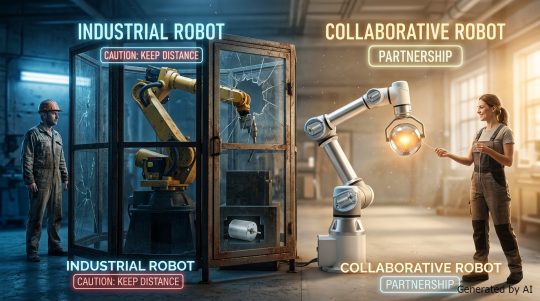
While collaborative robots are, in a broad sense, a type of industrial robot, they differ from conventional industrial robots in terms of safety, installation methods, and the types of tasks they excel at.
| Comparison Criteria | Collaborative Robots | Conventional Industrial Robots |
| Safety Fence | May be omitted depending on the results of a risk assessment | Isolation and safety measures, such as safety fences, are standard |
| Payload | Mainly small to medium-sized models | A wide range from small to large |
| Operating speed | Operation prioritizes safety when working alongside people | Well-suited for high-speed operation |
| Installation Space | Relatively space-efficient | Requires ample space, including safety barriers |
| Flexibility | Easily adapts to process and layout changes | Often used in a fixed configuration |
| Ideal production types | Small-batch, high-variety production; sites with frequent process changes | Mass production, standardized high-speed operations |
Collaborative robots are equipped with safety features designed for working alongside humans. If safety can be ensured through proper risk assessment, they can sometimes be operated without safety barriers. They are also characterized by their space-saving design, ease of implementation, and adaptability to process changes.
Conventional industrial robots come in a wide variety of models suited for high-speed operations and handling heavy loads, and are used in a broad range of settings, including mass production lines. Since collaborative robots and conventional industrial robots have different strengths, it is important to select the appropriate type based on the nature of the work, required speed, payload capacity, and installation environment.
Benefits of Introducing Collaborative Robots
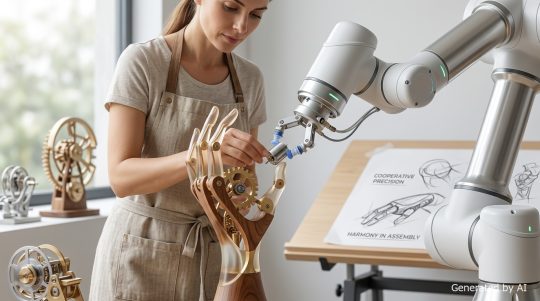
Introducing collaborative robots makes it easier to automate repetitive tasks and physically demanding work that were previously performed by humans. Furthermore, because they are space-saving, easy to install, and adaptable to process changes, they are an effective solution for addressing labor shortages and the need for high-mix, low-volume production.
Here, we introduce three main benefits of implementing collaborative robots.
Leading to Labor Savings and Increased Productivity
By entrusting repetitive tasks—such as material handling, assembly, and screw tightening—to collaborative robots, it becomes easier to keep production lines running even with a limited workforce. This allows workers to be reassigned to tasks requiring judgment and adjustments, leading to labor savings and improved productivity.
Workers can focus on tasks that require human experience and knowledge, such as decision-making, adjustments, and quality control. Furthermore, by deploying collaborative robots in processes facing labor shortages, it becomes possible to reevaluate staffing across the entire production floor.
By appropriately dividing tasks between humans and robots, companies can aim to improve productivity while making effective use of limited personnel.
Space-Saving and Flexible Implementation
Collaborative robots are space-efficient and easy to implement, and they can flexibly adapt to process changes. Provided safety is ensured through proper risk assessment, they can sometimes be operated without safety barriers, making them easy to integrate into existing production lines.
Many models are relatively compact, making them suitable for installation in confined spaces, such as around workbenches. Depending on the model and equipment configuration, it is also possible to move them to different production stages using carts or similar equipment.
This makes it easier to advance automation in accordance with changing conditions, even in facilities where product lines and production volumes fluctuate frequently.
Reducing the Burden on Workers
Collaborative robots can also be utilized as a means to reduce the physical strain on workers. By entrusting tasks such as handling heavy parts or performing repetitive tasks over long periods to the robots, it becomes easier to alleviate not only the strain on the lower back and arms but also the fatigue caused by monotonous work.
Workers can then devote their time to high-value tasks that require human judgment, such as inspection, decision-making, and process improvement. Reducing processes that place a heavy physical burden on workers is also effective in creating a work environment that is comfortable for everyone, regardless of age or physical condition.
Improving the work environment through the use of collaborative robots also helps create an environment where employees can continue working comfortably.
Disadvantages of Collaborative Robots and Precautions for Implementation

While collaborative robots offer many benefits, they are not suitable for every process. Since they are designed to work alongside humans, operational conditions can impose limitations on speed and force, and safety measures and risk assessments are essential.
To prevent mismatches after implementation, it is important to understand the drawbacks and points to note in advance.
Limitations on Speed and Payload
Since collaborative robots are designed to be used in the same space as humans, operational conditions impose limitations on their speed and force. Additionally, there are limits to the payload capacity depending on the model. This is because, to minimize the risk of contact with humans, they must operate at speeds and with forces that prioritize safety.
Although models with higher payload capacities have become more common in recent years, they may not meet the required production capacity in processes that involve handling heavy loads or require high-speed operations. For mass production lines or processes handling heavy loads, it is important to compare options—including conventional Industrial robots—and select the equipment best suited to the application.
Safety Measures and Risk Assessments Are Required
When introducing collaborative robots, it is necessary to verify the safety of the entire work environment, not just the robot itself. A risk assessment identifies potential hazards—such as collisions or entrapment—by examining everything from end-effectors like grippers to the workpieces and surrounding equipment.
While safety barriers may sometimes be omitted if safety is confirmed, this does not necessarily mean that barriers are never required for collaborative robots. Since risks may change if the placement of tools, workpieces, or equipment is altered, it is important to reassess safety as needed.
Not All Tasks Can Be Automated
Even with the introduction of collaborative robots, not all tasks on the manufacturing floor can be automated. Tasks requiring complex judgments based on human intuition and experience may be difficult for robots to handle on their own.
Furthermore, tasks such as the assembly of precision parts not only require high positioning accuracy but may also necessitate corrections using cameras or sensors to account for workpiece misalignment. To maximize the benefits of implementation, it is important to narrow down candidates from simple repetitive tasks or material handling, and identify processes suitable for automation by considering factors such as speed, payload capacity, and task complexity.
Main Applications and Use Cases for Collaborative Robots

Collaborative robots are primarily used in processes that involve repeating specific movements, such as assembly, material handling, inspection, and packaging. Because they can easily share workspace with humans, they are simple to integrate into existing production lines, allowing for automation to be implemented starting with just a portion of the process.
Typical applications and use cases are summarized below.
| Application | Key Application Examples | Suitable Industries |
| Assembly and Screw Tightening | Part assembly, screw tightening, part insertion | Automotive parts, electronic components, medical equipment |
| Conveying and Picking | Workpiece handling, parts feeding, product retrieval and sorting | Manufacturing, Logistics, E-commerce, Warehousin |
| Inspection and Measurement | Visual inspection, dimensional measurement, label verification | Visual inspection, dimensional measurement, label verification |
| Packaging and Palletizing | Box Packing, Stacking, Palletizing | Food, Beverages, Chemicals, Logistics |
These applications are not limited to the manufacturing sector, such as the automotive and electronics industries. They are also used for boxing and palletizing in food processing plants, as well as for picking and sorting goods in logistics warehouses. Furthermore, when combined with cameras and sensors, it is possible to perform tasks while verifying the position and shape of the target objects.
As related technologies evolve, the range of processes and industries where collaborative robots can be utilized continues to expand.
Market Trends and Future Outlook for Collaborative Robots

The collaborative robot market is expected to continue expanding, driven by labor shortages in the manufacturing sector and the growing need for automation. Some forecasts predict that the global market will grow from approximately $1.9 billion in 2025 to about $5.7 billion by 2031, indicating a broadening adoption base.
This market expansion is being driven by advancements in AI, image recognition, sensors, and control technologies. With the development of technologies that use cameras to recognize the position and shape of objects and adjust force levels, collaborative robots can now be used in processes that are more complex than ever before.
Their applications are no longer limited to manufacturing sites but are expanding to include tasks such as order picking in logistics warehouses and material handling and packaging in food processing plants. As technology evolves and the demand for automation grows, the role played by collaborative robots is expected to expand even further.
Source: Mordor Intelligence, “Collaborative Robot Market Size, Share & Forecast, 2031”
Key Considerations When Selecting a Collaborative Robot

Collaborative robots vary by model in terms of payload capacity, operating range, speed, precision, safety features, and other specifications. Therefore, rather than simply comparing specifications, it is important to first identify the processes you wish to automate and the specific working conditions, then determine the required performance and select a robot accordingly.
Here, we explain the main points to consider when selecting a collaborative robot.
Payload Capacity and Operating Range
When selecting a collaborative robot, it is important to verify the payload capacity, taking into account not only the weight of the workpiece being handled but also the weight of the gripper or tool attached to the end effector. If there is insufficient margin, the robot may not be able to perform as intended or achieve the expected performance.
It is also essential to verify the reach (the range the arm can extend) to ensure the arm can comfortably reach the required work positions. Consider potential interference with the installation site and surrounding equipment, and evaluate the operational range by visualizing the actual working posture.
In work environments where dust, water, or oil are present, compatibility with the installation environment—such as dustproof and waterproof performance—is also a key selection criterion.
Speed and Positioning Accuracy
Speed and positioning accuracy must be selected to match the required production capacity and work quality. When evaluating speed, it is easier to make a decision by using “takt time”—the time required to process a single product—as a benchmark.
On the other hand, for tasks such as component assembly or screw tightening, it is also important to verify “repeatability,” which indicates how accurately the robot can return to the same position. Selecting a model with higher performance than necessary may increase implementation costs.
Since higher performance isn’t always better, it’s important to select a model after carefully assessing the speed and accuracy required for the specific task.
Safety, Operability, and Maintainability
When selecting a collaborative robot, it is important to consider not only safety features but also operability and post-installation maintainability. Check for features such as force limitation in the event of a collision, motion control based on distance from people, and automatic shutdown when necessary, and select a model that is appropriate for your work environment and the results of your risk assessment.
In workplaces with frequent process changes, ease of teaching (the process of instructing the robot on how to move) and making configuration changes are also key considerations. Additionally, to minimize production downtime caused by breakdowns or malfunctions, it’s reassuring to verify the availability of maintenance services, parts supply, and the manufacturer’s support system.
Motors That Power Collaborative Robots
View the Coreless Motors Product Li
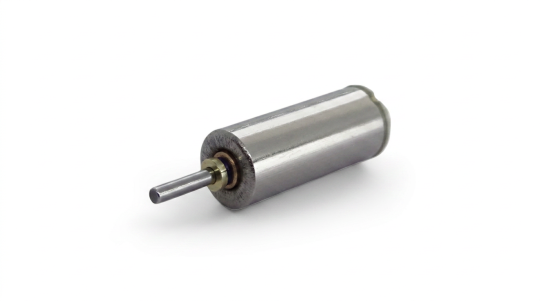
The motors that drive the joints play a crucial role in enabling collaborative robots to move their arms smoothly and stop precisely at the intended position. However, a robot’s operational performance is not determined by the motor alone but is influenced by its combination with components such as gearheads, encoders, and control systems.
Let’s now examine the role of motors in collaborative robots and the key performance characteristics required during motor selection.
The Role of Motors in Collaborative Robots
Motors are the primary power source for moving each joint of a collaborative robot. Proper control of the motor’s rotational speed and torque is essential for movements such as lifting the arm, rotating it, and stopping it at a target position.
In actual operation, the motor works in conjunction with other components, such as gearheads that adjust rotational speed to increase torque, encoders that detect rotational position, and control systems that direct movement. The smooth and precise operation of collaborative robots is achieved through the proper combination of multiple components centered around the motor.
Performance Requirements for Collaborative Robot Motors
Motors for collaborative robots must be compact and lightweight while still delivering the performance necessary to support smooth and precise motion. The key performance requirements and the reasons behind them are summarized below.
| Required Performance | Main Reasons |
| compact and lightweight | To minimize the weight of the joints and reduce their impact on the arm’s payload capacity and operational performance |
| Torque Appropriate for the Size | Ensure the driving force required for the application even in limited spaces |
| High Responsiveness and Control | Responds quickly to commands and precisely controls position and speed |
| Low Noise and Low Vibration | Easy to use even near people, supporting smooth operation |
| high efficiency | Minimizes power consumption and heat generation, leading to stable operation |
| High reliability | Ensures stable, long-term operation even in environments with repetitive motion |
The performance characteristics that should be prioritized vary depending on factors such as load capacity, operating speed, installation space, and frequency of use. It is important to determine—based on the specific application—whether to prioritize compactness and lightweightness or torque and responsiveness, and to perform motor selection to meet the required specifications.
Summary

While collaborative robots help address labor shortages, improve productivity, and reduce the workload on operators, choosing a model that does not suit the application will prevent you from achieving the desired results. When implementing these systems, it is important to consider not only payload capacity, operating range, safety, and operability but also the performance of the motors that drive the joints.
C.I. Takiron Corporation offers coreless motors and Brushless motors suitable for applications requiring compact and lightweight design and high responsiveness. If you have any questions regarding motor selection or development for collaborative robots, please feel free to contact us.
Product Information & Inquiries
For more details on C.I. Takiron’s micro motor products, please visit the website below.
- Product Site: https://cik-ele.com/en/
- Coreless Motors: https://cik-ele.com/en/products/list/coreless_motor/
- Brushless Motors: https://cik-ele.com/en/products/list/brushless_motor/
- Geared Motors: https://cik-ele.com/en/products/list/gearhead/
- Encoders: https://cik-ele.com/en/products/list/encoder/
If you are having trouble selecting a small motor for your product development, please feel free to contact us via the inquiry form. Our technical staff will discuss your application and requirements with you and propose the optimal solution.
- Inquiries: https://cik-ele.com/en/contact/