



Combining a motor with gears reduces rotational speed while amplifying torque, enabling output characteristics tailored to specific applications. Since motors operate at high speeds on their own, it is common practice to use a gear reduction mechanism to achieve the low-speed, high-torque output required for Industrial equipment.
Failure to select an appropriate combination can lead to reduced efficiency and premature failure. The basic process involves clarifying the required torque and rotational speed during the design phase, calculating the reduction ratio, and then determining the type of gear.
This article explains everything from the principle of motor operation and power transmission using gears to calculation formulas for reduction ratios and torque, the characteristics and selection criteria for different gear types, and application examples across various industrial sectors. We will also introduce combinations of Coreless motors and gearheads, so please use this information to assist you in motor selection for your product development.
| Supervised by: C.I. TAKIRON Corporation Electronic Devices Sales Group This article has been supervised based on the advanced technical expertise and insights we have cultivated since our founding in 1919 as a leading company in plastic processing. Our department continuously analyzes market trends and the latest technologies in ultra-compact, high-precision micro motors, focusing on providing high-value-added information to designers and developers. As a team of experts with in-depth knowledge of product characteristics, we support our customers’ problem-solving and technological innovation by delivering accurate and practical content. |
目次:
Principle of Power Transmission Using Motors and Gears
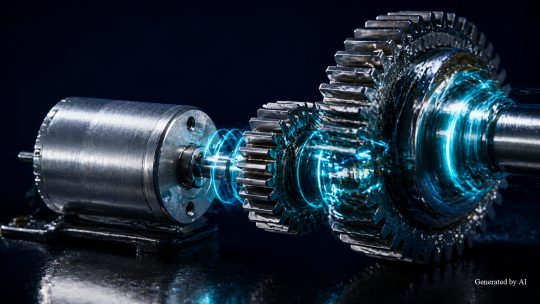
It is common to use a gear reduction mechanism to convert the rotational output of a motor to suit the application. Here, we explain the basics of power transmission and the relevant calculation formulas.
Contents of This Section
- Motor Output Characteristics and the Need for Gears
- Formulas for Calculating Reduction Ratios and Torque Amplification
- Power Loss Due to Transmission Efficiency
By understanding the formulas for calculating reduction ratios and torque, you can determine the optimal gear configuration by working backward from the required output specifications.
Motor Output Characteristics and the Need for Gears
Compact motors generally tend to have high-speed, low-torque output characteristics.
However, in industrial applications such as medical equipment and power tools, high torque at low speeds is essential. There is a significant gap between the output characteristics of the motor alone and the application’s required specifications, and a gear reduction mechanism serves to bridge that gap. The mechanism works such that reducing the rotational speed via gears proportionally increases the torque.
Formulas for Reduction Ratio and Torque Amplification
The relationship between the reduction ratio and torque is expressed by the following formula.
| Item | Formula |
| Reduction Ratio (i) | i = Number of teeth on the output side ÷ Number of teeth on the input side |
| Output Torque (Tout) | Tout = Tin × i × η |
| Output Speed (Nout) | Nout = Nin ÷ i |
* Tin: Input torque, η: Transmission efficiency, Nin: Input rotational speed
For example, with an input torque of 1 mNm, a reduction ratio of 10, and a transmission efficiency of 90%, the output torque is 1 mNm × 10 × 0.9 = 9 mNm. Since Micromotors typically handle torque in the mNm range, the reduction ratio significantly affects output performance. Please calculate the required torque and speed to determine the optimal reduction ratio.
Please also refer to the “What Is a Gearhead?” section in our product introduction.
▶ https://cik-ele.com/products/list/gearhead/
Power Loss Due to Transmission Efficiency
The transmission efficiency of gears varies depending on the type of gear. When using multi-stage reduction, the overall efficiency is calculated by multiplying the efficiencies of each stage.
For C.I. Takiron Corporation’s gearhead products, the transmission efficiency is specified as approximately 0.9 for spur gears and approximately 0.85 for planetary gears.
[Example of Efficiency Calculation for Multi-Stage Reduction (Calculated with a transmission efficiency of 0.9 for spur gears and 0.85 for planetary gears)]
- 2-stage spur gear: 0.9 × 0.9 = 0.81 (81%)
- 3-stage spur gear: 0.9 × 0.9 × 0.9 = 0.729 (approx. 73%)
- 2-stage planetary gear: 0.85 × 0.85 = 0.7225 (approx. 72%)
As the number of stages increases, overall efficiency decreases and power loss increases. During the design phase, consider a configuration that achieves the required reduction ratio with the minimum number of stages, and verify the balance between efficiency and size.
How to Select the Right Gear Type for Your Motor
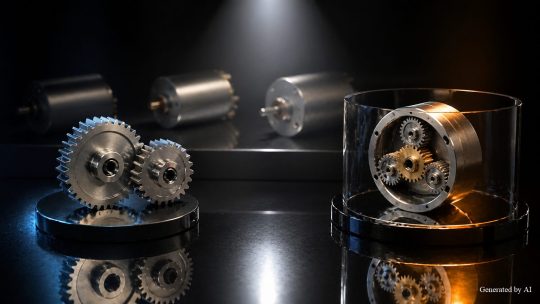
The optimal gear type to pair with a motor varies depending on the application’s requirements. Here, we compare two representative gear types and present selection criteria.
Topics Covered in This Section
- Criteria for Selecting Spur Gears
- Transmitting High Torque with Planetary Gears
- Check Against the Selection Criteria
After understanding the structural characteristics and performance differences of each gear type, select the gear type that best suits your design requirements.
Criteria for Selecting Spur Gears
Spur gears feature a simple structure in which the axes of the two meshing gears are parallel. They are characterized by a small number of components, which helps keep manufacturing costs low.
With a high transmission efficiency of approximately 90% per stage and minimal mechanical loss, they are well-suited for applications requiring energy saving performance. In actual design, it is common to limit the reduction ratio per stage to about 2.5 to 3 times; to achieve a higher reduction ratio, the number of stages must be increased, which can lead to larger size and weight.
To address these limitations, C.I. Takiron Corporation offers a lineup of Geared motors using φ12 and φ16 spur gearheads, enabling integration into compact devices.
Transmitting High Torque with Planetary Gears
A planetary gear system consists of a central sun gear, surrounding planetary gears, and an outer internal gear. Because the load is distributed across multiple planetary gears, this system is characterized by a high torque capacity.
The transmission efficiency is approximately 85% per stage, which is slightly lower than the approximately 90% efficiency of spur gears.Although planetary gears require high-precision machining, which increases costs, they are ideal for applications that require both high torque and a compact design. Furthermore, planetary gears can achieve smooth, high reduction ratios through multi-stage configurations. C.I. Takiron Corporation offers Geared motors using φ16 and φ22 planetary gearheads.
Check Against Selection Criteria
When selecting a gear type, the following five factors are evaluated comprehensively.
[Criteria for Gear Selection]
- Required Torque (calculated in mNm)
- Target Rotational Speed (set in r/min)
- Installation Space (Outer Diameter and Overall Length Constraints)
- Cost (unit price and manufacturing cost)
- Noise Level (Permissible Levels for the Operating Environment)
Straight-cut gears are suitable when prioritizing high efficiency and low cost. On the other hand, select planetary gears when high torque must be achieved within a limited space. In actual design, the optimal gear type is determined by considering environmental conditions—such as durability and operating temperature range—in addition to the criteria listed above.
Motor Selection Process and Application Examples
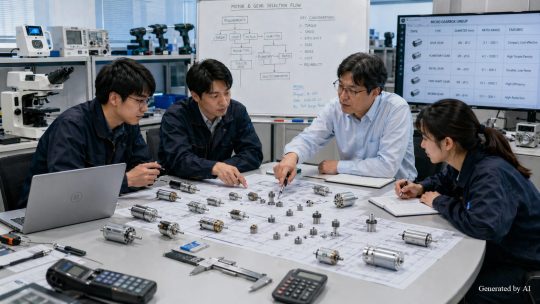
The motor selection and gear selection are based on the specific requirements of each application. This section introduces the practical selection process and application examples by industrial sector.
Contents Covered in This Section
- Achieving Precision Control in Medical Equipment
- Ensuring High Torque Output in Power Tools
- Implementing High-Speed Response in Optical Equipment
The selection process consists of the following five steps.
[Motor Selection and Gear Selection Process]
- Clarify requirements (torque, speed, accuracy, size)
- Calculating Required Torque and Speed
- Determining the reduction ratio
- Selecting the gear type (spur gear or planetary gear)
- Final confirmation of efficiency, size, and cost
Since the required performance varies depending on the application, we will explain the key selection criteria based on specific examples from various industrial sectors.
Achieving Precision Control in Medical Equipment
Medical equipment requires high positioning accuracy and drive performance characterized by low vibration and low noise. For example, in ultrasound endoscopes and surgical drills, it is necessary to control minute movements, making the reduction of cogging (rotational irregularities) a critical consideration right from the motor selection stage.
Because coreless motors are designed without an iron core in the rotor, they produce virtually no cogging in principle, enabling smooth rotation.They also have a low moment of inertia, offering excellent responsiveness during start-up and stopping. When combined with a spur gearhead, they enable precise speed control while maintaining high transmission efficiency. At C.I. Takiron Corporation, our Geared motors—which combine Coreless motors with φ12 and φ16 spur gearheads—offer flexible solutions for Precision Equipment Applications in medical devices.
Ensuring High Torque Output in Power Tools
Power tools require high torque for tasks such as tightening screws and drilling holes. Planetary gears are characterized by their ability to handle high torque due to a structure that distributes the load across multiple planetary gears. Furthermore, since the input and output shafts can be aligned on the same axis, they offer flexibility for space-saving designs—an essential requirement for Handheld devices.
Since planetary gears can achieve high reduction ratios by connecting multiple units in series, they are ideal for applications that convert the high-speed rotation of compact motors into low-speed, high torque output. C.I. Takiron Corporation offers Geared motors that combine φ16 and φ22 planetary gearheads with Coreless motors.
Implementing High-Speed Response in Optical Equipment
Optical equipment requires high-speed responsiveness for camera autofocus and lens drive. Furthermore, precise control of lens position requires both rapid acceleration and deceleration and accurate stopping precision.
Brushless motors offer the advantage of a long service life and reduced maintenance requirements due to their brushless design, which minimizes mechanical contact. Their ability to maintain stable torque output even at high rotational speeds makes them well-suited for optical equipment. When combined with compact gearheads, they enable low-vibration, high-speed positioning, thereby minimizing the impact on image quality. C.I. Takiron Corporation can develop custom solutions combining brushless motors and gearheads. *Please consult with us.
Summary
Motor selection and gear selection begin with a proper understanding of the formulas for calculating reduction ratios and torque. Depending on the product and conditions, spur gears offer a transmission efficiency of approximately 90% and are simple and low-cost, while planetary gears, with a transmission efficiency of approximately 85%, feature a compact design capable of transmitting high torque.
Please select the optimal combination of motor and gear to meet the specific requirements of each field: precision control and low vibration for medical equipment, high torque and compactness for power tools, and high-speed responsiveness for optical equipment.
When making your selection, follow this process—calculate the required torque and speed → determine the reduction ratio → select the gear type → verify efficiency and size—to prevent mismatches during the design phase.
Product Information & Inquiries
For more details on C.I. Takiron’s micro motor products, please visit the website below.
- Product Site: https://cik-ele.com/en/
- Coreless Motors: https://cik-ele.com/en/products/list/coreless_motor/
- Brushless Motors: https://cik-ele.com/en/products/list/brushless_motor/
- Geared Motors: https://cik-ele.com/en/products/list/gearhead/
- Encoders: https://cik-ele.com/en/products/list/encoder/
If you are having trouble selecting a small motor for your product development, please feel free to contact us via the inquiry form. Our technical staff will discuss your application and requirements with you and propose the optimal solution.
- Inquiries: https://cik-ele.com/en/contact/