

In medical pumps used in clinical settings—such as infusion pumps, insulin pumps, and hemodialysis machines—motors that deliver medications and blood with precision are essential. Since even the slightest deviation in flow rate directly affects patient safety, these motors must offer high precision and reliability.Furthermore, with the spread of home healthcare and growing demand for portable devices, requirements for miniaturization, quiet operation, and energy efficiency are increasing year by year. On the other hand, as miniaturization progresses, trade-offs in noise and performance are more likely to occur, making motor selection a critical factor that determines the overall performance of medical equipment.
In this article, we will first outline the role of motors in medical pumps and the performance requirements they must meet, and then explain why Coreless motors are well-suited for medical pumps. This content serves as a reference for development engineers considering motor selection, providing a clear understanding of the technical rationale.
| Supervised by: C.I. TAKIRON Corporation Electronic Devices Sales Group This article has been supervised based on the advanced technical expertise and insights we have cultivated since our founding in 1919 as a leading company in plastic processing. Our department continuously analyzes market trends and the latest technologies in ultra-compact, high-precision micro motors, focusing on providing high-value-added information to designers and developers. As a team of experts with in-depth knowledge of product characteristics, we support our customers’ problem-solving and technological innovation by delivering accurate and practical content. |
目次:
The Role of Motors Used in Medical Pumps and Major Devices
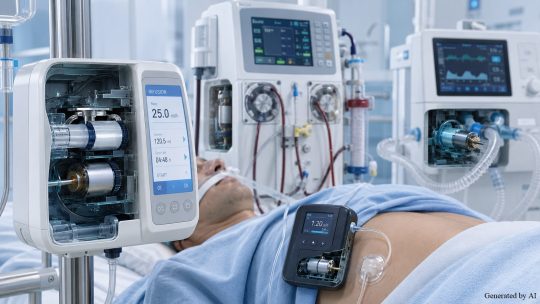
Medical pumps are a group of devices designed to accurately deliver various fluids—such as medications, blood, nutritional solutions, hormones, and contrast agents—into a patient’s body. The range of devices spans from large, stationary units to ultra-compact devices that patients carry with them at all times, and different types of motors are selected according to each specific application. Motor designs tailored to the precision, quiet operation, and durability required by each device form the foundation that supports the pump’s performance.
Topics Covered in This Section
- Motors that drive infusion pumps and dialysis machines
- Motors for portable devices such as insulin pumps
- Motors for respiratory support devices and cardiovascular equipment
We will outline the main types of medical pumps and the functions that motors perform in each device.
Motors that drive infusion pumps and dialysis machines
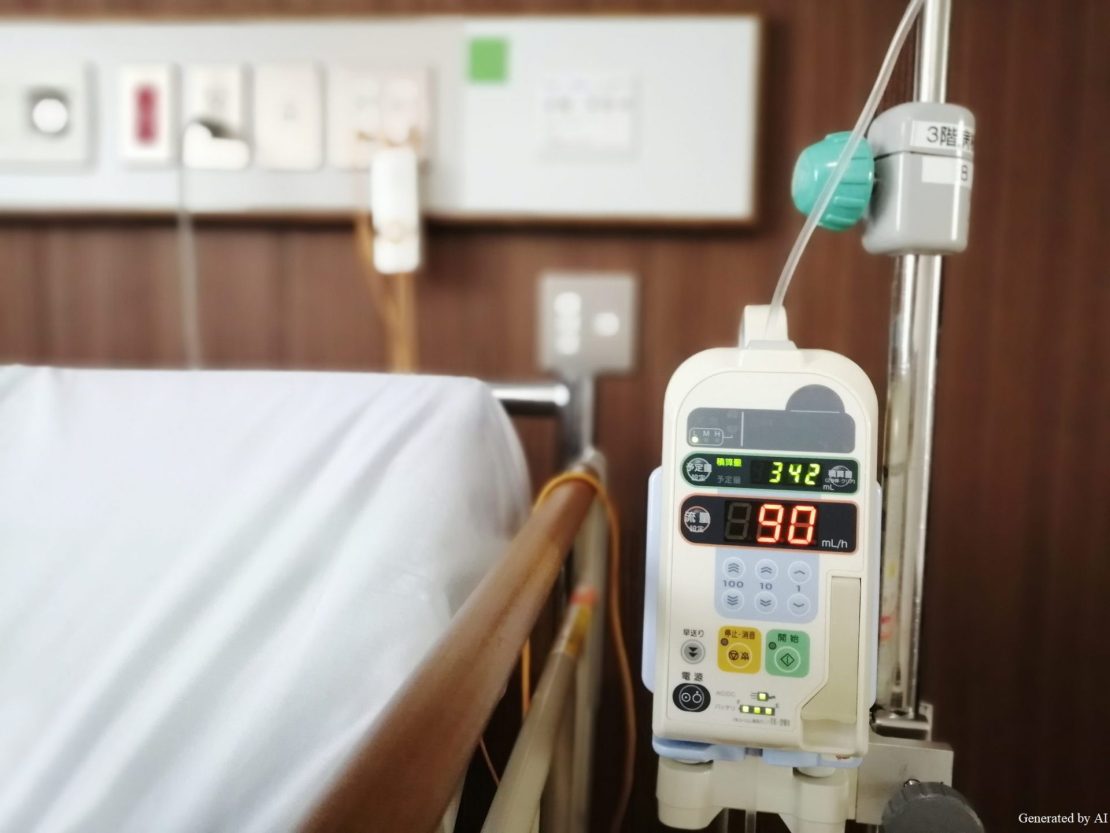
Infusion pumps and dialysis machines are representative medical pumps widely used in hospitals. There are two types of infusion pumps: peristaltic and syringe-type, each with a different motor drive mechanism. The main devices and the roles of their motors are as follows.
| Device | Pump Type | Role of the Motor |
| Infusion Pump (Peristaltic) | Roller sequentially compresses the tubing | Rotation of the rollers |
| Syringe Pump | Plunger extrusion | Linear drive at a constant speed |
| Dialysis machine | Circulation of blood and dialysate | Circulation pump drive |
In peristaltic infusion pumps, rollers sequentially squeeze the tubing to deliver the medication. There are two operating modes: continuous operation at a constant flow rate and bolus mode, which administers a fixed volume in a short time; both require precise speed control.
In dialysis machines, blood and dialysate must be circulated stably during the process of removing waste products from the blood, and fluctuations in flow rate directly affect patient safety. For both types of equipment, the motor must provide stable rotation with minimal torque ripple.
Motors for Portable Devices Such as Insulin Pumps
In portable medical equipment such as insulin pumps, the requirements for motors differ from those of stationary equipment because patients wear and use them on a daily basis. An insulin pump is an ultra-compact delivery device that diabetes patients carry with them at all times, and the diameter of the motor installed is generally 10 mm or less. Furthermore, there are reported cases of designs with motor diameters of 5 mm or less.
Since these devices are battery-powered, highly efficient designs that minimize power consumption are essential.Since the battery lifespan depends on the motor’s electric current consumption, even a slight difference in efficiency affects the device’s continuous operating time. Furthermore, a combination of a motor and control system capable of accurately handling multi-stage infusion rates and bolus administration is required. With the spread of home healthcare, the development of portable devices is accelerating, and the demand for compact, more energy-efficient motors is expected to grow even further in the future.
Motors for Respiratory Support Devices and Cardiovascular Equipment
Motors are also installed in respiratory support devices and cardiovascular medical equipment to drive pumps.Air pumps built into respiratory assist devices are components responsible for generating and controlling airflow. In air mattresses for pressure ulcer prevention and home-use respiratory support devices, air pumps must continuously supply stable air pressure, requiring motors that offer the durability to withstand long-term operation and quiet operation necessary for use near patients.
In the field of cardiology, diaphragm pumps are used in cardiac assist devices such as intra-aortic balloon pumps (IABP) and ventricular assist devices (VAD) to supply vacuum or positive pressure. These diaphragm pumps are driven by motors, which must operate quietly and with uninterrupted, stable performance.
Any irregularity in the motor’s rotation could affect the patient’s circulatory status, making this a medical pump application that demands exceptionally high reliability.
Performance Requirements for Medical Pump Motors
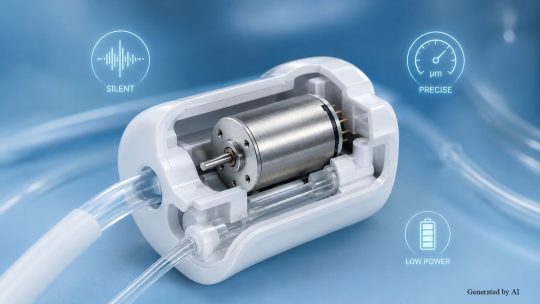
Motors for medical pumps are subject to stringent performance requirements that differ from those for industrial applications. While motors for industrial equipment or hobbyist applications are often selected primarily based on output and cost, motors for medical pumps—as a power source directly linked to the patient’s life and safety—must be designed to meet multiple performance requirements simultaneously.
Topics covered in this section
- Reducing patient burden through quiet operation and low vibration
- Compact size and low power consumption to support portable devices
- Flow control performance that determines the accuracy of drug administration
We will examine these three performance criteria, each of which directly impacts patient safety and comfort.
Reducing patient burden through quiet operation and low vibration
Since medical pumps are installed at the bedside in hospital rooms or in home care settings, a quiet design is essential to keep operating noise below the patient’s perception threshold. In hospital rooms at night, even the slightest motor noise can disrupt a patient’s sleep. Motor noise accounts for a significant portion of the pump’s overall noise, so reducing noise at the motor level directly contributes to the pump’s quiet operation.
Similar considerations are essential regarding vibration. Vibration originating from the motor is amplified through the pump housing and transmitted to tubing and piping.In particular, cogging torque generated by iron-core motors causes uneven rotation and fine vibrations. Motors with a structure that minimizes cogging are suitable for medical pumps, and designs are required that reduce drive-induced vibration and noise to levels imperceptible on the device. In devices that come into direct contact with patients’ bodies or operate for long periods at the bedside, the use of low-vibration motors contributes to improved comfort and reduced stress.
Compact, Energy-Efficient, and Suitable for Portable Devices
Against the backdrop of the growing popularity of home healthcare, the development of portable medical equipment is accelerating. Compact models for home use are now emerging even for dialysis machines and respiratory support devices, which were traditionally limited to stationary models within hospitals. The following are the requirements for representative medical pumps and compact motors that are increasingly becoming portable.
| Equipment | Application | Main Requirements for Motors |
| Enteral feeding pump | Continuous administration of nutritional solutions | Compact and low power consumption |
| Insulin Pumps | Automatic insulin delivery | Ultra-compact (10 mm or less) and high efficiency |
| Compression therapy pump | Prevention of deep vein thrombosis | Stable operation and quiet operation |
| Wound treatment pump | Negative Pressure Wound Therapy | Long-Duration Operation and Energy Efficiency |
In battery-powered portable devices, the power efficiency of the motor is a key factor affecting battery life. In the case of enteral feeding pumps, design efforts are underway to achieve both compactness and high drive performance using Coreless motors with diameters of around 20 mm. Since motors in portable medical equipment affect the pump’s performance, efficiency, lifespan, and cost, the ability to accommodate compact, low-power designs is a critical requirement in device development.
Flow Control Performance That Determines the Accuracy of Medication Administration
In infusion pumps and feeding pumps, even a slight error in the amount of medication delivered can affect patient safety.One factor affecting flow control accuracy is motor torque ripple. Motors with high torque ripple exhibit uneven rotational speed, causing the pump’s output to pulsate and compromising the accuracy of the administered dose. Motor selection that ensures stable torque even at low speeds is the foundation of precise flow control.
A design with a long service life is also a key factor in the reliability of flow control. In infusion pumps and dialysis machines that operate continuously, brush wear and bearing degradation can cause changes in motor characteristics, leading to a decline in flow accuracy.In brushed motors, brush wear is the primary factor limiting lifespan, while in brushless motors, bearing wear is the primary factor. Motor selection based on the operating environment and runtime ensures stable flow control over the long term.
Three Reasons Coreless Motors Are Chosen for Medical Pumps
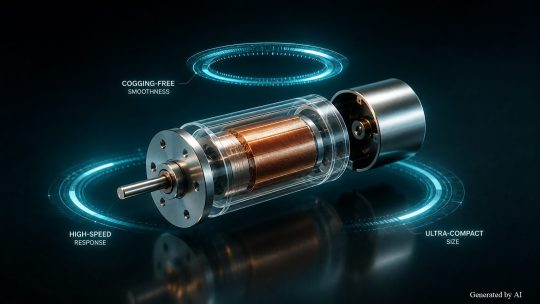
Coreless motors feature a design in which the rotor does not contain an iron core. The characteristics resulting from this design align with the stringent performance requirements of medical pumps, leading to their increasing adoption.
Topics Covered in This Section
- Enables precise flow control that is cogging-free
- Low-inertia rotors enable high-speed response
- Compact and space-saving, suitable for portable devices
We will outline how the structural features of Coreless motors meet the various performance requirements of medical pumps.
Cogging-free operation enables precise flow control
The cogging-free rotational characteristics are the greatest structural advantage of Coreless motors. In conventional motors with iron cores, cogging torque is generated by the magnetic interaction between the rotor’s iron core and the permanent magnets, resulting in periodic torque fluctuations during rotation. Coreless motors employ a hollow coil structure without an iron core, so cogging torque is virtually nonexistent. The differences between the two are as follows.
| Item | Motor with Iron Core | Coreless motors |
| Cogging Torque | Generated by magnetic interference between the iron core and magnets | No iron core; virtually no cogging torque |
| Rotational stability at low speeds | Speed irregularities are prone to occur due to torque ripple | Maintains smooth rotation |
| Impact on flow control | Risk of flow pulsation | Enables stable fluid delivery at a constant speed |
Due to their coreless design, coreless motors exhibit low torque ripple and are characterized by their ability to deliver smooth fluid delivery even at low speeds. This design is well-suited for precise pump control that avoids peak fluctuations in flow rate and delivers chemical solutions or nutrient solutions at a constant rate.
Low-inertia rotor enables high-speed response
The high-speed responsiveness provided by the low-inertia rotor is the second reason Coreless motors are suitable for medical pumps. The hollow rotor of a Coreless motor is lighter in mass and has a lower moment of inertia because it lacks an iron core. A rotor with low inertia reaches the target speed immediately after energization and can decelerate and stop instantly in response to a stop command.
This high-speed responsiveness is well-suited for intermittent, on-demand operations such as bolus administration. In bolus mode, a fixed volume of medication must be administered in a short time, followed by an immediate motor stop; however, motors with slow start-up and stop response times are prone to dosing errors. Coreless motors enhance dosing accuracy in on-demand operations through instantaneous start-up and stop capabilities.
Compact, Space-Saving Design Suitable for Portable Devices
The ability to achieve compact, space-saving design is the third reason Coreless motors are well-suited for portable medical equipment. Because Coreless motors lack an iron core, the motor body can be designed to be more compact compared to iron-core motors with equivalent output. Without the volume and mass of an iron core, it is possible to achieve higher power density even in limited spaces.
[Design Advantages of Coreless Motors for Portable Medical Equipment]
- The core-less structure results in low rotor inertia, enabling high-response and precise control
- Since cogging does not occur, they offer low-vibration, smooth torque characteristics, contributing to improved flow control and positioning accuracy
- Excellent at delivering high power for short durations, demonstrating high dynamic performance in applications requiring intermittent operation or high responsiveness
While compact and lightweight design is not achievable under all conditions, in applications where responsiveness and intermittent drive performance are critical, leveraging the characteristics of Coreless motors allows the required performance to be achieved in a more compact configuration.
C.I. Takiron Corporation offers a lineup of Coreless motors with outer diameters ranging from 4 mm to 22 mm, allowing for designs tailored to specific applications and installation spaces. Thanks to the characteristics of this Coreless structure, we support the miniaturization of a wide range of portable medical pumps, from applications requiring installation in confined spaces to medium-sized devices.
Summary

There are many types of medical pumps, including infusion pumps, insulin pumps, dialysis machines, respiratory support devices, and cardiovascular devices. In all of these devices, motors that accurately deliver medicinal fluids or blood are indispensable. Motors are subject to strict performance requirements, such as quiet operation, low vibration, miniaturization, low power consumption, high-precision flow control, and long service life; therefore, the motor selection determines the overall performance of the medical equipment.
Due to their core-less structure, coreless motors can simultaneously achieve smooth, cogging-free rotation; high-speed responsiveness and energy efficiency thanks to a low-inertia rotor; and a small, compact design. They offer a structurally superior option for meeting the requirements of medical pumps, such as precise flow control and integration into portable devices.
Product Information & Inquiries
For more details on C.I. Takiron’s micro motor products, please visit the website below.
- Product Site: https://cik-ele.com/en/
- Coreless Motors: https://cik-ele.com/en/products/list/coreless_motor/
- Brushless Motors: https://cik-ele.com/en/products/list/brushless_motor/
- Geared Motors: https://cik-ele.com/en/products/list/gearhead/
- Encoders: https://cik-ele.com/en/products/list/encoder/
If you are having trouble selecting a small motor for your product development, please feel free to contact us via the inquiry form. Our technical staff will discuss your application and requirements with you and propose the optimal solution.
- Inquiries: https://cik-ele.com/en/contact/