



“Rated output” is a term that always appears in catalogs for motors and power supply equipment.
While it is an important metric for product selection, surprisingly few people may fully understand the difference between rated output and maximum output or power consumption.
Rated output is a standard value indicating the output performance of the equipment guaranteed by the manufacturer.
Selecting equipment without a proper understanding of this value can lead to problems such as failure due to overload, overheating, or failure to achieve the expected performance. Especially in product development involving compact motors, a proper understanding of rated output is the first step toward ensuring reliability.
In this article, we will explain everything from the basic definition of rated output to calculation methods and points to consider during motor selection, based on technical principles.
We provide knowledge that development engineers can apply in their daily work.
| Supervised by: C.I. TAKIRON Corporation Electronic Devices Sales Group This article has been supervised based on the advanced technical expertise and insights we have cultivated since our founding in 1919 as a leading company in plastic processing. Our department continuously analyzes market trends and the latest technologies in ultra-compact, high-precision micro motors, focusing on providing high-value-added information to designers and developers. As a team of experts with in-depth knowledge of product characteristics, we support our customers’ problem-solving and technological innovation by delivering accurate and practical content. 。 |
目次:
The Basic Meaning and Importance of Rated Output
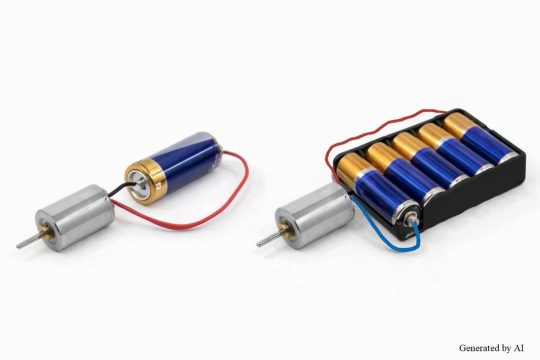
Rated output is the upper limit of output at which a device can operate continuously and safely under specified conditions.
In JIS standards, “rating” is defined as “the guaranteed operating limits of a rotating machine,” and rated output is positioned as the shaft output (mechanical output) corresponding to that rating.
For motors, it refers to the output continuously generated while exhibiting the best performance at the rated voltage and frequency; for power supply units, it refers to the maximum power that can be supplied stably.
Contents of this section
- Definition and Role of Rated Output
- The Relationship Between Rated Output and Temperature Rise
- Performance Range Guaranteed by Rated Output
This value serves as a benchmark for the performance guaranteed by the manufacturer and functions as a criterion for product selection. Particularly in the field of compact motors, where both miniaturization and high output are required, an accurate understanding of rated output leads to appropriate decisions during the design phase.
Definition and Role of Rated Output
Rated output refers to the output that can be continuously operated within thermally acceptable limits under specified operating conditions (ambient temperature, operating conditions, cooling conditions, etc.), and it is a performance standard guaranteed by the manufacturer. In motors, it is expressed as shaft output.
In JIS C 4034-1 (Rotating Electrical Machinery), rated output is defined as the output value corresponding to the rating. In practice, it refers to the shaft output that can be operated continuously under the rated conditions specified by the manufacturer.
Selecting equipment based on this value helps avoid the risk of failure due to overload and ensures long-term reliability. Accurately determining the rated output during the development stage is essential for guaranteeing product safety and durability.
The Relationship Between Rated Output and Temperature Rise
When a motor converts electrical energy into mechanical energy, heat generation occurs due to losses such as copper losses and iron losses.
Operating the motor at or below its rated output keeps the temperature rise within acceptable limits, preventing winding burnout and component degradation.
| Factors | Details |
| Copper Loss | Heat generation due to the resistance of the windings |
| Iron loss | Heat generation due to magnetic losses in the iron core |
| Mechanical Loss | Heat generation due to bearing friction and air resistance |
Since temperature management directly affects equipment lifespan, rated output is a critical indicator in thermal design. In particular, Coreless motors do not have an iron core, so no iron losses occur, enabling efficient thermal management.
In applications requiring long periods of continuous operation, such as medical equipment and optical equipment, stable operation with minimal temperature rise is key to reliability.
Performance range guaranteed by rated output
When operating at rated output, the motor delivers its rated speed and rated torque. Performance metrics such as efficiency and power factor are optimized under these conditions, allowing the equipment to perform at its maximum capacity.
There is a clear relationship between a motor’s output, torque, and rotational speed (detailed calculation formulas are described later). Based on this relationship, once the rated output and rated rotational speed are determined, the rated torque the motor can deliver is also determined.
For example, a motor with a rated output of 1 W and a rated speed of 6,000 rpm is calculated to be capable of continuously delivering a torque of approximately 1.59 mN·m (0.00159 N·m) under specified conditions.
Since performance may not meet specifications when used outside of rated conditions, verification during the design phase is crucial.
Takiron CI’s Coreless motors achieve high-precision control within the rated output range thanks to their smooth rotational characteristics, which generate virtually no cogging torque.
They are highly regarded in applications requiring stable output characteristics, such as medical endoscopes and industrial precision equipment.
Differences Between Rated Output and Related Terms

To correctly understand rated output, it is important to grasp the differences between it and maximum output or power consumption.
Maximum output (instantaneous maximum output) is the output that can be generated temporarily, such as during startup, while rated output refers to the output that can be sustained during continuous operation under specified conditions.
Power consumption is the input power required for the device to operate, while rated output is the power the device can deliver.
Topics Covered in This Section
- The Difference Between Rated Output and Maximum Output
- The relationship between rated output and power consumption
- The difference between rated input and rated output
Rated input, on the other hand, indicates the input required for the equipment to achieve maximum performance. Understanding these differences enables proper equipment selection and safe operation. When performing motor selection, it is essential to accurately distinguish between these terms and make decisions based on actual operating conditions.
The Difference Between Rated Output and Maximum Output
Maximum output is the output a device can generate instantaneously and is intended for short-term use, such as during motor startup. On the other hand, rated output indicates the output that can be sustained during continuous operation under specified conditions.
For example, even if a compact motor with a rated output of 1 W can momentarily generate an output equivalent to 2 W during startup, maintaining this state will cause the winding temperature to rise rapidly, leading to insulation degradation or burnout.
Since continuous operation at maximum output can cause overheating and failure, it is recommended to operate at or below the rated output during normal use.
In applications requiring long-term continuous operation, such as medical equipment and industrial equipment, designing based on the rated output is fundamental to ensuring reliability. Even if a motor can handle momentary high loads, it is stability during continuous operation that ultimately determines product quality.
The Relationship Between Rated Output and Power Consumption
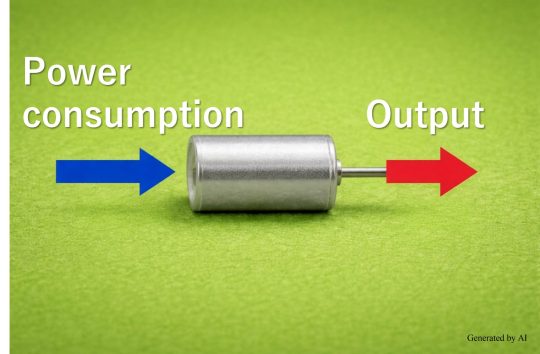
Power consumption refers to the input power supplied from an external source to operate the equipment. On the other hand, rated output indicates the output power that can be extracted from the equipment.
In motors, a portion of the input electrical energy is lost as copper losses, iron losses, and mechanical losses; therefore, the output power is less than the input power. This relationship is shown in the table below.
| Item | Definition | Example for a Motor |
| Power Consumption (Input Power) | Power supplied to the equipment | Supply voltage × electric current at the motor terminals |
| Rated Output | The power output that the equipment can generate | Mechanical output available from the shaft |
| Efficiency | Output ÷ Input × 100 | Our coreless motors achieve approximately 70% (varies by size). |
For example, to obtain a rated output of 1 W from a motor with 70% efficiency, approximately 1.43 W of power consumption is required. When selecting equipment, it is necessary to consider this relationship and design the power supply capacity and wiring accordingly.
Because coreless motors are designed without an iron core in the rotor, there is no iron loss associated with the core, enabling high efficiency operation.
Takiron CI’s compact motors leverage this characteristic to achieve energy-efficient designs, contributing to extended runtime in battery-powered devices.
The Difference Between Rated Input and Rated Output
Rated input is the input required for the device to achieve maximum performance and is expressed in terms of voltage and electric current.
Rated output is the maximum value that the device can stably output.
In a motor catalog, if the specifications are listed as, for example, “Rated Voltage: 3V, Rated Electric Current: 0.5A, Rated Output: 1W,” this means that the rated output (1W) is guaranteed under the rated input conditions (3V, 0.5A = 1.5W). Therefore, it is important to verify the power supply specifications.
If the motor is operated at a voltage lower than the rated voltage, the rated output may not be achieved. Conversely, applying a voltage significantly higher than the rated voltage may cause the motor to fail.
Some of Takiron CI’s compact motors support low-voltage startup from as low as 1.0V, enabling flexible design for battery-powered devices.
Accurately understanding the relationship between rated input and rated output during the development stage leads to safe and reliable product design with high reliability.
Calculation and Selection of Motor Rated Output
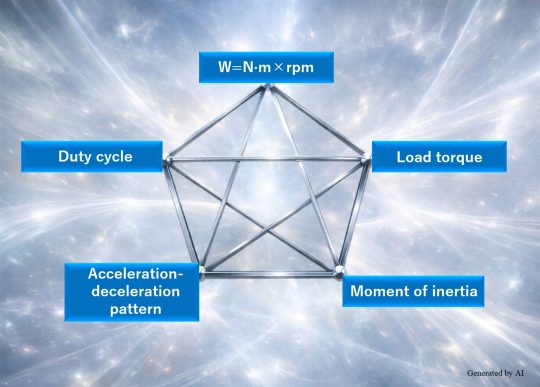
A motor’s rated output can be calculated based on the relationship between torque and rotational speed.
However, in actual selection, it is necessary to consider various conditions such as load torque, load moment of inertia, and operating patterns, in addition to the calculation formula.
Contents of this section
- Basic Calculation Formulas for Motor Output
- Selection of Rated Power Considering Actual Load
- Safety factors and efficiency in rated power selection
When selecting the rated output, it is also important to allow for an appropriate margin relative to the actual load.
An undersized rated output carries the risk of failure due to overload, while an oversized rated output is disadvantageous in terms of initial cost and energy efficiency.
Proper selection allows for a long service life for equipment and cost optimization.
Basic Formula for Motor Output
Motor output is calculated based on torque and rotational speed. As mentioned in the previous explanation of rated output, we will provide a detailed explanation of the calculation formula and unit conversions here.
| Item | Formula | Notes |
| Basic Formula | Power (W) = Torque (N·m) × Angular velocity (rad/s) | Standard Formula in the SI System |
| Practical Formula | Power (W) = Torque (N·m) × Rotational Speed (rpm) × 2π / 60 | Used when rpm is specified |
| Simplified formula | Power (W) ≈ Torque (N·m) × Rotational Speed (rpm) / 9.550 | For approximate calculations |
For example, the output of a motor with a torque of 10 mN·m (0.01 N·m) and a rotational speed of 6,000 rpm can be calculated as follows.
Power = 0.01 × 6,000 × 2π / 60 ≒ 6.28 W
From this formula, we can see that even with the same output, the characteristics differ between high-speed, low-torque types and low-speed, high-torque types.
High-speed types tend to be selected for optical equipment, which requires high-speed responsiveness, while low-speed types are selected for industrial tools, which require high torque.
Selecting the appropriate characteristics for the application is the key to maximizing product performance.
Selecting the rated output considering the actual load
When performing motor selection, factors such as load torque, moment of inertia, acceleration/deceleration patterns, and duty cycle are evaluated comprehensively. In intermittent operation, the thermal diffusion effect may allow the motor to handle instantaneous loads exceeding the rated output.
[Key Considerations for Selection]
- Steady-state load torque
- Peak torque during acceleration and deceleration
- Load moment of inertia
- Operating pattern (continuous/intermittent)
- Ambient temperature conditions
It is important to perform simulations under conditions that closely resemble actual operation.
For example, since medical pumps are designed for continuous operation, their full rated output is taken into account; however, electronic locks, which operate intermittently for short periods, can handle loads that momentarily exceed the rated value.
Takiron CI’s Coreless motors feature low inertia and high responsiveness, enabling efficient operation even in applications with frequent acceleration and deceleration.
Setting load conditions close to those of the actual equipment during the development stage and conducting verification that includes temperature rise helps ensure reliability.
Safety Factor and Efficiency in Rated Output Selection
In motor selection, it is recommended to allow for a safety factor of approximately 1.5 to 2.0 times the load torque. However, oversizing the motor leads to reduced efficiency and increased costs. *
| Safety Factor | Advantages | Disadvantages |
| 1.2–1.5 times | Good efficiency, optimal cost | Little margin |
| 1.5–2.0 times | Good balance, standard | Standard selection |
| 2.0 times or more | Ample margin, reliable | Reduced efficiency, increased costs |
*These figures are examples only and may vary depending on criteria (such as load torque and rotational speed), manufacturer, and application.
Selecting a motor with high efficiency allows you to secure the required rated output while reducing input power, leading to energy saving. This is a particularly important selection factor for battery-powered equipment, as motor efficiency directly affects operating time.
Takiron CI’s Coreless motors operate with high efficiency due to the absence of iron loss, and despite their compact size, they can reliably deliver the required rated output.
We have a proven track record in applications requiring long-term, stable operation, such as medical equipment, optical equipment, and security equipment. If you are having difficulty with motor selection for your product development, we will propose the optimal solution tailored to your application and requirements.
Summary
Rated output is the maximum output at which a device can operate continuously and safely under specified conditions; it is a critical performance indicator determined by factors such as temperature rise and mechanical strength. Maximum output refers to instantaneous output, while power consumption refers to input power—each has a distinct meaning.
When performing motor selection, it is important to calculate the rated output based on torque and rotational speed and ensure an appropriate margin for the actual load. By correctly understanding and appropriately selecting the rated output, you can achieve a long service life for the equipment, improved reliability, and cost optimization.
Takiron CI’s compact motors utilize a high efficiency coreless motor design, enabling them to stably deliver the required rated output despite their small size.
They deliver reliability across a wide range of fields, including medical equipment, industrial equipment, optical equipment, and security equipment.
Product Information & Inquiries
For more details on C.I. Takiron’s micro motor products, please visit the website below.
- Product Site: https://cik-ele.com/en/
- Coreless Motors: https://cik-ele.com/en/products/list/coreless_motor/
- Brushless Motors: https://cik-ele.com/en/products/list/brushless_motor/
- Geared Motors: https://cik-ele.com/en/products/list/gearhead/
- Encoders: https://cik-ele.com/en/products/list/encoder/
If you are having trouble selecting a small motor for your product development, please feel free to contact us via the inquiry form. Our technical staff will discuss your application and requirements with you and propose the optimal solution.
- Inquiries: https://cik-ele.com/en/contact/